
Catalogue Search | MBRL


Are you sure you want to remove the book from the shelf?

{{itemTitle}}
27,873
result(s) for
"Investments Data processing."
Sort by:

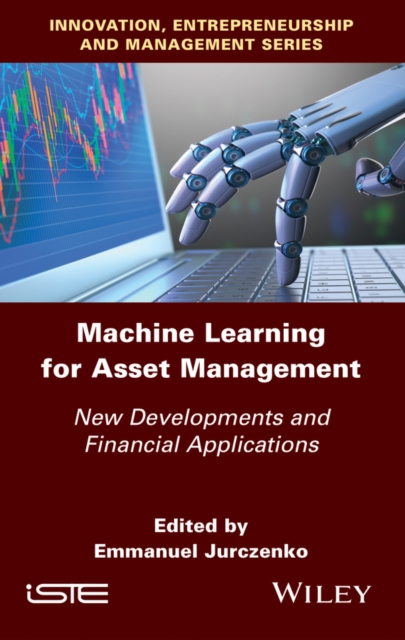
Machine Learning for Asset Management
This new edited volume consists of a collection of original articles written by leading financial economists and industry experts in the area of machine learning for asset management.The chapters introduce the reader to some of the latest research developments in the area of equity, multi-asset and factor investing.
eBook

MoneyGPT : AI and the threat to the global economy
Financial expert, investment advisor and author James Rickards shows how generative AI is reshaping the world of finance, explaining what smart investors can do to protect their assets. AI-powered programmes like ChatGPT have become valuable tools in the financial market, and proven to be incredibly beneficial to investors looking to identify investment opportunities and risks that might be overlooked by humans. Yet there is a darker side to these products, which we are only just beginning to fully understand. In this book, Rickards shows how models like ChatGPT work, and how they can be leveraged to capitalise on markets and avoid losses by providing accurate, up-to-date financial insights. Rickards' guide is essential reading for anyone looking to navigate this tumultuous new climate.
BOOK

Quantitative Trading
The first part of this book discusses institutions and mechanisms of algorithmic trading, market microstructure, high-frequency data and stylized facts, time and event aggregation, order book dynamics, trading strategies and algorithms, transaction costs, market impact and execution strategies, risk analysis, and management. The second part covers market impact models, network models, multi-asset trading, machine learning techniques, and nonlinear filtering. The third part discusses electronic market making, liquidity, systemic risk, recent developments and debates on the subject.
eBook


Building Winning Trading Systems with Tradestation
The updated edition of the guide to building trading systems that can keep pace with the market
The stock market is constantly evolving, and coupled with the new global economic landscape, traders need to radically rethink the way they do business at home and abroad. Enter Building Winning Trading Systems, Second Edition, the all-new incarnation of the established text on getting the most out of the trading world. With technology now a pervasive element of every aspect of trading, the issue has become how to create a new system that meets the demands of the altered financial climate, and how to make it work.
Giving voice to the question on every trader and investor's lips, the book asks, \"How can we build a trading system that will be paramount for our increasingly stressed markets?\" The answer? Establish mechanical trading systems that remove human emotion from the equation and form the cornerstone of a complete trading plan and with greater agility, characteristics that are more important than ever given the kinetic pace of the markets.
* Presents an all-new strategy for trading systems that will show traders how to create systems that will work in the twenty first century
* Expert advice from highly respected trading authority, George Pruitt
* Includes a new website featuring updated TradeStation code and shows how to use the world's best investment software platform to develop and utilize trading systems that really work
Once again paving the way for traders who want to adapt to their environment, Building Winning Trading Systems, Second Edition combines expertise in indicator design and system building in one indispensable volume.
eBook

Information systems for global financial markets : emerging developments and effects
\"This book offers focused research on the systems and technologies that provide intelligence and expertise to traders and investors and facilitate the agile ordering processes, networking, and regulation of global financial electronic markets\"--Provided by publisher.
Book

The investment industry for IT practitioners : an introductory guide
Giving IT professionals in financial services firms a rounded and comprehensive grounding in their knowledge of their industry, this book offers a primer on the major financial instruments, transactions, and processes, as well as a sound knowledge of the principles of good IT management in the industry.
eBook

Principles of Quantitative Development
Principles of Quantitative Development is a practical guide to designing, building and deploying a trading platform. It is also a lucid and succinct exposé on the trade life cycle and the business groups involved in managing it, bringing together the big picture of how a trade flows through the systems, and the role of a quantitative professional in the organization.
The book begins by looking at the need and demand for in-house trading platforms, addressing the current trends in the industry. It then looks at the trade life cycle and its participants, from beginning to end, and then the functions within the front, middle and back office, giving the reader a full understanding and appreciation of the perspectives and needs of each function. The book then moves on to platform design, addressing all the fundamentals of platform design, system architecture, programming languages and choices. Finally, the book focuses on some of the more technical aspects of platform design and looks at traditional and new languages and approaches used in modern quantitative development.
The book is accompanied by a CD-ROM, featuring a fully working option pricing tool with source code and project building instructions, illustrating the design principles discussed, and enabling the reader to develop a mini-trading platform.
The book is also accompanied by a website http://pqd.thulasidas.com that contains updates and companion materials.
eBook
Data mining in finance : advances in relational and hybrid methods
This overview of major algorithmic approaches to predictive data mining, includes statistical, neural networks, ruled-based, decision-tree, and fuzzy-logic methods. It examines the suitability of these approaches to financial data mining. The book focuses specifically on relational data mining (RDM), which is a learning method able to learn more expressive rules than other symbolic approaches. RDM is thus better suited for financial mining, because it is able to make greater use of underlying domain knowledge. Relational data mining also has a better ability to explain the discovered rules - an ability critical for avoiding spurious patterns which inevitably arise when the number of variables examined is very large. The earlier algorithms for relational data mining, also known as inductive logic programming (ILP), suffer from a relative computational inefficiency and have rather limited tools for processing numerical data. The approach expounded here combines relational data mining with the analysis of statistical significance of discovered rules.
eBook