
Catalogue Search | MBRL


Are you sure you want to remove the book from the shelf?

{{itemTitle}}
64
result(s) for
"Invisibility in art."
Sort by:

Invisibility in visual and material culture
The essays in 'Invisibility in Visual and Material Culture' contribute pioneering and revelatory insights into the phenomenon of invisibility, forging new and multi-disciplinary approaches at the intersection of aesthetics, technology, representation and politics. Importantly, they acknowledge the complex interaction between invisibility and its opposite, visibility, arguing that the one cannot be fully grasped without the other. Considering these entanglements across different media forms, the chapters reveal that the invisible affects many cultural domains, from digital communication and operative images to the activism of social movements, as well as to identity, race, gender and class issues. Whether the subject is comic books, photographic provocations, biometric and brainwave sensing technologies, letters, or a cinematic diary, the analyses in this book engage critically and theoretically with the topic of invisibility and thus represent the first scholarly study to identify its importance for the field of visual culture.
Book
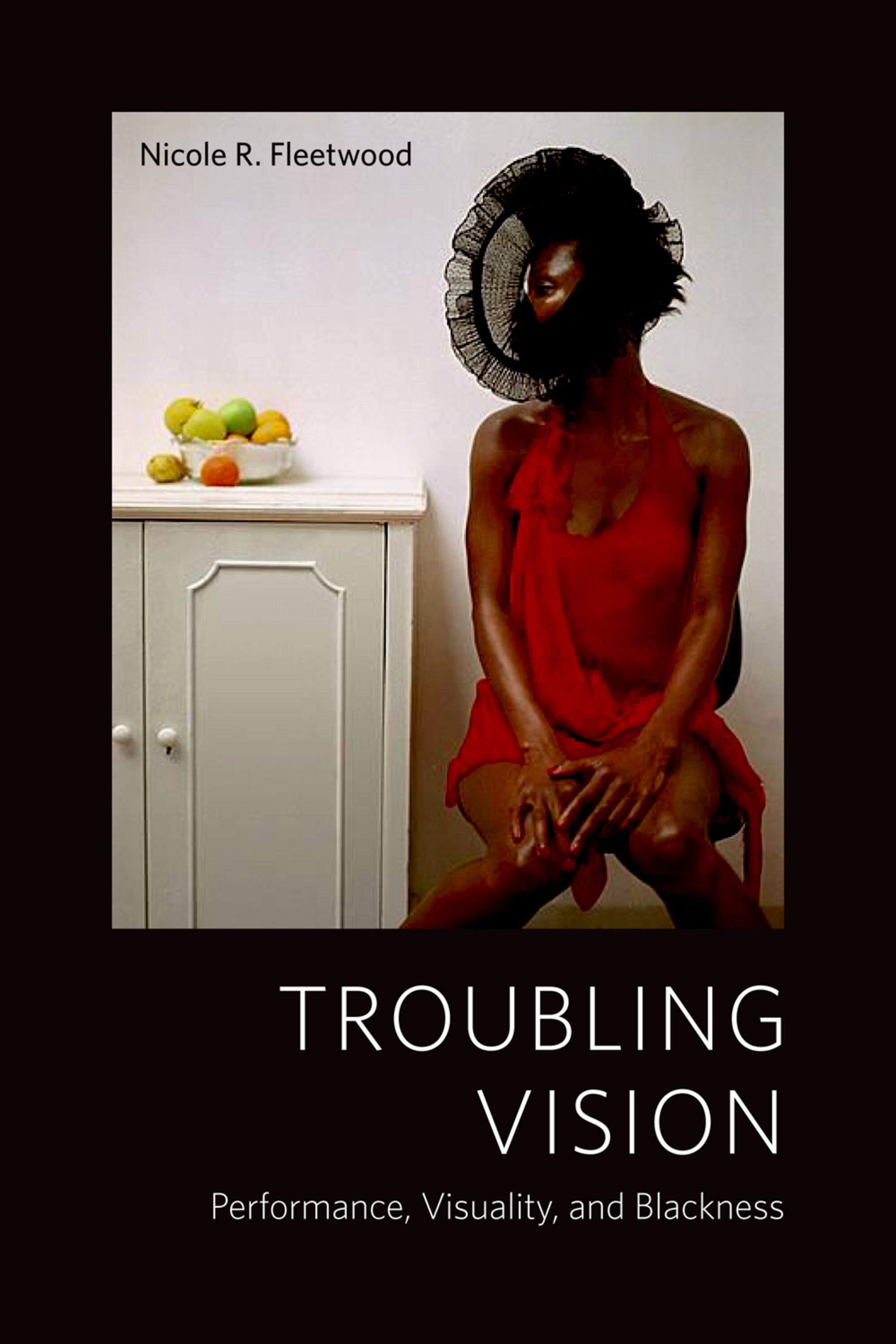
Troubling vision
Troubling Vision addresses American culture’s fixation on black visibility, exploring how blackness is persistently seen as a problem in public culture and even in black scholarship that challenges racist discourse. Through trenchant analysis, Nicole R. Fleetwood reorients the problem of black visibility by turning attention to what it means to see blackness and to the performative codes that reinforce, resignify, and disrupt its meaning. Working across visual theory and performance studies, Fleetwood asks, How is the black body visualized as both familiar and disruptive? How might we investigate the black body as a troubling presence to the scopic regimes that define it as such? How is value assessed based on visible blackness? Fleetwood documents multiple forms of engagement with the visual, even as she meticulously underscores how the terms of engagement change in various performative contexts. Examining a range of practices from the documentary photography of Charles “Teenie” Harris to the “excess flesh” performances of black female artists and pop stars to the media art of Fatimah Tuggar to the iconicity of Michael Jackson, Fleetwood reveals and reconfigures the mechanics, codes, and metaphors of blackness in visual culture.
eBook

From invisibility to artificial life: ethical quandaries in science fiction
This paper analyzes how science fiction serves as a critical ethical early-warning system. By examining H.G. Wells’s The Invisible Man, Mary Shelley’s Frankenstein and Kazuo Ishiguro’s Never Let Me Go, the authors demonstrate that the genre’s core function is not mere technological prediction but a profound exploration of the social and moral catastrophes that arise when scientific ambition divorces itself from ethical constraints. The study constructs a framework linking specific ethical violations – such as the pursuit of power through invisibility, the irresponsible creation and abandonment of artificial life and the systemic exploitation of clones under anthropocentrism – to broader societal collapse. The authors’ central argument is that these narratives perform proactive and participatory ethics, forcing a confrontation with dilemmas posed by hypothetical technologies. Ultimately, the paper contends that science fiction uniquely advocates for the essential fusion of scientific progress and humanistic values, asserting that true advancement requires this symbiosis.
Journal Article

Visuality of the Invisible: The Image of Medjed in Sources of the 21st Dynasty
This paper discusses iconographic features of the deity or “demon” Medjed (Mḏd). The specific and unusual image of this character is only found during the 21st Dynasty and is unknown in the funerary art of the New Kingdom and Late Period. Only oneYe coffin and nine papyri are known in which the image of Medjed is depicted. Eight are in the context of Spell 17 of the Book of the Dead. In the text of Spell 17, Medjed is described in lines 71–72 of Grapow’s Urk. V Abschnitt 24. The “invisibility” of this “demon” is evidently the reason for his unusual iconography: Medjed has a conical shaped body, with human legs. Although he does not have a true head, his eyes are indicated, and he wears a belt. Equally the deity could be depicted as a figure covered entirely in a conical cover except for the eyes and feet, which are visible. This curious treatment can be understood as an attempt by Egyptian artists to depict an invisible being.
Journal Article

The Reality of the Invisible: The Phenomenology of Invisibility in H. Conrad-Martius’s Metaphysical Realism
This article aims to establish the theoretical foundations for a phenomenology of the invisible, conceived as an ontologically primary dimension of reality. It draws on the work of the realist phenomenologist Hedwig Conrad-Martius (1888–1966) and situates the discussion within the methodological framework of Husserl’s phenomenology—as developed by members of the Munich–Göttingen Circle, of which Conrad-Martius was one of the leading figures, and which employed the methods of Ideation and epoché. This study elaborates three ontological structures, Nothingness, Selfness (ichhaftes Sein), and Transcendence, proposed here as anchor points for addressing the phenomenon of invisibility. Through this, it seeks to extend the phenomenological notion of givenness from what appears to that which resists appearance. Given that Conrad-Martius herself does not explicitly link these structures—as developed in her thought—to invisibility, nor does her writing offer a systematic conceptual development or detailed examination of their broader implications, the author—taking inspiration from Eugen Fink’s notion of “philosophizing-along-with” (Mit-Philosophieren) as a means to achieve a methodological and “theoretical stance”—frames a thematic exploration of invisibility in relation to these structures. The article thus proposes an ontologically grounded phenomenological framework for understanding the invisible as an integral dimension of the totality of reality: the primordial ground preceding all existence (Nothingness), the structural condition of human reality (Selfness), and that which lies beyond both human finitude and existence as such (Transcendence). In doing so, it seeks to contribute to contemporary phenomenological discourse by articulating the invisible as a fundamental mode of Being.
Journal Article

Cleaning, sculpting or preparing? Scientific knowledge in Caitlin Wylie’s preparing dinosaurs
Caitlin Wylie’s “Preparing Dinosaurs: the work behind the scenes” (MIT Press 2021) provides a rich ethnographic analysis of the work of fossil preparators. On her account, knowledge in vertebrate paleontology is mediated through a three-way division of labour between paleontologists, preparators and volunteers, each with their own role, expertise and responsibility. In this review, I develop her notion of ‘preparation as knowledge’, focusing in particular on the nature of objectivity in paleontological knowledge and on the middle-road she indicates between constructivist and realist approaches to epistemology.
Journal Article

Pathologies of the modern paradigm and the refugee question: a critical analysis
This article examines the internal contradictions and social pathologies generated by the modern paradigm, focusing especially on the issue of migration. Using epistemological critiques from thinkers like Adorno, Kuhn, Popper, Hayek, and the Frankfurt School, the paper argues that modernity’s promise of universal rationality and scientific progress has frequently resulted in structures that are exclusionary, homogenizing, and sometimes even totalitarian. The paper then links these theoretical debates to contemporary migration. It emphasizes how refugee women—especially those facing the combined challenges of gender and displacement—experience complex layers of social invisibility and discursive erasure. By critically applying recognition theory and discourse analysis, the study highlights how modernity’s promise of inclusion frequently hides the actual mechanisms of marginalization. In this part, the article demonstrates that these marginalization processes are linked to the scientific premises of the modern paradigm and considers the migration problem as an example of the pathology of the modern paradigm.
Journal Article
Post-Linguistic Acts and the Worshiped Invisible
For communities on the margins of hostile or indifferent power structures, the political order can be experienced as a force whose acts are not motivated by reasons in accord with recognizable norms. Power, then, as a social phenomenon, is naturalized in the sense that it is dehumanized. Derrida explored some of this territory in his final seminar, the Beast and the Sovereign. Power becomes a latent animality, structuring social life as it removes itself from mechanisms of accountability. At the same time, the Black church ritual, in the United States and elsewhere, provides an experience of a self-sustaining power, whose invisibility is taken as coextensive with its omnipresence. The act of worship becomes a project of counter-habituation whereby power can be constituted as just and life-affirming. Simone Weil’s spiritual writings on the necessity of God’s love can be of some assistance here, but her concern with “decreation” is on its face a self-erasing theological enterprise, the sociopolitical implications of which would seem to put it at odds with a movement, among marginalized people, toward increased recognition. A look at the relation between Weil’s writing method—which I analyze as a kind of endophrasis—and Edmund Husserl’s transcendental understanding of the self provides a way to reorganize our understanding of the sociocultural project supported by the ritual. To grasp the counter-habituating project of the ritual, we must see it as founded in non-linguistic thinking and post-linguistic acts. These acts are, in part, improvisational, which is a key to habituating the recognition of higher-order necessity through free activity. They bring the worshiper “through” culturally determined linguistic acts to another kind of experience, in which the freedom to worship an invisible God is manifest.
Journal Article

Rereading the Phenomenology’s Recasting of Perception: The Path to a Differing and Interwoven Temporality, Imaginal, and Poetic Ontology
The point of this Special Issue of Philosophies and of this essay is to look deeply into Merleau-Ponty’s Phenomenology of Perception, published in 1945, and to “read backwards” from the later works (whether published, transcripts of the later lectures, or the unpublished notes) in order to find the inchoate ideas that were already present in the Phenomenology that was to be developed into the series of ideas of the later ontology of the flesh of the world. The presence of these inchoate ideas is subtle and not as clearly developed as in the later works, but now we can see them more clearly. The dispersed, decentered, and intermittent sense of self, the circulation of sense into the depth of the world, the radical temporality of institution, the latency of sense, the imaginal lining of all perception and its role in Being, the invisibility of the visible and the poetic flesh ontology will be touched upon in this essay as all of them are developments of the initial move in the Phenomenology to make perception the access to the real. This essay will go further than the many recent interpretations that look at some of these developing ideas to articulate that this is a necessary trajectory from Merleau-Ponty’s starting point in the Phenomenology of Perception and that all these phenomena to which these ideas point can only come forward in their interrelated interwovenness. This would mean that all these strands are integral to the chiasmatic nature of the flesh of the world.
Journal Article

Divine Visibility in the Gospel of John
This article argues that John’s christology affirms the material visibility of God by reconciling the notion of an “unseen” God to the visibility of the Father that Jesus presents. Three pieces of evidence support this claim. The first is that “unseen” and “invisible” are not synonymous. A survey of Second Temple, biblical, and rabbinic literature reveals that one may not assume that all hellenized Jews embraced Platonist notions of invisibility. Second, Jesus presents the Father as visible, however restricted that visibility may be to Jesus’s person. Third, John’s use of Isaiah suggests that the visibility of God in the theophanies is consonant with God’s visibility in Jesus.
Journal Article