
Catalogue Search | MBRL


Are you sure you want to remove the book from the shelf?

{{itemTitle}}
589
result(s) for
"Iran -- Civilization"
Sort by:
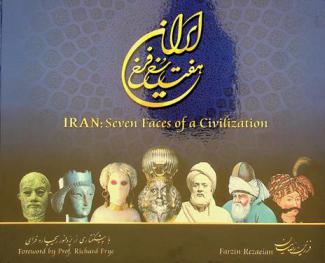
Iran : seven faces of a civilization = Īrān : haft rukh-I tamaddun
Visual recreation of modern and ancient Iran.
Book

A state of mixture
Christian communities flourished during late antiquity in a Zoroastrian political system, known as the Iranian Empire, that integrated culturally and geographically disparate territories from Arabia to Afghanistan into its institutions and networks. Whereas previous studies have regarded Christians as marginal, insular, and often persecuted participants in this empire, Richard Payne demonstrates their integration into elite networks, adoption of Iranian political practices and imaginaries, and participation in imperial institutions.The rise of Christianity in Iran depended on the Zoroastrian theory and practice of hierarchical, differentiated inclusion, according to which Christians, Jews, and others occupied legitimate places in Iranian political culture in positions subordinate to the imperial religion. Christians, for their part, positioned themselves in a political culture not of their own making, with recourse to their own ideological and institutional resources, ranging from the writing of saints' lives to the judicial arbitration of bishops. In placing the social history of East Syrian Christians at the center of the Iranian imperial story,A State of Mixturehelps explain the endurance of a culturally diverse empire across four centuries.
eBook
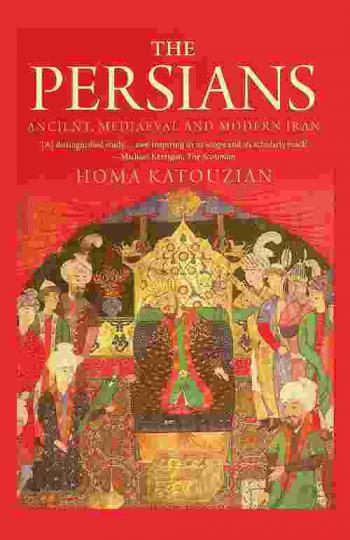
The Persians : ancient, mediaeval and modern Iran
In recent years, Iran has gained attention mostly for negative reasons--for its authoritarian religious government, disputed nuclear programme, and controversial role in the Middle East--but there is much more to the story of this ancient land than can be gleaned from the news. This ... history of Iran ... covers the entire history of the area from the foundation of the ancient Persian Empire to today's Iranian state. Writing from an Iranian rather than a European perspective, Katouzian integrates the significant cultural and literary history of Iran with its political and social history. Some of the greatest poets of human history wrote in Persian--among them Rumi, Omar Khayyam, and Saadi--and Katouzian discusses and occasionally quotes their work ... Katouzian argues that the absolute and arbitrary power traditionally enjoyed by Persian/Iranian rulers has resulted in an unstable society where fear and short-term thinking dominate.
Book
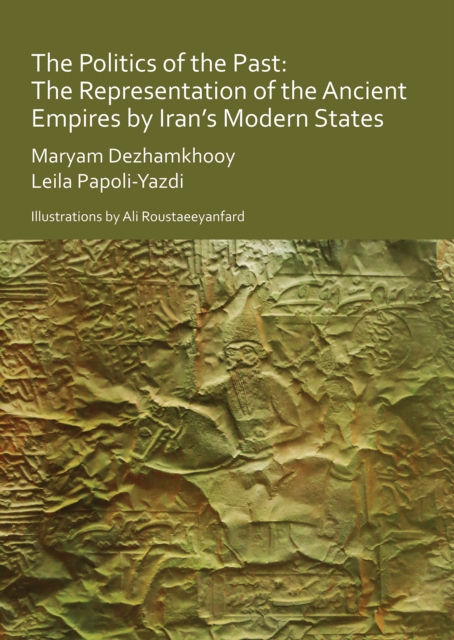
The Politics of the Past
Politics of the past: The Representation of the Ancient Empires by Iran’s Modern States' examines the highly problematic politics of the past surrounding the archaeology of ancient empires in Iran. Being indigenous, the authors regard the relations between archaeological remains, (negative) heritage, and modern strategies of suppression. The chapters provide a detailed analysis of how the practice of archaeology could be biased and ideologically charged. Discussing their own personal and professional experiences, the authors exemplify the real (ethical) dilemmas that archaeologists confront in the Middle East, calling for reflectivity and awareness among the archaeologists of the region. The text is accompanied by visual deconstruction of ancient rock reliefs to indicate the possibility of alternative histories.
eBook


Early Mongol Rule in Thirteenth-Century Iran
An account of the re-emergence of Persia as a world player and the reassertion of its cultural, political and spiritual links with Turkic Lands, this book opposes the way in which, for too long, the whole period of Mongol domination of Iran has been viewed from a negative standpoint. Though arguably the initial irruption of the Mongols brought little comfort to those in its path, this is not the case with the second 'invasion' of the Chinggisids. This study demonstrates that Hülegü Khan was welcomed as a king and a saviour after the depredations of his predecessors, rather than as a conqueror, and that the initial decades of his dynasty's rule were characterised by a renaissance in the cultural life of the Iranian plateau.
'No doubt it will be a while before such a comprehensive study of these years of Ilkhanate is again attempted, not least because Lane has written such a rich and provocative book that brings together much relevant material neglected in standard narrative accounts.' - Journal of School of Oriental and African Studies
1. The Sources 2. Divine Punishment or God's Secret Intent? 3. Baghdad and its Aftermath 4. The Uneasy Borders a. Abaqa and the West b. Berke Khan and the North c. Baraq Khan and the East 5. The Provinces a. Kirman b. Shiraz c. Herat 6. The Juwaynis 7. Kwaja Nasír al-Din Tusi 8. Poets, Sufis, and Qalandars 9. Return of a King
After spending 20 years living, working and seeking adventure throughout the Middle East and then later in the Far East, during which years he worked as an English teacher, a freelance writer and journalist and as a businessman, George Lane returned to his more concentrated academic life in 1991 when he took up work and studies at SOAS. Since then he has been concerned primarily with Medieval Islamic History and with Iran and Central Asia in particular. George Lane has two young children with whom he lives with his wife in Dulwich, S. E. London.
eBook


Nationalizing Iran
When Naser al-Din Shah, who ruled Iran from 1848 to 1896, claimed the title Shadow of God on Earth, his authority rested on premodern conceptions of sacred kingship. By 1941, when Mohammad Reza Shah Pahlavi came to power, his claim to authority as the Shah of Iran was infused with the language of modern nationalism. In short, between roughly 1870 and 1940, Iran's traditional monarchy was forged into a modern nation-state.
InNationalizing Iran, Afshin Marashi explores the changes that made possible this transformation of Iran into a social abstraction in which notions of state, society, and culture converged. He follows Naser al-Din Shah on a tour of Europe in 1873 that led to his importing a new public image of monarchy-an image based on the European late imperial model-relying heavily on the use of public ceremonies, rituals, and festivals to promote loyalty to the monarch. Meanwhile, Iranian intellectuals were reimagining ethnic history to reconcile \"authentic\" Iranian culture with the demands of modernity. From the reform of public education to the symbolism surrounding grand public ceremonies in honor of long-dead poets, Marashi shows how the state invented and promoted key features of the common culture binding state and society. The ideological thrust of that century would become the source of dramatic contestation in the late twentieth century.
Marashi's study of the formative era of Iranian nationalism will be valuable to scholars and students of history, sociology, political science, and anthropology, as well as journalists, policy makers, and other close observers of contemporary Iran.
eBook

Experiencing Persian Heritage
Tourism is seen as a way of promoting a nation's history or heritage. This is especially resonant for countries such as Iran which is home to one of the world's oldest continuous major civilizations, with its historical and urban settlements dating back to 4000 BC. However, the mere existence of historical and cultural resources is not sufficient to develop a country as an international destination. Building on comparatively limited tourism and hospitality research on Iran as a destination, and being mindful of recent political, cultural, and social transitions there, Experiencing Persian Heritage: Perspectives and Challenges is developed as an essential reference for destination development in emerging international destinations similar to Iran--rich in history, culture, heritage, and ethnic and natural diversities. These constitute the unique substances for image formulation, marketing, and competitive and global positioning. The topics advanced in this volume summarize a number of relevant challenges and opportunities for practical applications in hospitality and tourism. The book will be of interest to national and international tourism authorities, postgraduate students, and faculty members in tourism, marketing, heritage management, history and anthropology.
eBook