
Catalogue Search | MBRL


Are you sure you want to remove the book from the shelf?

{{itemTitle}}
1,894
result(s) for
"Iran -- Military policy"
Sort by:

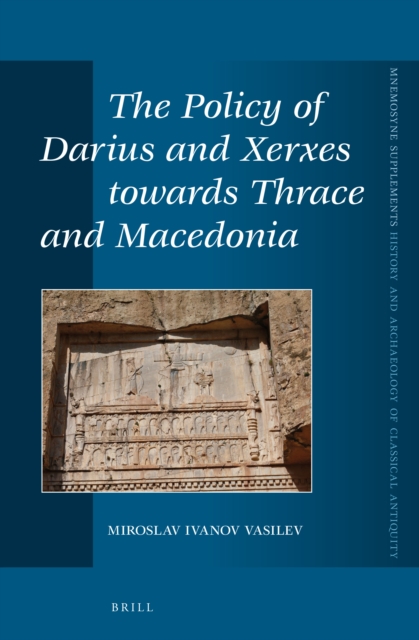
The Policy of Darius and Xerxes towards Thrace and Macedonia
In The Policy of Darius and Xerxes towards Thrace and Macedonia Miroslav Vasilev analyses in detail the policy of the Persian kings towards their European possessions in the years 514-465 BC. The book examines the status of Macedonian rulers under the Persian kings, as well as the status of the Thracian territories conquered as a result of the campaigns of Darius and Megabazus. In addition, the author localizes many tribes, rivers, lakes, mountains, and other geographical features of primary importance in defining the territorial span of the European lands conquered by the Persians. Vasilev examines literary sources, epigraphic evidence, coins, and archaeological finds relevant to the topic.
eBook

The Iranian Nuclear Crisis
This paper explains how Iran developed its nuclear programme to the point where it threatens to achieve a weapons capability within a short time frame, and analyses Western policy responses aimed at forestalling that capability. Key questions are addressed: will the world have to accept an Iranian uranium-enrichment programme, and does having a weapons capability mean having the Bomb?
For nearly two decades, Western strategy on the Iran nuclear issue emphasised denial of supply. Since 2002, there has also been a demand-side dimension to the strategy, aimed at changing Iran’s cost–benefit calculations through inducements and pressure. But the failure of these policies to prevent Iran from coming close to achieving a nuclear-weapons capability has promoted suggestions for fallback strategies that would grant legitimacy to uranium enrichment in Iran in exchange for intrusive inspections and constraints on the programme.
The paper assesses these ‘second-best’ options in terms of their feasibility and their impact on the proliferation risks of diversion of nuclear material and knowledge, clandestine development and NPT break-out, and the risk of stimulating a proliferation cascade in the Middle East and beyond. It concludes that the risks are still best minimised by reinforcing the binary choice presented to Iran of cooperation or isolation, and strengthening denial of supply.
Mark Fitzpatrick is Senior Fellow for Non-Proliferation at The International Institute for Strategic Studies and Director of its Non-Proliferation and Disarmament Programme. He is the editor and principal author of IISS strategic dossiers on Nuclear Programmes in the Middle East: In the shadow of Iran (London: IISS, 2008) and Nuclear Black Markets: Pakistan, A.Q. Khan and the rise of proliferation networks: A net assessment (London: IISS, 2007). He has published articles on the Iranian and North Korean nuclear programmes and other proliferation topics in Survival , the Financial Times , the International Herald Tribune and other publications, and he is a frequent news commentator and international lecturer on these subjects. He was a US diplomat for 26 years, including as Deputy Assistant Secretary for Non-Proliferation.
Introduction 1. Framing the Problem: Iran,s Pursuit of Fissile Material 2. Western Strategy So Far 3. Can Iran's Capability Be Kept Non-Weaponised? Conclusion
eBook


Iran's Security Policy in the Post-Revolutionary Era
Religion, nationalism, ethnicity, economics, and geopolitics all are important in explaining Iran's goals and tactics in its relationship with the outside world, as are the agendas of key security institutions and the ambitions of their leaders. This report assesses Iran's security policy in light of these factors. It examines broad drivers of Iran's security policy, describes important security institutions, explores decisionmaking, and reviews Iran's relations with key countries. The authors conclude that Iraq is widely recognized as the leading threat to Iran's Islamic regime and Afghanistan is seen as an emerging threat. In contrast, Iran has solid, if not necessarily warm, relations with Syria and established working ties to Pakistan and Russia. Iran's policies toward its neighbors are increasingly prudent: It is trying to calm regional tension and end its isolation, although its policies toward Israel and the United States are often an exception to this policy. Iran's security forces, particularly the regular military, are often voices of restraint, preferring shows of force to overactive confrontations. Finally, Iran's security forces generally respect and follow the wishes of Iran's civilian leadership; conducting rogue operations is rare to nonexistent.
eBook


Anticipating a Nuclear Iran
This volume is based on the assumption that Iran will soon obtain nuclear weapons, and Jacquelyn K. Davis and Robert L. Pfaltzgraff Jr. develop alternative models for assessing the challenges of a nuclear Iran for U.S. security. Through three scenario models, the book explores the political, strategic, and operational challenges facing the United States in a post--Cold War world. The authors concentrate on the type of nuclear capability Iran might develop; the conditions under which Iran might resort to threatened or actual weapons use; the extent to which Iran's military strategy and declaratory policy might embolden Iran and its proxies to pursue more aggressive policies in the region and vis-à-vis the United States; and Iran's ability to transfer nuclear materials to others within and outside the region, possibly sparking a nuclear cascade. Drawing on recent post--Cold War deterrence theory, the authors consider Iran's nuclear ambitions as they relate to its foreign policy objectives, domestic politics, and role in the Islamic world, and they suggest specific approaches to improve U.S. defense and deterrence planning.
eBook

Israel and Iran
Israel and Iran have come to view each other as direct regional rivals. The two countries are not natural rivals; they have shared geopolitical interests, which led to years of cooperation both before and after the 1979 Islamic revolution. But their rivalry has intensified recently, particularly with the rise of fundamentalist leaders in Iran and the prospect of a nuclear-armed Iran posing grave strategic and ideological challenges to Israel.
eBook
Mullahs, Guards, and Bonyads
The U.S. ability to \"read\" the Iranian regime and formulate appropriate policies has been weakened by lack of access to the country and by the opacity of decisionmaking in Tehran. To improve understanding of Iran's political system, the authors describe Iranian strategic culture; investigate Iran's informal networks, formal government institutions, and personalities; assess the impact of elite behavior on Iranian policy; and summarize key trends.
eBook