
Catalogue Search | MBRL


Are you sure you want to remove the book from the shelf?

{{itemTitle}}
7
result(s) for
"Iran-Iraq War, 1980-1988 -- Influence"
Sort by:

The Iran-Iraq War
This volume offers a wide-ranging examination of the Iran-Iraq War (1980-88), featuring fresh regional and international perspectives derived from recently available new archival material.
Three decades ago Iran and Iraq became embroiled in a devastating eight-year war which served to re-define the international relations of the Gulf region. The Iran-Iraq War stands as an anomaly in the Cold War era; it was the only significant conflict in which the interests of the United States and Soviet Union unwittingly aligned, with both superpowers ultimately supporting the Iraqi regime.
The Iran-Iraq War re-assesses not only the superpower role in the conflict but also the war's regional and wider international dimensions by bringing to the fore fresh evidence and new perspectives from a variety of sources. It focuses on a number of themes including the economic dimensions of the war and the roles played by a variety of powers, including the Gulf States, Turkey, France, the Soviet Union and the United States. The contributions to the volume serve to underline that the Iran-Iraq war was a defining conflict, shaping the perspectives of the key protagonists for a generation to come.
This book will be of much interest to students of international and Cold War history, Middle Eastern politics, foreign policy, and International Relations in general.
eBook
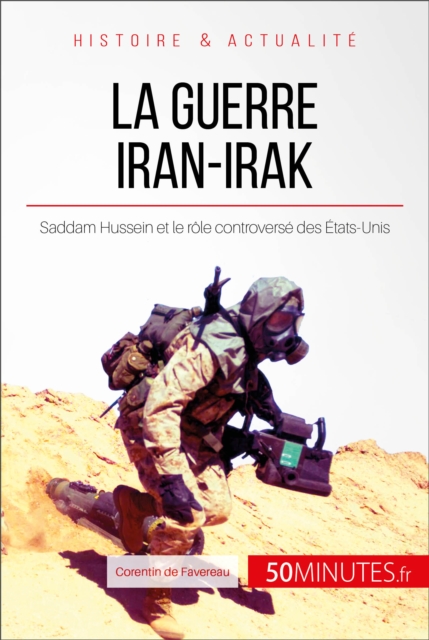
La guerre Iran-Irak
Découvrez enfin tout ce qu'il faut savoir sur la guerre Iran-Irak en moins d'une heure!
Le 22 septembre 1980, Saddam Husein s'attaque au Chatt al-Arab et proclame sa domination du secteur. S'engage alors une guerre que l'on espère éclair, mais qui s'enlise rapidement. Trois ans plus tard, tout semble permis pour parvenir à ses fins, même le recours à l'arme chimique. Pourtant, la guerre est loin d'être terminée. Ce livre vous permettra d'en savoir plus sur:
• Le contexte politique et social de l'époque
• Les acteurs majeurs du conflit
• Le déroulement de la guerre Iran-Irak et sa chronologie (carte à l'appui)
• Les raisons du statu quo
• Les répercussions de la guerre Le mot de l'éditeur:
« Dans ce numéro de la collection « 50MINUTES|Grandes Batailles », Corentin de Favereau nous présente l'un des conflits les plus meurtriers depuis 1945, mais aussi le plus long. Prenant place au sein d'une lutte plusieurs fois millénaire, l'auteur permet au lecteur de mieux comprendre la situation actuelle du Golfe, mais également le rôle trouble joué par l'administration américaine au cours des événements, notamment quant à l'utilisation d'armes chimiques sur la population iranienne. » Stéphanie DagrainÀ PROPOS DE LA SÉRIE 50MINUTES | Grandes Batailles
La série « Grandes Batailles » de la collection « 50MINUTES » aborde plus de cinquante conflits qui ont bouleversé notre histoire. Chaque livre a été pensé pour les lecteurs curieux qui veulent tout savoir sur une bataille, tout en allant à l'essentiel, et ce en moins d'une heure. Nos auteurs combinent les faits, les analyses et les nouvelles perspectives pour rendre accessibles des siècles d'histoire.
eBook
Us Foreign Policy and the Gulf Wars
The US-led coalition which launched an invasion of Iraq on 20 March 2003 led to a decade-long military presence in the country. In the run-up to that invasion, many comparisons were made with the 1991 Gulf War. Ahmed Ijaz Malik takes these two instances of military intervention by Republican US governments to highlight how the official discourse of leaders and decision-makers has an impact on foreign policy and its results. By taking these two examples, he examines how discourse affects real events, and the extent to which the legacy of the Cold War has influenced the decisions which are made at the upper echelons of the US government. US Foreign Policy and the Gulf Wars critically analyses the post-Cold War liberal cosmopolitan and realist discourses related to these two instances of US military intervention. Using an approach which Malik labels 'critical realism', this book examines the ways in which discourses often act as ideological covers for material interests, whilst still not holding a deterministic view whereby these interests alone shape policies. From this perspective, this book assesses the themes of 'Just War', humanitarianism and cosmopolitanism. It furthermore uses the approach of 'critical realism' to engage with a variety of arguments on the emerging role of the US - as they were displayed in academic discourses and other intellectual contributions around each of the 1991 and 2003 wars. Malik relates these discussions to an analysis of the official discourses, documents and policies displayed prior to the 1991 and 2003 wars, as well as to an examination of the resulting actual conduct. Since the implications of the US military presence in the Middle East are so central to the study of International Relations and Security Studies, this book will be invaluable for specialists in these disciplines, as well as for those interested in policy formation and the wider Middle East.
eBook

Iraq in Wartime
When US-led forces invaded Iraq in 2003, they occupied a country that had been at war for 23 years. Yet in their attempts to understand Iraqi society and history, few policy makers, analysts and journalists took into account the profound impact that Iraq's long engagement with war had on the Iraqis' everyday engagement with politics, the business of managing their daily lives, and their cultural imagination. Drawing on government documents and interviews, Dina Rizk Khoury traces the political, social and cultural processes of the normalization of war in Iraq during the last twenty-three years of Ba'thist rule. Khoury argues that war was a form of everyday bureaucratic governance and examines the Iraqi government's policies of creating consent, managing resistance and religious diversity, and shaping public culture. Coming on the tenth anniversary of the US-led invasion of Iraq, this book tells a multilayered story of a society in which war has become the norm.
eBook

Moments of Silence
The Iran-Iraq War was the longest conventional war of the 20th century. The memory of it may have faded in the wake of more recent wars in the region, but the harrowing facts remain: over one million soldiers and civilians dead, millions more permanently displaced and disabled, and an entire generation marked by prosthetic implants and teenage martyrdom. These same facts have been instrumentalized by agendas both foreign and domestic, but also aestheticized, defamiliarized, readdressed and reconciled by artists, writers, and filmmakers across an array of identities: linguistic (Arabic, Persian, Kurdish), religious (Shiite, Sunni, atheist), and political (Iranian, Iraqi, internationalist). Official discourses have unsurprisingly tried to dominate the process of production and distribution of war narratives. In doing so, they have ignored and silenced other voices.
Centering on novels, films, memoirs, and poster art that gave aesthetic expression to the Iran-Iraq War, the essays gathered in this volume present multiple perspectives on the war’s most complex and underrepresented narratives. These scholars do not naively claim to represent an authenticity lacking in official discourses of the war, but rather, they call into question the notion of authenticity itself. Finding, deciding upon, and creating a language that can convey any sort of truth at all—collective, national, or private—is the major preoccupation of the texts and critiques in this diverse collection.
eBook
Iran: Attacks on Afghan Refugees
Iran. Ministry of the Interior asserts that [United States influence; Soviet influence] provoked Attacks by Iranian citizens against Afghan refugees in Iran in order to discourage Iranian assistance to Afghan rebels ; Iranian citizens resent the Afghan refugees in Iran because they receive benefits from Social welfare that would otherwise be distributed to Displaced persons from the Iran-Iraq War (1980-1988)
Government Document
U.S. Policy toward Iran
United States interests in Iran include ensuring access to the [Persian Gulf; Strait of Hormuz] and limiting Soviet influence in Iran ; U.S. Office of the White House asserts that instability caused by the [Iran-Iraq War (1980-1988); Economic deterioration; Political unrest] offers opportunities for increased Soviet influence in Iran which would change the Balance of power in the Middle East ; United States policy toward Iran seeks to eliminate [Terrorism; Human rights violations] in Iran while normalizing Iran-United States relations and encouraging Iranian opposition to [Soviet aggression; Soviet Union Occupation of Afghanistan (1979-1989)]
Government Document