
Catalogue Search | MBRL


Are you sure you want to remove the book from the shelf?

{{itemTitle}}
54
result(s) for
"Iraq -- Politics and government -- 1991"
Sort by:

State of repression : Iraq under Saddam Hussein
A new account of modern Iraqi politics that overturns the conventional wisdom about its sectarian divisions. How did Iraq become one of the most repressive dictatorships of the late twentieth century? The conventional wisdom about Iraq's modern political history is that the country was doomed by its diverse social fabric. But in State of Repression, Lisa Blaydes challenges this belief by showing that the country's breakdown was far from inevitable. At the same time, she offers a new way of understanding the behavior of other authoritarian regimes and their populations. Drawing on archival material captured from the headquarters of Saddam Hussein's ruling Ba'th Party in the wake of the 2003 US invasion, Blaydes illuminates the complexities of political life in Iraq, including why certain Iraqis chose to collaborate with the regime while others worked to undermine it. She demonstrates that, despite the Ba'thist regime's pretensions to political hegemony, its frequent reliance on collective punishment of various groups reinforced and cemented identity divisions. In addition, a series of costly external shocks to the economy--resulting from fluctuations in oil prices and Iraq's war with Iran-weakened the capacity of the regime to monitor, co-opt, coerce, and control factions of Iraqi society. In addition to calling into question the common story of modern Iraqi politics, State of Repression offers a new explanation of why and how dictators repress their people in ways that can inadvertently strengthen regime opponents.
Book

Saddam's war of words : politics, religion, and the Iraqi invasion of Kuwait
No detailed description available for \"Saddam's War of Words\".
eBook

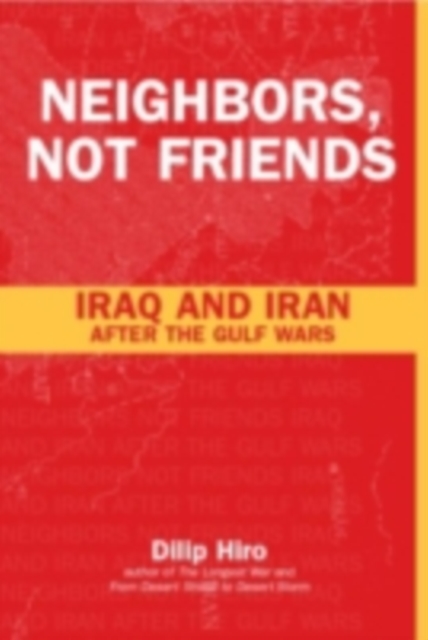
Neighbors, Not Friends
This highly controversial and topical book provides the first full, balanced account of how Iraq cheated the UN inspectors on disarmament and how the US manipulated and infiltrated the UN inspection teams and other staff to gather intelligence on Iraq to overthrow Saddam Hussein.
Aimed at the general reader, it follows and assesses the role of Saddam Hussein who became president of Iraq in 1979. Dilip Hiro, an experienced journalist who has written extensively on the region, provides a historical and accessible perspective to the relationship between Iraq and Iran and examines the consequences of internationally significant events such as the death of Ayatollah Khomeini in Iran a year after the end of the 1980-88 Iran-Iraq War and the 1990 invasion of Kuwait by Saddam Hussein.
Providing a full account and analysis of events in Iraq since the 1991 Gulf War, he contrasts the long totalitarianism under Hussein with the evolution of the political-religious system in Iran and the development of its internal politics.
This is an essential overview to the conflicts in the Gulf, and should be read by anyone with an interest in the region, its politics and its interactions with the US and UN.
Dilip Hiro is a full-time writer and journalist, and a frequent commentator on Middle Eastern, Gulf and Islamic affairs in radio and telelvision. He is the author of The Longest War, The Iran-Iraq Military Conflict, Holy Wars:The Rise of Islamic Fundamentalism and Iran Under the Ayatollahs among other books. His articles on the Middle East and allied subjects have appeared in the Washington Post, Wall Street Journal, Sunday Times, Guardian, Toronto Star and International Herald Tribune .
Part 1: Iraq 1. Saddam Center-Stage, Exit Bush 2. Enter Clinton: Saddam's New Nemesis 3. A Shattering Betrayal, Then Lucky Breaks for Saddam 4. The Mother of all Failed Coups 5. Saddam and Re-elected Clinton 6. 'Desert Thunder' That Didn't Thunder 7. Operation 'Desert Fox' Part 2: Iran 8. Iran, A Return to Normalcy 9. Rafsanjani's Reconstruction and Economic Reform 10. Khatami, a Moderate with a Mission 11. Political Reform and Reaction 12. Reform Restrained
eBook


Iraq in Wartime
When US-led forces invaded Iraq in 2003, they occupied a country that had been at war for 23 years. Yet in their attempts to understand Iraqi society and history, few policy makers, analysts and journalists took into account the profound impact that Iraq's long engagement with war had on the Iraqis' everyday engagement with politics, the business of managing their daily lives, and their cultural imagination. Drawing on government documents and interviews, Dina Rizk Khoury traces the political, social and cultural processes of the normalization of war in Iraq during the last twenty-three years of Ba'thist rule. Khoury argues that war was a form of everyday bureaucratic governance and examines the Iraqi government's policies of creating consent, managing resistance and religious diversity, and shaping public culture. Coming on the tenth anniversary of the US-led invasion of Iraq, this book tells a multilayered story of a society in which war has become the norm.
eBook


Arab storm : politics and diplomacy behind the Gulf war
As Iraqi troops surged into Kuwait in 1990, British Ambassador to Saudi Arabia Alan Munro played a vital role in both forging and maintaining a formidable coalition to evict them. Never before had Western and Arab states fought side by side against another Arab country. He reveals here all the behind-the-scenes manoeuvring that made this possible. He recalls with verve and candour the frantic phone calls, the diplomatic interplay, the confusion of the battlefield, and the difficulties of dealing with the international media. Munro surrounds his revelations with a thoughtful and informed analysis of the international politics of the Middle East. With Western armies once more deployed in the Gulf, this new updated paperback edition of Munro's book provides a timely reminder of the pressures, pitfalls and potential of international diplomacy in the region.An authoritative account...impressive and valuable - The SpectatorA frank and entertaining book. - Patrick Seale, former correspondent for The Observer and author of Assad of Syria: The Struggle for the Middle East\"Superbly chronicled\"- The Wall Street Journal.
eBook

Oil and democracy in Iraq
\"This is the first major study of the alternatives confronting Iraq as it seeks to rebuild its vital while simultaneously constructing a new political system. A key challenge facing the country is to allocate the revenues oil generates in a way that avoids economic and social instability. Reviewing the present status of the industry, the authors use comparative analysis to suggest how it might best be rebuilt.\"--Jacket.
Book

The Struggle for Iraq's Future
Many Westerners have offered interpretations of Iraq's nation-building progress in the wake of the 2003 war and the eventual withdrawal of American troops from the country, but little has been written by Iraqis themselves. This forthright book fills in the gap. Zaid Al-Ali, an Iraqi lawyer with direct ties to the people of his homeland, to government circles, and to the international community, provides a uniquely insightful and up-to-date view of Iraq's people, their government, and the extent of their nation's worsening problems.
The true picture is discouraging: murderous bombings, ever-increasing sectarianism, and pervasive government corruption have combined to prevent progress on such crucial issues as security, healthcare, and power availability. Al-Ali contends that the ill-planned U.S. intervention destroyed the Iraqi state, creating a black hole which corrupt and incompetent members of the elite have made their own. And yet, despite all efforts to divide them, Iraqis retain a strong sense of national identity, Al-Ali maintains. He reevaluates Iraq's relationship with itself, discusses the inspiration provided by the events of the Arab Spring, and redefines Iraq's most important struggle to regain its viability as a nation.
eBook