
Catalogue Search | MBRL


Are you sure you want to remove the book from the shelf?

{{itemTitle}}
189
result(s) for
"Iraq Kuwait crisis 1990-1991"
Sort by:
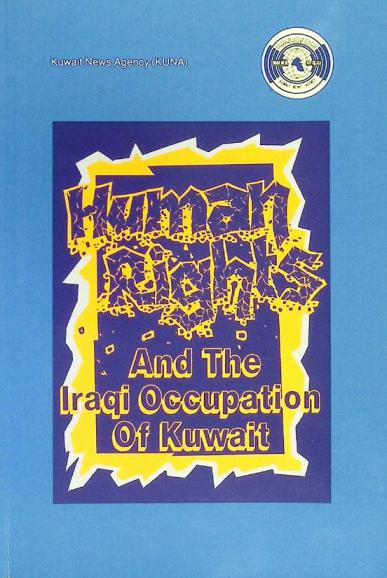
Human rights and the iraqi occupation of Kuwait
This book is a comprehensive documentary and legal record compiled by the Kuwait News Agency (KUNA) to monitor and archive human rights violations during the Iraqi invasion and occupation of the State of Kuwait (1990–1991). The report provides a systematic analysis of the atrocities committed against the civilian population, based on eyewitness testimonies, field reports, and international monitoring data. It covers a wide range of violations, including arbitrary detention, torture, extrajudicial killings, and the forced disappearance of Kuwaiti citizens and residents (the POWs and missing persons issue). Additionally, the book examines the environmental and economic crimes committed, such as the ignition of oil wells and the systematic looting of public and private property, framed within the context of International Humanitarian Law and the Universal Declaration of Human Rights. This work serves as a vital historical archive and a legal reference for researchers in international relations, human rights advocacy, and the history of the Arabian Gulf.
BOOK

Worldmaking at the End of History: The Gulf Crisis of 1990–91 and International Law
This Article argues that the Gulf Crisis of 1990–91, the first major international crisis of the post-Cold War era, was a constitutive moment for international law. The Article examines the contests in the United Nations over the meaning of the Crisis and shows that these contests were also over the meaning of cooperation under international law in the “new world order.” The Article casts the Gulf Crisis itself as a moment of “worldmaking,” in which the United States refashioned foundational concepts like interdependence, sovereignty, and humanity in warfare and deployed them to suit a state-centered vision of international cooperation under hierarchy.
Journal Article

Channels of Power
When President George W. Bush launched an invasion of Iraq in
March of 2003, he did so without the explicit approval of the
Security Council. His father's administration, by contrast,
carefully funneled statecraft through the United Nations and
achieved Council authorization for the U.S.-led Gulf War in 1991.
The history of American policy toward Iraq displays considerable
variation in the extent to which policies were conducted through
the UN and other international organizations.
In Channels of Power, Alexander Thompson surveys U.S. policy
toward Iraq, starting with the Gulf War, continuing through the
interwar years of sanctions and coercive disarmament, and
concluding with the 2003 invasion and its long aftermath. He offers
a framework for understanding why powerful states often work
through international organizations when conducting coercive
policies-and why they sometimes choose instead to work alone or
with ad hoc coalitions. The conventional wisdom holds that because
having legitimacy for their actions is important for normative
reasons, states seek multilateral approval. Channels of Power
offers a rationalist alternative to these standard legitimation
arguments, one based on the notion of strategic information
transmission: When state actions are endorsed by an independent
organization, this sends politically crucial information to the
world community, both leaders and their publics, and results in
greater international support.
When President George W. Bush launched an invasion of Iraq in
March of 2003, he did so without the explicit approval of the
Security Council. His father's administration, by contrast,
carefully funneled statecraft through the United Nations and
achieved Council authorization for the U.S.-led Gulf War in 1991.
The history of American policy toward Iraq displays considerable
variation in the extent to which policies were conducted through
the UN and other international organizations.In Channels of
Power , Alexander Thompson surveys U.S. policy toward Iraq,
starting with the Gulf War, continuing through the interwar years
of sanctions and coercive disarmament, and concluding with the 2003
invasion and its long aftermath. He offers a framework for
understanding why powerful states often work through international
organizations when conducting coercive policies-and why they
sometimes choose instead to work alone or with ad hoc coalitions.
The conventional wisdom holds that because having legitimacy for
their actions is important for normative reasons, states seek
multilateral approval. Channels of Power offers a
rationalist alternative to these standard legitimation arguments,
one based on the notion of strategic information transmission: When
state actions are endorsed by an independent organization, this
sends politically crucial information to the world community, both
leaders and their publics, and results in greater international
support.
eBook
Droits de l'homme et occupation irakienne du koweit
Cet ouvrage présente une étude documentaire et analytique des violations systématiques des droits humains perpétrées durant l'occupation irakienne du Koweït (1990-1991). Il examine un large éventail de témoignages, de rapports de terrain et de preuves juridiques documentant les exactions commises contre les civils, notamment les arrestations arbitraires, la torture, les disparitions forcées et la destruction de biens publics et privés. L'ouvrage analyse également ces pratiques au regard du droit international humanitaire, de la Quatrième Convention de Genève et du droit international, en soulignant les efforts de documentation entrepris par les médias koweïtiens et les organisations de défense des droits humains afin d'internationaliser la question et d'obtenir réparation devant la justice.
BOOK

Iraq in Wartime
When US-led forces invaded Iraq in 2003, they occupied a country that had been at war for 23 years. Yet in their attempts to understand Iraqi society and history, few policy makers, analysts and journalists took into account the profound impact that Iraq's long engagement with war had on the Iraqis' everyday engagement with politics, the business of managing their daily lives, and their cultural imagination. Drawing on government documents and interviews, Dina Rizk Khoury traces the political, social and cultural processes of the normalization of war in Iraq during the last twenty-three years of Ba'thist rule. Khoury argues that war was a form of everyday bureaucratic governance and examines the Iraqi government's policies of creating consent, managing resistance and religious diversity, and shaping public culture. Coming on the tenth anniversary of the US-led invasion of Iraq, this book tells a multilayered story of a society in which war has become the norm.
eBook

The Iraqi Invasion of Kuwait
Focusing on the 1990 Iraqi invasion of Kuwait, Hamdi Hassan offers a balanced examination of the motivation of the Iraqi polity and the conditions which accelerated and facilitated the decision to invade.
Critical of the traditional approach of most Middle East studies, The Iraqi Invasion of Kuwait offers a counterpoint to Western interpretations of this key event in the contemporary history of the Middle East.
Hassan examines how Saddam Hussein assessed and responded to American and Israeli intentions after the invasion, the reaction of other Arab states, and the unprecedented grassroots support for the Iraqi leadership. In this context, the author examines the social structure of Iraqi society - families, clans and regional alliances - and the importance of Ba'athism. Hassan also examines the political structure of the country, relating the identity of Arabism - the religion and language which is associated closely with the Pan Arabist ideals - to Iraqi foreign policy.
eBook

The Discourse of Propaganda
In the early 1990s, false reports of Iraqi soldiers in Kuwait
allowing premature infants to die by removing them from their
incubators helped to justify the Persian Gulf War, just as spurious
reports of weapons of mass destruction later undergirded support
for the Iraq War in 2003. In The Discourse of Propaganda ,
John Oddo examines these and other such cases to show how
successful wartime propaganda functions as a discursive
process.
Oddo argues that propaganda is more than just misleading
rhetoric generated by one person or group; it is an elaborate
process that relies on recontextualization, ideally on a massive
scale, to keep it alive and effective. In a series of case studies,
he analyzes both textual and visual rhetoric as well as the social
and material conditions that allow them to circulate, tracing how
instances of propaganda are constructed, performed, and repeated in
diverse contexts, such as speeches, news reports, and popular,
everyday discourse.
By revealing the agents, (inter)texts, and cultural practices
involved in propaganda campaigns, The Discourse of
Propaganda shines much-needed light on the topic and
challenges its readers to consider the complicated processes that
allow propaganda to flourish. This book will appeal not only to
scholars of rhetoric and propaganda but also to those interested in
unfolding the machinations motivating America's recent military
interventions.
eBook