
Catalogue Search | MBRL


Are you sure you want to remove the book from the shelf?

{{itemTitle}}
12,269
result(s) for
"Irish politics"
Sort by:


The Fenians
Aspirations of social mobility and anti-Catholic discrimination were the lifeblood of subversive opposition to British rule in Ireland during the mid-nineteenth century. Refugees of the Great Famine who congregated in ethnic enclaves in North America and the United Kingdom supported the militant Fenian Brotherhood and its Dublin-based counterpart, the Irish Republican Brotherhood (IRB), in hopes of one day returning to an independent homeland. Despite lackluster leadership, the movement was briefly a credible security threat which impacted the history of nations on both sides of the Atlantic. Inspired by the failed Young Ireland insurrection of 1848 and other nationalist movements on the European continent, the Fenian Brotherhood and the IRB (collectively known as the Fenians) surmised that insurrection was the only path to Irish freedom. By 1865, the Fenians had filled their ranks with battle-tested Irish expatriate veterans of the Union and Confederate armies who were anxious to liberate Ireland. Lofty Fenian ambitions were ultimately compromised by several factors including United States government opposition and the resolution of volunteer Canadian militias who repelled multiple Fenian incursions into New Brunswick, Quebec, Ontario, and Manitoba. The Fenian legacy is thus multi-faceted. It was a mildly-threatening source of nationalist pride for discouraged Irish expatriates until the organization fulfilled its pledge to violently attack British soldiers and subjects. It also encouraged the confederation of Canadian provinces under the 1867 Dominion Act. In this book, Patrick Steward and Bryan McGovern present the first holistic, multi-national study of the Fenian movement. While utilizing a vast array of previously untapped primary sources, the authors uncover the socio-economic roots of Irish nationalist behavior at the height of the Victorian Period. Concurrently, they trace the progression of Fenian ideals in the grassroots of Young Ireland to its de facto collapse in 1870s. In doing so, the authors change the perception of the Fenians from fanatics who aimlessly attempted to free their homeland to idealists who believed in their cause and fought with a physical and rhetorical force that was not nonsensical and hopeless as some previous accounts have suggested. PATRICK STEWARD works in the Mayo Clinic Development Office in Rochester, Minnesota. He obtained a Ph.D. in Irish History at University of Missouri under the direction of Kerby Miller. Patrick additionally holds two degrees from Tufts University and he was a strategic intelligence analyst at the Drug Enforcement Administration in Washington, D.C. early in his professional career. BRYAN MCGOVERN is an associate professor of history at Kennesaw State University in Kennesaw, Georgia. He is author of the widely praised 2009 book John Mitchel, Irish Nationalist, Southern Secessionist and has written various articles, chapters, and book reviews on Irish and Irish-American nationalism.
eBook

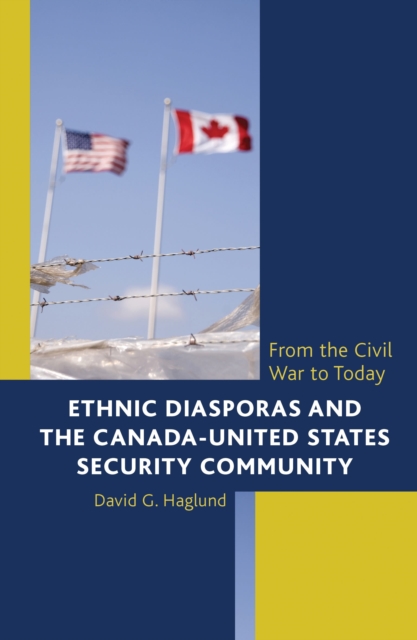
Ethnic diasporas and the canada-united states security community
Ethnic Diasporas and the Canada-U.S. Security Community focuses on three diasporas and their impact on North American security relations, the Irish and Germans, which were mainly in the U.S., and the Muslim diaspora, which is based in both countries.
eBook


Northern Ireland's Lost Opportunity
Northern Ireland's Lost Opportunity is a unique in-depth investigation into working-class Loyalism in Northern Ireland as represented by the Ulster Volunteer Force (UVF), the Red Hand Commando (RHC) and their political allies. In an unorthodox account, Tony Novosel argues that these groups, seen as implacable enemies by Republicans and the left, did develop a political analysis of the Northern Ireland conflict in the 1970s which involved a compromise peace with all political parties and warring factions – something that historians and writers have largely ignored. Distinctive, deeply informed and provocative, Northern Ireland's Lost Opportunity is the first study to focus not on the violent actions of the UVF/RHC but on their political vision and programme which, Novosel argues, included the potential for a viable peace based on compromise with all groups, including the Irish Republican Army.
eBook

Respectability and reform : Irish American women's activism, 1880-1920
\"This project offers a national study of the different agendas and strategies pursued by Irish American women in the Gilded Age and Progressive Era, focusing on their roles in diaspora nationalism, the labor movement, and the suffrage movement.\"--Provided by publisher.
Book

Candidate Gender and Voter Choice: Analysis from a Multimember Preferential Voting System
Women are greatly underrepresented in elected office. A large literature on the subject has considerably advanced our understanding of this phenomenon, but many questions remain unanswered. Using original aggregate and individual-level data, the authors explore the interplay of candidate gender, partisanship, incumbency, and campaign spending in a multimember preferential voting system. This setting allows unparalleled exploration of the heterogeneous nature of voter decision making. The authors find little evidence for an independent effect of candidate gender on voter choice. Voters do not discriminate against women even in an electoral environment that affords them this opportunity without any cost to their partisan preferences.
Journal Article


Going beyond The three worlds of welfare capitalism: regime theory and public health research
International research on the social determinants of health has increasingly started to integrate a welfare state regimes perspective. Although this is to be welcomed, to date there has been an over-reliance on Esping-Andersen’s The three worlds of welfare capitalism typology (1990). This is despite the fact that it has been subjected to extensive criticism and that there are in fact a number of competing welfare state typologies within the comparative social policy literature. The purpose of this paper is to provide public health researchers with an up-to-date overview of the welfare state regime literature so that it can be reflected more accurately in future research. It outlines The three worlds of welfare capitalism typology, and it presents the criticisms it received and an overview of alternative welfare state typologies. It concludes by suggesting new avenues of study in public health that could be explored by drawing upon this broader welfare state regimes literature.
Journal Article