
Catalogue Search | MBRL


Are you sure you want to remove the book from the shelf?

{{itemTitle}}
13
result(s) for
"Ironwork History."
Sort by:

History of the manufacture of iron in all ages : and particularly in the United States from colonial times to 1891
A data-rich history of the manufacture and use of iron, from the ancient Egyptian period to late 19th-century America.
Book

The Disappearing Technology and Products of Traditional Tibetan Village Blacksmiths
Tibetans have a long history of iron mining, smelting, and forging. For centuries, craftsmen in major cities and large iron production centers made high-quality swords and suits of armor, as well as decorative iron ritual objects for monasteries and the elites, but blacksmithing workshops in small villages have always produced and repaired everyday objects for agricultural and home use. Modern political changes, along with greater availability of industrial objects in local markets, have greatly reduced the rank of the village blacksmith. Ethnographic fieldwork reported here from two Tibetan Bön villages in the Aba Tibetan and Qiang Autonomous Prefecture, China (once part of traditional Amdo area of Tibet), highlights some of the threats to the continued existence of village blacksmiths. Both a part-time blacksmith in one village and a full-time blacksmith in another make only a marginal living from their work. Their descendants are unlikely to continue the business. Many of the village blacksmiths in the area have already stopped production and closed their workshops. It is likely that the village blacksmith tradition might soon disappear altogether in this region of the world without support. Preservation of this tradition could benefit both cultural and environmental sustainability goals.
Journal Article

Ранносредновековният железодобивен комплекс Брестница–Полето в Северозападна България: хронология и археометричен анализ (предварителни данни)
The research subject is the newly discovered Early Medieval metallurgical complex Brestnitsa–Poleto in northwestern Bulgaria. The preliminary results of the conducted excavations and laboratory analyses presented here focus on the discovered bloomery structures and related finds in order to clarify the chronology and architecture of the features, as well as the technological processes.The dating of the archaeological structures derives from field observations of the horizontal stratigraphy, the characteristics of the ceramic complex, the metal finds and from the radiocarbon samples. To clarify the technology, many ore pieces, slags and blooms have been analysed. Basic analytical techniques include XRD, XRF and optical microscopy.The results of the research prove that there was a hitherto unknown bloomery centre with a settlement in the Poleto locality, which is the first fully studied Early Medieval iron making complex in the Balkan Peninsula.
Journal Article

Restoring Identity to People and Place: Reanalysis of Human Skeletal Remains from a Cemetery at Catoctin Furnace, Maryland
Nearly four decades ago, a highway expansion project resulted in the excavation of 35 unmarked graves at Catoctin Furnace, an industrial ironworking village in western Maryland. Initial analysis identified the remains as Africans or African Americans associated with the late 18th- and early 19th-century operation of the ironworks. Renewed efforts to learn more about these poorly documented individuals and connect the site’s untold past to present generations through heritage tourism, prompted reanalysis of the skeletons. Updated assessments of demography and pathology, along with new analyses including heavy metals and carbon and nitrogen stable isotopes, elucidate the life histories of these early laborers and their involvement in furnace operations. Some data derived from recent testing differentiate the Catoctin Furnace individuals from their plantation-based contemporaries in the mid-Atlantic, suggesting regional differences in diet and possible occupational exposure to toxins.
Journal Article

Krupp
The history of Krupp is the history of modern Germany. No company symbolized the best and worst of that history more than the famous steel and arms maker. In this book, Harold James tells the story of the Krupp family and its industrial empire between the early nineteenth century and the present, and analyzes its transition from a family business to one owned by a nonprofit foundation.
Krupp founded a small steel mill in 1811, which established the basis for one of the largest and most important companies in the world by the end of the century. Famously loyal to its highly paid workers, it rejected an exclusive focus on profit, but the company also played a central role in the armament of Nazi Germany and the firm's head was convicted as a war criminal at Nuremberg. Yet after the war Krupp managed to rebuild itself and become a symbol of Germany once again--this time open, economically successful, and socially responsible.
Books on Krupp tend to either denounce it as a diabolical enterprise or celebrate its technical ingenuity. In contrast, James presents a balanced account, showing that the owners felt ambivalent about the company's military connection even while becoming more and more entangled in Germany's aggressive politics during the imperial era and the Third Reich.
By placing the story of Krupp and its owners in a wide context, James also provides new insights into the political, social, and economic history of modern Germany.
eBook

Seeing the Nation for the Trees: At the Frontier of Italian Nineteenth-Century Modernity
In this article we analyse the emergence and the transformation of three different socio-natural spaces in a particular historical context - that is, the establishment of a modern state. We explore this issue by researching the relationship between forests and modernisation from Unification
in 1861 to the 1890s. Over this period Italy experienced a radical change connected with the state-building process, and forests represented a material place where innovations in social and economic development were tested. Based on three case studies, this article explores how modernity was
articulated through urban parks, ironworks, and infrastructures. The three cases speak of both depletion and conservation; they exemplify the patterns through which, in the very making of modernity, Italian society articulated its relationship to nature in an attempt to overcome customary
rights and the traditional rural organisation of society. Forests were constructed as socio-ecological spaces reflecting Italy's contested and heterogeneous modernisation process through which political tensions, social conflicts and economic development theories were inscribed on transformed
landscapes.
Journal Article
Tales of the Iron Bloomery
In Tales of the Iron Bloomery Bernt Rundberget argues that the ironmaking of southern Hedmark was an important basis for political developments from chiefdom to Norwegian kingdom in the period AD 700-1300.
eBook
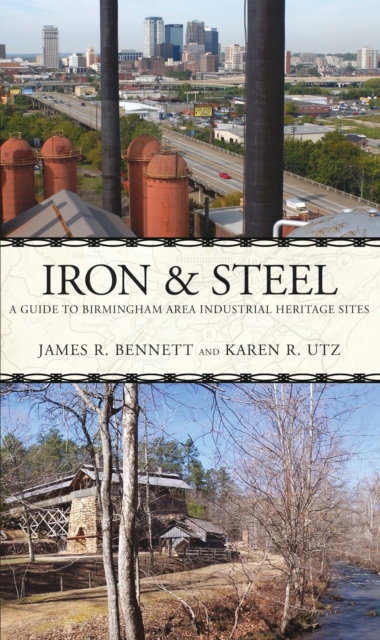
Iron and Steel
This guidebook of historic iron-production sites is designed to give the reader a factual and illuminating look at the people and events that shaped Birmingham into one of America's leading steel centers. Iron & Steel is heavily illustrated with both color and historical black-and-white photographs. It can be used while visiting parks or read as a coherent volume before or after a visit. The book contains chapters devoted to the larger preserved sites open to the public, such as Sloss Furnaces National Historic Landmark and Tannehill Ironworks Historical State Park. It also highlights lesser-known, yet still accessible, sites such as Blocton Coke Ovens Park. The work provides easy-to-follow maps for every site as well as driving directions to the more remote locations, giving visitors easy access to all the notable iron and steel sites in Jefferson, Shelby, Tuscaloosa, and Bibb counties. Each chapter also includes a variety of historical information, with accompanying photographs, in order to present the reader with a detailed and comprehensive account of the Birmingham Iron and Steel District. Featured sites include: Tannehill Ironworks Historical State Park; Shelby Ironworks Park; Billy Gould Coke Ovens Park; Brierfield Ironworks Historical State Park; Oxmoor Furnace Site; Irondale Furnace Park; Helena Rolling Mill Site; Red Mountain Park, Iron Ore Mines; Lewisburg Coke Ovens Park; Sloss Furnaces National Historic Landmark; Ruffner Mountain Nature Center; Blocton Coke Ovens Park; and Vulcan Park and Museum.
eBook

The Blacksmiths of Tamale: The Dynamics of Space and Time in a Ghanaian Industry
In the last twenty years the number of smiths and the range of their activity have greatly increased in Tamale, the principal city of northern Ghana. The evolution of the national economy and the particular situation of Tamale in the geography of Ghana explain this development and the contribution that the city's smiths make to the economy, national as well as local. Au cours des vingt dernières années, le nombre de forgerons et l'éventail de leurs activités ont considérablement augmenté à Tamale, principale ville du Nord du Ghana. L'évolution de l'économie nationale et la situation particulière de Tamale dans la géographie du Ghana expliquent ce développement et la contribution des forgerons de la ville à l'économie locale, mais aussi nationale.
Journal Article

Alabama Blast Furnaces
Go to resource on all the furnaces that made Alabama
internationally significant in the iron and steel
industry This work is the first and remains the only
source of information on all blast furnaces built and operated
in Alabama, from the first known charcoal furnace of 1815
(Cedar Creek Furnace in Franklin County) to the coke-fired
giants built before the onset of the Great Depression. Woodward
surveys the iron industry from the early, small local market
furnaces through the rise of the iron industry in support of
the Confederate war effort, to the giant internationally
important industry that developed in the 1890s. The bulk of the
book consists of individual illustrated histories of all blast
furnaces ever constructed and operated in the state, furnaces
that went into production and four that were built but never
went into blast. Written to provide a record of every blast
furnace built in Alabama from 1815 to 1940, this book was
widely acclaimed and today remains one of the most quoted
references on the iron and steel industry.
eBook