
Catalogue Search | MBRL


Are you sure you want to remove the book from the shelf?

{{itemTitle}}
299
result(s) for
"Irredentism"
Sort by:

A (Post-)Byzantine Prophecy Reworded
The paper examines a hitherto little-known Greek prophecy of the late sixteenth century, which may be called the Vaticinium de restitutione Constantinopoleos (VatResCon). The prophecy was penned in reaction to the fall of Cyprus (1571) and predicts the imminent recapture of Constantinople through an alliance with Western forces. The purpose of this article is twofold: first, I reconstruct the historical context in which this prophecy was composed by reviewing the factors that led to the unprecedented proliferation of Byzantine apocalyptic literature in the aftermath of the fall of Constantinople (1453). To illustrate this remarkable development, I present three notable apocalyptic texts composed shortly after 1453. Second, I discuss the dating and manuscript transmission of VatResCon and introduce a demotic paraphrase of the prophecy, which has come down in a single Meteōra manuscript. I provide a diplomatic edition and translation of the paraphrastic version, which can be dated to the early seventeenth century. The edition of the paraphrase serves as a corollary to the recently published editio princeps of VatResCon. An examination of the manuscript environment shows that VatResCon ordinarily comes down in oracular collections that place it in the context of prophetic messianism and apocalyptic irredentism. Moreover, I argue that the prophecy’s pro-Western orientation can explain its short-lived popularity, as the expectation to receive military assistance against the Turks gradually shifted towards Russia. In essence, VatResCon signifies the transition from Venetophile to Russophile prophecies while demonstrating that the Byzantine apocalyptic tradition was alive well over a century after the Eastern Roman polity had come to an end.
Journal Article

Nationalism and the Puzzle of Reversing State Size
Having increased for centuries, territorial state size began to decline toward the end of the nineteenth century and has continued to do so. The authors argue that processes triggered by ethnic nationalism are the main drivers of this development. Their empirical approach relies on time-varying spatial data on state borders and ethnic geography since the nineteenth century. Focusing on deviations from the nation-state ideal, the authors postulate that state internal ethnic fragmentation leads to reduction in state size and that the cross-border presence of dominant ethnic groups makes state expansion more likely. Conducted at the systemic and state levels, the analysis exploits information at the interstate dyadic level to capture specific nationalist processes of border change, such as ethnic secession, unification, and irredentism. The authors find that although nationalism exerts both integrating and disintegrating effects on states' territories, it is the latter impact that has dominated.
Journal Article

Redemption through Rebellion: Border Change, Lost Unity, and Nationalist Conflict
Are past border changes responsible for today's civil wars? Departing from conventional, state‐centric research designs, this article examines this question by focusing on “aggregate” ethnic groups, which are defined independently of state borders. Introducing a new index of “territorial fractionalization” that measures how fragmented such groups are across states, we postulate that higher fragmentation is linked to a greater risk of civil conflict. Furthermore, we expect that groups that experienced increases in fragmentation are particularly violence prone, as illustrated by postimperial revisionism and other cases of irredentism and secession. To test our arguments, we combine geocoded data on ethnic settlement areas with our own newly collected data on international borders since 1886, complemented by mediation analysis based on ethnonationalist claims. Covering ethnic groups around the world since 1946 through 2017, our findings are robust to the inclusion of control variables, fixed effects, and the use of alternative historical ethnicity data sets.
Journal Article
Inside Irredentism: A Global Empirical Analysis
Although many countries have ethnic kin on the \"wrong side\" of their borders, few seek to annex foreign territories on the basis of ethnicity. This article examines why some states pursue irredentism, whereas others exhibit restraint. It focuses on the triadic structure of the kin group in the irredentist state, its coethnic enclave, and the host state, and provides new data on all actual and potential irredentist cases from 1946 to 2014. The results indicate that irredentism is more likely when the kin group is near economic parity with other groups in its own state, which results in status inconsistency and engenders grievances. It is also more likely in more ethnically homogeneous countries with winner-take-all majoritarian systems where the kin group does not need to moderate its policy to win elections by attracting other groups. These conditions generate both the grievance and opportunity for kin groups to pursue irredentism.
Journal Article
A (Post-)Byzantine Prophecy Reworded
The paper examines a hitherto little-known Greek prophecy of the late sixteenth century, which may be called the Vaticinium de restitutione Constantinopoleos (VatResCon). The prophecy was penned in reaction to the fall of Cyprus (1571) and predicts the imminent recapture of Constantinople through an alliance with Western forces. The purpose of this article is twofold: first, I reconstruct the historical context in which this prophecy was composed by reviewing the factors that led to the unprecedented proliferation of Byzantine apocalyptic literature in the aftermath of the fall of Constantinople (1453). To illustrate this remarkable development, I present three notable apocalyptic texts composed shortly after 1453. Second, I discuss the dating and manuscript transmission of VatResCon and introduce a demotic paraphrase of the prophecy, which has come down in a single Meteōra manuscript. I provide a diplomatic edition and translation of the paraphrastic version, which can be dated to the early seventeenth century. The edition of the paraphrase serves as a corollary to the recently published editio princeps of VatResCon. An examination of the manuscript environment shows that VatResCon ordinarily comes down in oracular collections that place it in the context of prophetic messianism and apocalyptic irredentism. Moreover, I argue that the prophecy’s pro-Western orientation can explain its short-lived popularity, as the expectation to receive military assistance against the Turks gradually shifted towards Russia. In essence, VatResCon signifies the transition from Venetophile to Russophile prophecies while demonstrating that the Byzantine apocalyptic tradition was alive well over a century after the Eastern Roman polity had come to an end.
Journal Article
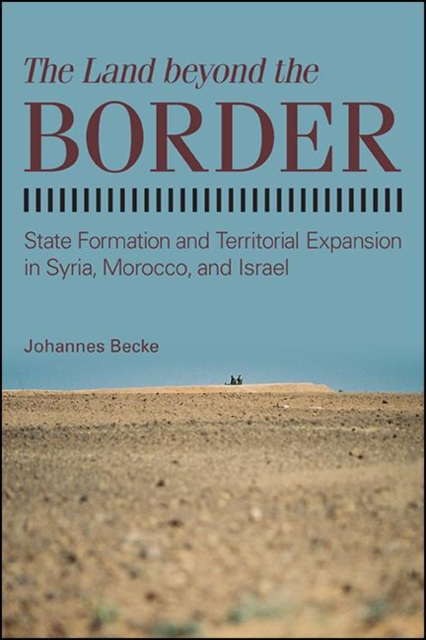
The Land Beyond the Border
Based on three case studies from the Middle East, The Land beyond the Border advances an innovative theoretical framework for the study of state expansions and state contractions. Johannes Becke argues that state expansion can be theorized according to four basic ideal types-a form of patronage (patronization), the imposition of a satellite regime (satellization), the establishment of territorial exclaves (exclavization), or a full-fledged takeover (incorporation). Becke discusses how both irredentist ideologies and political realities have shaped the dynamics of state expansion and state contraction in the recent history of each state. By studying Israel comparatively with other Middle Eastern regimes, this book forms part of an emerging research agenda seeking to bring the research fields of Israel Studies and Middle East Studies closer together. Instead of treating Israel's rule over the occupied territories as an isolated case, Becke offers students the chance to understand Israel's settlement project within the broader framework of postcolonial state formation.
eBook

Towards Unpacking the Origin and Development of Eswatini (Swazi) Irredentism
This article sets out to examine the origin and development of Eswatini irredentism in southern Africa as a neglected theme in African scholarship. Eswatini irredentist disputes, albeit unresolved, have been a subject of mere peripheral allusion in southern African scholarship. The global importance of irredentism as a phenomenon in international relations since the end of the Cold War makes this study imperative. How the smallest and landlocked state on the Southern African mainland can audaciously and persistently make territorial claims against its giant South African neighbour is intriguing, paradoxical and worth investigating. The study methodology involved the use of archival documentation, newspaper articles, government gazettes, indepth interviews and focus group discussions (FGD). This study revealed that Eswatini irredentism is ethnic nationalism par excellence and its roots were nurtured by the imperial order and South Africa before Eswatini’s independence. After independence in 1968, Eswatini irredentism blossomed on historical and ethnic foundations, and was tolerated and fanned by South Africa as a strategy of surreptitiously establishing an Eswatini Bantustan for the resettlement of ethnic Eswatini people and other blacks. The post-apartheid South African governments did a volte-face and rejected persistent Eswatini irredentist claims in toto nourished by the Sobhuza Testament.
Cet article vise à examiner l’origine et le développement de l’irrédentisme d’Eswatini en Afrique australe en tant que thème négligé dans la recherche africaine. Les différends irrédentistes de l’Eswatini, bien que non résolus, ont fait l’objet d’une simple allusion périphérique dans la recherche sudafricaine. L’importance mondiale de l’irrédentisme en tant que phénomène dans les relations internationales depuis la fin de la guerre froide rend cette étude impérative. Comment le plus petit État enclavé du continent d’Afrique australe peut audacieusement et constamment revendiquer des territoires contre son voisin géant sud-africain est intrigant, paradoxal et mérite d’être étudié. La méthodologie de l’étude comprenait l’utilisation de documents d’archives, d’articles de journaux, de gazettes gouvernementales, d’entrevues approfondies et de discussions de groupe. Cette étude a révélé que l’irrédentisme de l’Eswatini est un nationalisme ethnique par excellence et que ses racines ont été nourries par l’ordre impérial et l’Afrique du Sud avant l’indépendance de l’Eswatini. Après l’indépendance en 1968, l’irrédentisme de l’Eswatini s’est épanoui sur des bases historiques et ethniques, et a été toléré et attisé par l’Afrique du Sud comme une stratégie d’établissement subreptice d’un bantoustan d’Eswatini pour la réinstallation des Eswatiniens ethniques et d’autres Noirs. Les gouvernements sud-africains post-apartheid ont fait volte-face et rejeté les revendications irrédentistes persistantes de l’Eswatini dans leur ensemble nourries par le Testament de Sobhuza.
Journal Article

The Future Is History: Restorative Nationalism and Conflict in Post-Napoleonic Europe
As illustrated by Russia's invasion of Ukraine, the recent revival of nationalism has triggered a threatening return of revisionist conflict. While the literature on nationalism shows how nationalist narratives are socially constructed, much less is known about their real-world consequences. Taking nationalist narratives seriously, we study how past “golden ages” affect territorial claims and conflict in post-Napoleonic Europe. We expect nationalists to be more likely to mobilize and initiate conflict if they can contrast the status quo to a historical polity with supposedly greater national unity and/or independence. Using data on European state borders going back to 1100, combined with spatial data covering ethnic settlement areas during the past two centuries, we find that the availability of plausible golden ages increases the risk of both domestic and interstate conflict. These findings suggest that specific historical legacies make some modern nationalisms more consequential than others.
Journal Article

Irredentism and Institutions
Why do states engage in irredentism? Expanding on previous scholarship, this article advances a new theory with rationalist microfoundations that accounts for the incentives of both elites and citizens to support irredentism in democracies and dictatorships. Our model suggests irredentism is more likely when it enables political elites to provide a specific mix of private goods, public goods, and welfare transfers to citizens who desire them at the lowest tax rate. This leads to the prediction that irredentism is most likely in majoritarian democratic electoral systems and military dictatorships, and least likely in proportional electoral systems and single-party dictatorships. We test and find supportive evidence for these expectations using a comprehensive dataset covering all observed and potential irredentist cases from 1946 to 2014.
Journal Article
Violence Exposure and Ethnic Identification: Evidence from Kashmir
This article studies the conditions that lead peripheral minorities to identify with the state, their ethnic group, or neighboring countries. We contribute to research on separatism and irredentism by examining how violence, psychological distance, and national status determine identification. The analysis uses data from a novel experiment that randomized videos of actual violence in a large, representative survey of the Kashmir Valley region in the Indian state of Jammu and Kashmir, an enduring site of separatist and irredentist conflict. We find that a strong regional identity is a counterweight to irredentism, but violent repression by the state can push members of the minority to identify with an irredentist neighbor. Violence increases perceived distance from the nation and reduces national identification. There is suggestive evidence that these effects are concentrated among individuals with attributes that otherwise predict higher levels of identification with the state. Information about integrative institutions and increased national status brought about by economic growth is insufficient to induce national identification in a context where psychological distance from the nation is large.
Journal Article