
Catalogue Search | MBRL


Are you sure you want to remove the book from the shelf?

{{itemTitle}}
7
result(s) for
"Isidore, of Seville, Saint, d. 636"
Sort by:

Isidore of Seville and his Reception in the Early Middle Ages
Isidore of Seville (560–636) was a crucial figure in the preservation and sharing of classical and early Christian knowledge. His compilations of the works of earlier authorities formed an essential part of monastic education for centuries. Due to the vast amount[-]of information he gathered and its wide dissemination in the Middle Ages, Pope John Paul II even named Isidore the patron saint of the Internet in 1997. This volume represents a cross section of the various approaches scholars have taken toward Isidore’s writings. The essays explore his sources, how he selected and arranged them for posterity, and how his legacy was reflected in later generations’ work across the early medieval West. Rich in archival detail, this collection provides a wealth of interdisciplinary expertise on one of history’s greatest intellectuals.
eBook

The Politics of Identity in Visigothic Spain
This book reappraises the historical writings of the seventh-century Spanish bishop Isidore of Seville as a coherent and pastorally-informed programme intended to reconcile the population of Spain to their recent conquest by the barbarian Visigoths.
eBook

Finding the right words : Isidore's Synonyma in Anglo-Saxon England
Isidore of Seville (circa 570-636) was the author of the Etymologiae, . the most celebrated and widely circulated encyclopaedia of the western Middle Ages. In addition, Isidore's Synonyma were very successful and became one of the classics of medieval spirituality. Indeed, it was the Synonyma that were to define the so-called 'Isidorian style,' a rhymed, rhythmic prose that proved influential throughout the Middle Ages.
Finding the Right Words is the first book-length study to deal with the transmission and reception of works by Isidore of Seville in Anglo-Saxon England, with a particular focus on the Synonyma. Beginning with a general survey of Isidore's life and activity as a bishop in early seventh-century Visigothic Spain, Claudia Di Sciacca offers a comprehensive introduction to the Synonyma , drawing special attention to their distinctive style. She goes on to discuss the transmission of the text to early medieval England and its 'vernacularisation,' that is, its translations and adaptations in Old English prose and verse. The case for the particular receptiveness of the Synonyma in Anglo-Saxon England is strongly supported by both a close reading of primary sources and an extensive selection of secondary literature. This rigorous, well-documented volume demonstrates the significance of the Synonyma to our understanding of the literary pretensions and pedagogical practices of Anglo-Saxon England, and offers new insights into the interaction of Latin and vernacular within its literary culture.
eBook
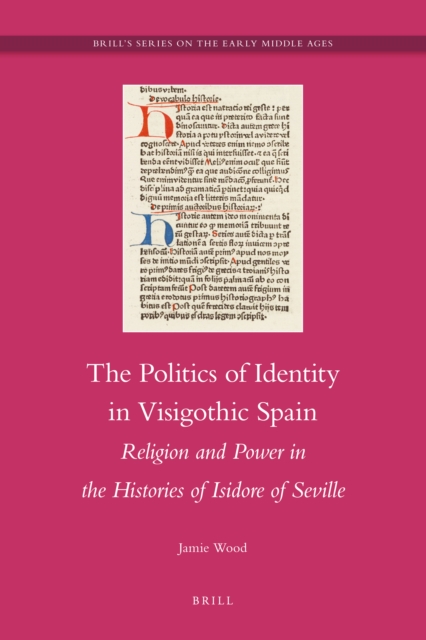
The politics of identity in Visigoth Spain: religion and power in the histories of Isidor of Seville
Previous scholarship has interpreted Bishop Isidore of Seville (d. 636) retrospectively as the architect of the medieval Spanish church, as the father of Spanish identity, and as a key figure in the transmission of Classical and Patristic learning to the Middle Ages. Drawing on recent studies on identity formation in the early medieval period and an upsurge in interest in late antique Spain, this book examines the historical Isidore as a social actor managing a complex web of responsibilities and relationships. A comparative analysis of Isidore's historical works demonstrates that writing about the past was a method for reconciling Visigothic kings, nobles and Spanish bishops in a period of transformation. This results in a fresh portrait of Isidore as motivated, both politically and pastorally, to balance competing interests and ensure the spiritual and material security of the people of Spain.
eBook

Finding the Right Words
Isidore of Seville (circa 570-636) was the author of theEtymologiae,. the most celebrated and widely circulated encyclopaedia of the western Middle Ages. In addition, Isidore'sSynonymawere very successful and became one of the classics of medieval spirituality. Indeed, it was theSynonymathat were to define the so-called 'Isidorian style,' a rhymed, rhythmic prose that proved influential throughout the Middle Ages.
Finding the Right Wordsis the first book-length study to deal with the transmission and reception of works by Isidore of Seville in Anglo-Saxon England, with a particular focus on theSynonyma.Beginning with a general survey of Isidore's life and activity as a bishop in early seventh-century Visigothic Spain, Claudia Di Sciacca offers a comprehensive introduction to theSynonyma, drawing special attention to their distinctive style. She goes on to discuss the transmission of the text to early medieval England and its 'vernacularisation,' that is, its translations and adaptations in Old English prose and verse. The case for the particular receptiveness of theSynonymain Anglo-Saxon England is strongly supported by both a close reading of primary sources and an extensive selection of secondary literature. This rigorous, well-documented volume demonstrates the significance of theSynonymato our understanding of the literary pretensions and pedagogical practices of Anglo-Saxon England, and offers new insights into the interaction of Latin and vernacular within its literary culture.
eBook