
Catalogue Search | MBRL


Are you sure you want to remove the book from the shelf?

{{itemTitle}}
26,228
result(s) for
"Islam History."
Sort by:

Non-Muslims in the Early Islamic Empire
The Muslim conquest of the East in the seventh century entailed the subjugation of Christians, Jews, Zoroastrians and others. Although much has been written about the status of non-Muslims in the Islamic empire, no previous works have examined how the rules applying to minorities were formulated. Milka Levy-Rubin's remarkable book traces the emergence of these regulations from the first surrender agreements in the immediate aftermath of conquest to the formation of the canonic document called the Pact of 'Umar, which was formalized under the early 'Abbasids, in the first half of the ninth century. The study reveals that the conquered peoples themselves played a major role in the creation of these policies and that they were based on long-standing traditions, customs and institutions from earlier pre-Islamic cultures that originated in the worlds of both the conquerors and the conquered. In its connections to Roman, Byzantine and Sasanian traditions, the book will appeal to historians of Europe as well as Arabia and Persia.
eBook

A Prophet Has Appeared
Early Islam has emerged as a lively site of historical
investigation, and scholars have challenged the traditional
accounts of Islamic origins by drawing attention to the wealth of
non-Islamic sources that describe the rise of Islam. A Prophet
Has Appeared brings this approach to the classroom. This
collection provides students and scholars with carefully selected,
introduced, and annotated materials from non-Islamic sources dating
to the early years of Islam. These can be read alone or alongside
the Qur'an and later Islamic materials. Applying
historical-critical analysis, the volume moves these invaluable
sources to more equal footing with later Islamic narratives about
Muhammad and the formation of his new religious movement.
Included are new English translations of sources by twenty
authors, originally written in not only Greek and Latin but also
Syriac, Georgian, Armenian, Hebrew, and Arabic and spanning a
geographic range from England to Egypt and Iran. Ideal for the
classroom and personal library, this sourcebook provides readers
with the tools to meaningfully approach a new, burgeoning area of
Islamic studies.
eBook
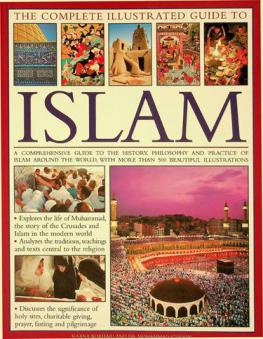
The complete illustrated guide to Islam : a comprehensive guide to the history, philosophy and practice of Islam around the world, with more than 500 beautiful illustrations
Features the traditions, teachings and texts central to the religion and discusses the significance of holy sites, prayer and pilgrimage.
Book

Imagining the Arabs
Investigating the core questions about Arab identity and history, this book tackles the time-honoured stereotypes that depict Arabs as ancient Arabian Bedouin, and reveals the stories to be a myth: tales told by Muslims to recreate the past to explain the meaning of Islam and its origins.
eBook

Islamisation
The spread of Islam and the process of Islamisation (meaning both conversion to Islam and the adoption of Muslim culture) is explored in the twenty-four chapters of this volume. Taking a comparative perspective, both the historical trajectory of Islamisation and the methodological problems in its study are addressed, with coverage moving from Africa to China and from the seventh century to the start of the colonial period in 1800. Key questions are addressed. What is meant by Islamisation? How far was the spread of Islam as a religion bound up with the spread of Muslim culture? To what extent are Islamisation and conversion parallel processes? How is Islamisation connected to Arabisation? What role do vernacular Muslim languages play in the promotion of Muslim culture? The broad, comparative perspective allows readers to develop a thorough understanding of the process of Islamisation over eleven centuries of its history.
eBook


Turkey, Islam, nationalism, and modernity : a history, 1789-2007
This title reveals the historical dynamics propelling two centuries of Ottoman and Turkish history. Findley's reassessment of political, economic and cultural history highlights the dialectical interaction between radical and conservative currents of change.
eBook