
Catalogue Search | MBRL


Are you sure you want to remove the book from the shelf?

{{itemTitle}}
113
result(s) for
"Islam Mediterranean Region History."
Sort by:


Sharing Sacred Spaces in the Mediterranean
While devotional practices are usually viewed as mechanisms for reinforcing religious boundaries, in the multicultural, multiconfessional world of the Eastern Mediterranean, shared shrines sustain intercommunal and interreligious contact among groups. Heterodox, marginal, and largely ignored by central authorities, these practices persist despite aggressive, homogenizing nationalist movements. This volume challenges much of the received wisdom concerning the three major monotheistic religions and the \"clash of civilizations.\" Contributors examine intertwined religious traditions along the shores of the Near East from North Africa to the Balkans.
eBook
Insatiable appetite : food as cultural signifier in the Middle East and beyond
\"Insatiable Appetite: Food as Cultural Signifier in the Middle East and Beyond explores the cultural ramifications of food and foodways in the Mediterranean, and Arab-Muslim countries in particular. The volume addresses the cultural meanings of food from a wider chronological scope, from antiquity to present, adopting approaches from various disciplines, including classical Greek philology, Arabic literature, Islamic studies, anthropology, and history. The contributions to the book are structured around six thematic parts, ranging in focus from social status to religious prohibitions, gender issues, intoxicants, vegetarianism, and management of scarcity\"-- Provided by publisher.
BOOK
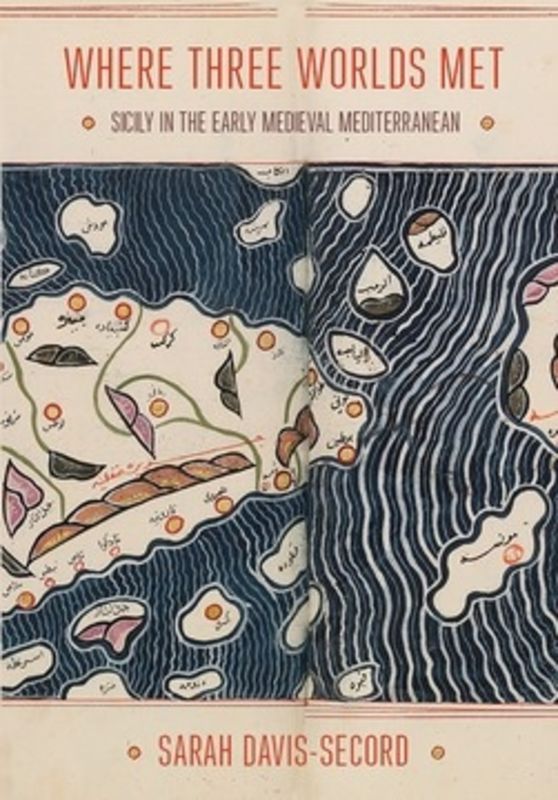
Where Three Worlds Met
In Where Three Worlds Met, Sarah Davis-Secord investigates Sicily's place within the religious, diplomatic, military, commercial, and intellectual networks of the Mediterranean by tracing the patterns of travel, trade, and communication among Christians (Latin and Greek), Muslims, and Jews. By looking at the island across this long expanse of time and during the periods of transition from one dominant culture to another, Davis-Secord uncovers the patterns that defined and redefined the broader Muslim-Christian encounter in the Middle Ages.
eBook


Arab Society in Revolt: The West's Mediterranean Challenge
For every pithy conceptualization of complex events, there are additional lenses through which to examine them. One of the several virtues of this book is precisely that it brings different perspectives to bear on the complexity, diversity, and uncertainty of recent and current events in the Arab world. The thirteen authors concentrate on the critical social forces shaping the region -demography, religion, gender, telecommunication connectivity, and economic structures -and they are painstakingly analyzed and evaluated. -from the foreword by Strobe Talbott, president of the Brookings Institution
The Arab Spring will be remembered as a period of great change for the Arab states of North Africa and the eastern Mediterranean. Facing fundamental transitions in governance, these countries are also undergoing profound social, cultural, and religious changes. The European Union and the United States, caught unprepared by the uprisings, now must address the inescapable challenges of those changes. How will the West respond to these new realities, particularly in light of international economic uncertainty, EU ambivalence toward a \"cohesive foreign policy,\" and declining U.S. influence abroad?Arab Society in Revoltexplains and interprets the societal transformations occurring in the Arab Muslim world, their ramifications for the West, and possible policy options for dealing with this new world.
Arab Society in Revoltexamines areas of change particularly relevant in the southern Mediterranean: demography and migration, Islamic revival and democracy, rapidly changing roles of women in Arab society, the Internet in Arab societies, commercial and social entrepreneurship as change factors, and the economics of Arab transitions. The book then looks at those cultural and religious as well as political and economic factors that have influenced the Western response, or lack of it, to the Arab Spring as well as the policy options that remain open.
eBook

The race for paradise : an Islamic history of the crusades
\"In The Race for Paradise, Paul M. Cobb offers an accurate and accessible representation of the Islamic experience of the Crusades during the Middle Ages. Cobb overturns previous claims and presents new arguments, such as the idea that the Frankish invasions of the Near East were something of a side-show to the broader internal conflict between Sunnis and Shi'ites in the region. The Race for Paradise moves along two fronts as Cobb stresses that, for medieval Muslims, the contemporaneous Latin Christian expansion throughout the Mediterranean was seen as closely linked to events in the Levant. As a consequence of this expanded geographical range, the book takes a broader chronological range to encompass the campaigns of Spanish kings north of the Ebro and the Norman conquest of Sicily (beginning in 1060), well before Pope Urban II's famous call to the First Crusade in 1095. Finally, The Race for Paradise brilliantly combats the trend to portray the history of the Crusades, particularly the Islamic experience, in simplistic or binary terms. Muslims did not solely experience the Crusades as fanatical warriors or as helpless victims, Cobb writes; as with any other human experience of similar magnitude, the Crusades were experienced in a great variety of ways, ranging from heroic martyrdom, to collaboration, to utter indifference\"-- Provided by publisher.
Book

Early Islamic North Africa : a new perspective
This volume proposes a new approach to the Arab conquests and the spread of Islam in North Africa.In recent years, those studying the Islamic world have shown that the coming of Islam was not marked by devastation or decline, but rather by considerable cultural and economic continuity.In North Africa, with continuity came significant change.
eBook

Mudâejar art : Islamic aesthetics in Christian art
\"Mudâejar art : Islamic aesthetics in Christian art reveals the fascinating exuberance of a unique cultural and artistic symbiosis that characterizes Christian Spain after the Reconquista. The Mudâejars were Muslims allowed to stay in the reconquered territories. Their artists and artisans strongly influenced the culture and art of the new Christian kindoms. In Aragon, Castille, Extremadura and Andalucâia sumptuously decorated brick churches, monasteries and palaces illustrate the creative endurance of Islamic forms in Christian art between the 11th and 16th centures in Spain. Thirteen itineraries invite you to discover 124 musuems, monuments and sites in Madrid, Guadalajara, Saragossa, Tordesillas, Toledo, Guadalupe and Seville (among others)-- Provided by publisher.
Book

Synagogues in the Islamic World
This beautifully illustrated volume looks at the spaces created by and for Jews in areas under the political or religious control of Muslims in regions such as Central Asia, the Middle East, North Africa and Spain.
eBook