
Catalogue Search | MBRL


Are you sure you want to remove the book from the shelf?

{{itemTitle}}
83
result(s) for
"Islam and politics Middle East History 20th century"
Sort by:

The future of the Middle East : faith, force, and finance
This deeply informed book considers the intertwined roles of faith, force, and finance in shaping the modern Middle East. Leading expert Monte Palmer argues that these factors will continue to have a major impact on the Middle East as the United States and other major powers increasingly find themselves embedded in conflicts that defy resolution. Palmer considers the lessons learned from past and current conflicts: the limits of using tyrants as avenues of force; the transformation of faith into force; the root causes of terror; and the perils of a global environment that threatens a new cold war between Russia and the United States, a war of religions between the Abrahamic faiths, and a war of terror that is rapidly becoming global. As he clearly shows, the relative dominance of faith, force, or finance is always shifting, depending on time, place, and local conditions. Drawing on cases from ten critical periods, beginning with World War I through the current chaos and stalemate, the author offers constructive paths forward for building a Middle East of peace and stability.
Book
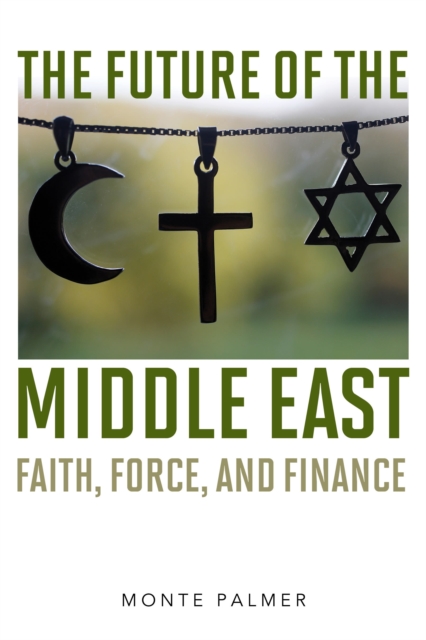
The Future of the Middle East
This deeply informed book considers the intertwined roles of faith, force, and finance in shaping the modern Middle East. Leading expert Monte Palmer argues that these factors will continue to have a major impact on the Middle East as the United States and other major powers increasingly find themselves embedded in conflicts that defy resolution. Palmer considers the lessons learned from past and current conflicts: the limits of using tyrants as avenues of force; the transformation of faith into force; the root causes of terror; and the perils of a global environment that threatens a new cold war between Russia and the United States, a war of religions between the Abrahamic faiths, and a war of terror that is rapidly becoming global. As he clearly shows, the relative dominance of faith, force, or finance is always shifting, depending on time, place, and local conditions. Drawing on cases from ten critical periods, from World War I through the current chaos and stalemate, the author offers constructive paths forward for building a Middle East of peace and stability.
eBook
The Shia revival : how conflicts within Islam will shape the future
Considers the ways in which struggles between the Shia and Sunni in the Middle East will affect the region's future, offering insight into the power conflicts between Iran and Saudi Arabia for political and spiritual leadership of the Muslim world.
Book
War without End
This book provides the historical and political context to explain acts of terror, including the September 11th, and the bombing of American Embassies in Nairobi and Dar as Salaam and the West's responses. Providing a brief history of Islam as a religion and as socio-political ideology, Dilip Hiro goes on to outline the Islamist movements that have thrived in Egypt, Saudi Arabia and Afghanistan, and their changing relationship with America. It is within this framework that the rising menace of Osama bin Laden and his Al Qaida network is discussed.The Pentagon's amazingly swift victory over the Taliban in Afghanistan is examined along with implications of the Bush Doctrine, encapsulated in his declaration, 'so long as anybody is terrorizing established governments, there needs to be a war' - a recipe for war without end.
eBook

The Formation of Turkish Republicanism
\"Turkish republicanism is commonly thought to have originated with Mustafa Kemal Atatürk and the founding of modern Turkey in 1923, and understood exclusively in terms of Kemalist ideals, characterized by the principles of secularism, nationalism, statism, and populism. Banu Turnaoglu challenges this view, showing how Turkish republicanism represents the outcome of centuries of intellectual dispute in Turkey over Islamic and liberal conceptions of republicanism, culminating in the victory of Kemalism in the republic's formative period. Drawing on a wealth of rare archival material, Turnaoglu presents the first complete history of republican thinking in Turkey from the birth of the Ottoman state to the founding of the modern republic. She shows how the Kemalists wrote Turkish history from their own perspective, presenting their own version of republicanism as inevitable while disregarding the contributions of competing visions. Turnaoglu demonstrates how republicanism has roots outside the Western political experience, broadening our understanding of intellectual history. She reveals how the current crises in Turkish politics--including the Kurdish Question, democratic instability, the rise of radical Islam, and right-wing Turkish nationalism--arise from intellectual tensions left unresolved by Kemalist ideology. A breathtaking work of scholarship, The Formation of Turkish Republicanism offers a strikingly new narrative of the evolution and shaping of modern Turkey\"-- Provided by publisher.
BOOK

Contesting Indonesia
Contesting Indonesia explains
Islamist, separatist and communal violence across Indonesian
history since 1945. In a sweeping argument that connects
endemic violence to a national narrative, Kirsten E. Schulze finds
that the outbreak of violence is related to competing local notions
of the national imaginary as well as contentious belonging.
Through detailed examination of six case studies: the Darul
Islam rebellions, Jemaah Islamiyah's jihad, and the conflicts in
East Timor, Aceh, Poso, and Ambon, Schulze argues that violence was
more likely to occur in places that are on the geographic,
ideological, ethnic, and religious periphery of the Indonesian
state; that violence by non-state actors was most protracted in
locations where there was a well-established alternative national
imaginary supported by an alternative historical narrative; and
that violence by the state was most likely in places where the
state had a significant territorial interest.
Drawing on a vast collection of interviews and archival and
published sources, Contesting Indonesia provides a new
understanding of the history of violence across the Indonesian
archipelago.
eBook
The Middle East in International Relations
The international relations of the Middle East have long been dominated by uncertainty and conflict. External intervention, interstate war, political upheaval and interethnic violence are compounded by the vagaries of oil prices and the claims of military, nationalist and religious movements. The purpose of this book is to set this region and its conflicts in context, providing on the one hand a historical introduction to its character and problems, and on the other a reasoned analysis of its politics. In an engagement with both the study of the Middle East and the theoretical analysis of international relations, the author, who is one of the best known and most authoritative scholars writing on the region today, offers a compelling and original interpretation. Written in a clear, accessible and interactive style, the book is designed for students, policymakers, and the general reader.
eBook

A Slow Reckoning
A Slow Reckoning examines the
Soviet Union's and the Afghan communists' views of and policies
toward Islam and Islamism during the Soviet-Afghan War
(1979-1989). As Vassily Klimentov demonstrates, the Soviet
and communist Afghan disregard for Islam was telling of the overall
communist approach to reforming Afghanistan and helps explain the
failure of their modernization project.
A Slow Reckoning reveals how during most of the
conflict Babrak Karmal, the ruler installed by the Soviets,
instrumentalized Islam in support of his rule while retaining a
Marxist-Leninist platform. Similarly, the Soviets at all levels
failed to give Islam its due importance as communist ideology and
military considerations dominated their decision making. This
approach to Islam only changed after Mikhail Gorbachev replaced
Karmal by Mohammad Najibullah and prepared to withdraw Soviet
forces. Discarding Marxism-Leninism for Islam proved the correct
approach, but it came too late to salvage the Soviet
nation-building project.
A Slow Reckoning also shows how Soviet leaders only
started seriously paying attention to an Islamist threat from
Afghanistan to Central Asia after 1986. While the Soviets had
concerns related to Islamism in 1979, only the KGB believed the
threat to be potent. The Soviet elites never fully conceptualized
Islamism, continuing to see it as an ideology the United States,
Iran, or Pakistan could instrumentalize at will. They believed the
Islamists had little agency and that their retrograde ideology
could not find massive appeal among progressive Soviet Muslims. In
this, they were only partly right.
eBook

How happy to call oneself a Turk : provincial newspapers and the negotiation of a Muslim national identity
The modern nation-state of Turkey was established in 1923, but when and how did its citizens begin to identify themselves as Turks? Mustafa Kemal Atatrk, Turkeys founding president, is almost universally credited with creating a Turkish national identity through his revolutionary program to secularize the former heartland of the Ottoman Empire. Yet, despite Turkeys status as the lone secular state in the Muslim Middle East, religion remains a powerful force in Turkish society, and the country today is governed by a democratically elected political party with a distinctly religious (Islamist) orientation. In this history, Gavin D. Brockett takes a fresh look at the formation of Turkish national identity, focusing on the relationship between Islam and nationalism and the process through which a religious national identity emerged. Challenging the orthodoxy that Atatrk and the political elite imposed a sense of national identity from the top down, Brockett examines the social and political debates in provincial newspapers from around the country. He shows that the unprecedented expansion of print media in Turkey between 1945 and 1954, which followed the end of strict, single-party authoritarian government, created a forum in which ordinary people could inject popular religious identities into the new Turkish nationalism. Brockett makes a convincing case that it was this fruitful negotiation between secular nationalism and Islamrather than the imposition of secularism alonethat created the modern Turkish national identity.
eBook

Imagining the Middle East
As its interests have become deeply tied to the Middle East, the
United States has long sought to develop a usable understanding of
the people, politics, and cultures of the region. In Imagining
the Middle East , Matthew Jacobs illuminates how Americans'
ideas and perspectives about the region have shaped, justified, and
sustained U.S. cultural, economic, military, and political
involvement there. Jacobs examines the ways in which an informal
network of academic, business, government, and media specialists
interpreted and shared their perceptions of the Middle East from
the end of World War I through the late 1960s. During that period,
Jacobs argues, members of this network imagined the Middle East as
a region defined by certain common characteristics--religion, mass
politics, underdevelopment, and an escalating
Arab-Israeli-Palestinian conflict--and as a place that might be
transformed through U.S. involvement. Thus, the ways in which
specialists and policymakers imagined the Middle East of the past
or present came to justify policies designed to create an imagined
Middle East of the future. Jacobs demonstrates that an analysis of
the intellectual roots of current politics and foreign policy is
critical to comprehending the styles of U.S. engagement with the
Middle East in a post-9/11 world.
eBook