
Catalogue Search | MBRL


Are you sure you want to remove the book from the shelf?

{{itemTitle}}
27
result(s) for
"Islam and politics Turkey History 20th century."
Sort by:


Turkey, Islam, nationalism, and modernity : a history, 1789-2007
This title reveals the historical dynamics propelling two centuries of Ottoman and Turkish history. Findley's reassessment of political, economic and cultural history highlights the dialectical interaction between radical and conservative currents of change.
eBook


How happy to call oneself a Turk : provincial newspapers and the negotiation of a Muslim national identity
The modern nation-state of Turkey was established in 1923, but when and how did its citizens begin to identify themselves as Turks? Mustafa Kemal Atatrk, Turkeys founding president, is almost universally credited with creating a Turkish national identity through his revolutionary program to secularize the former heartland of the Ottoman Empire. Yet, despite Turkeys status as the lone secular state in the Muslim Middle East, religion remains a powerful force in Turkish society, and the country today is governed by a democratically elected political party with a distinctly religious (Islamist) orientation. In this history, Gavin D. Brockett takes a fresh look at the formation of Turkish national identity, focusing on the relationship between Islam and nationalism and the process through which a religious national identity emerged. Challenging the orthodoxy that Atatrk and the political elite imposed a sense of national identity from the top down, Brockett examines the social and political debates in provincial newspapers from around the country. He shows that the unprecedented expansion of print media in Turkey between 1945 and 1954, which followed the end of strict, single-party authoritarian government, created a forum in which ordinary people could inject popular religious identities into the new Turkish nationalism. Brockett makes a convincing case that it was this fruitful negotiation between secular nationalism and Islamrather than the imposition of secularism alonethat created the modern Turkish national identity.
eBook

The Formation of Turkish Republicanism
\"Turkish republicanism is commonly thought to have originated with Mustafa Kemal Atatürk and the founding of modern Turkey in 1923, and understood exclusively in terms of Kemalist ideals, characterized by the principles of secularism, nationalism, statism, and populism. Banu Turnaoglu challenges this view, showing how Turkish republicanism represents the outcome of centuries of intellectual dispute in Turkey over Islamic and liberal conceptions of republicanism, culminating in the victory of Kemalism in the republic's formative period. Drawing on a wealth of rare archival material, Turnaoglu presents the first complete history of republican thinking in Turkey from the birth of the Ottoman state to the founding of the modern republic. She shows how the Kemalists wrote Turkish history from their own perspective, presenting their own version of republicanism as inevitable while disregarding the contributions of competing visions. Turnaoglu demonstrates how republicanism has roots outside the Western political experience, broadening our understanding of intellectual history. She reveals how the current crises in Turkish politics--including the Kurdish Question, democratic instability, the rise of radical Islam, and right-wing Turkish nationalism--arise from intellectual tensions left unresolved by Kemalist ideology. A breathtaking work of scholarship, The Formation of Turkish Republicanism offers a strikingly new narrative of the evolution and shaping of modern Turkey\"-- Provided by publisher.
BOOK

Turkey in Africa
This book offers a comprehensive and multidisciplinary analysis of Turkey-Africa relations.
Bringing together renowned authors to discuss various dimensions of Turkey's African engagement while casting a critical analysis on the sustainability of Turkey-Africa relations, this book draws upon the rising power literature to examine how Turkish foreign policy has been conceptualized and situated theoretically. Moving from an examination of the economic and military dimensions of Turkey's policy including trade relations, business practices, security cooperation and peacekeeping discourse, it then illuminates the multilateral dimension of Turkey's Africa policy with a focus on soft power instruments of public diplomacy, humanitarian/development assistance, religious activities and airline diplomacy. Overall, it shows how Turkey's African opening can be integrated into its wider interest in gaining global power status and its desire to become a strong regional power.
This book will be of key interest to scholars and students of Turkish foreign policy/politics, African politics, and more broadly to international relations.
eBook

Religion, Politics and Gender Equality in Turkey: implications of a democratic paradox?
This article examines the gendered implications of the intertwining of Islam and politics that took shape after the process of democratisation in Turkey had brought a political party with an Islamist background to power. This development revived the spectre of restrictive sex roles for women. The country is thus confronted with a democratic paradox: the expansion of religious freedoms accompanying potential and/or real threats to gender equality. The ban on the Islamic headscarf in universities has been the most visible terrain of public controversy on Islam. However, the paper argues that a more threatening development is the propagation of patriarchal religious values, sanctioning secondary roles for women through the public bureaucracy as well as through the educational system and civil society organisations.
Journal Article

Borders of Belief: Religious Nationalism and the Formation of Identity in Ireland and Turkey
Religion and nationalism are two of the most powerful forces in the world. And as powerful as they are separately, humans throughout history have fused religious beliefs and nationalist politics to develop religious nationalism, which uses religious identity to define membership in the national community. But why and how have modern nationalists built religious identity as the foundational signifier of national identity in what sociologists have predicted would be a more secular world? This book takes two cases - nationalism in both Ireland and Turkey in the 20th century - as a foundation to advance a new theory of religious nationalism. By comparing cases, Goalwin emphasizes how modern political actors deploy religious identity as a boundary that differentiates national groups This theory argues that religious nationalism is not a knee-jerk reaction to secular modernization, but a powerful movement developed as a tool that forges new and independent national identities.
eBook
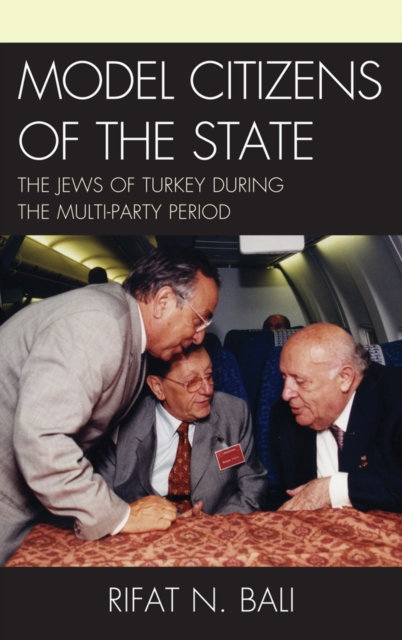
Model citizens of the state
Model Citizens of the State: The Jews of Turkey during the Multi-Party Period is about the history of the Turkish Jews from 1950 to present. By using unpublished primary sources as well as secondary sources, the book describes the struggle of Turkish Jews for the application of their constitutional rights, their fight against anti-Semitism and the indifferent attitude of the Turkish establishment to these problems. Finally, it describes Turkish Jewish leadership’s involvement in the lobbying efforts on behalf of the Turkish Republic against the acceptance of resolutions in the U.S. Congress recognizing the Armenian Genocide.
eBook