
Catalogue Search | MBRL


Are you sure you want to remove the book from the shelf?

{{itemTitle}}
7,448
result(s) for
"Islam and secularism"
Sort by:


Political Islam, Iran, and the Enlightenment
Ali Mirsepassi's book presents a powerful challenge to the dominant media and scholarly construction of radical Islamist politics, and their anti-Western ideology, as a purely Islamic phenomenon derived from insular, traditional and monolithic religious 'foundations'. It argues that the discourse of political Islam has strong connections to important and disturbing currents in Western philosophy and modern Western intellectual trends. The work demonstrates this by establishing links between important contemporary Iranian intellectuals and the central influence of Martin Heidegger's philosophy. We are also introduced to new democratic narratives of modernity linked to diverse intellectual trends in the West and in non-Western societies, notably in India, where the ideas of John Dewey have influenced important democratic social movements. As the first book to make such connections, it promises to be an important contribution to the field and will do much to overturn some pervasive assumptions about the dichotomy between East and West.
eBook

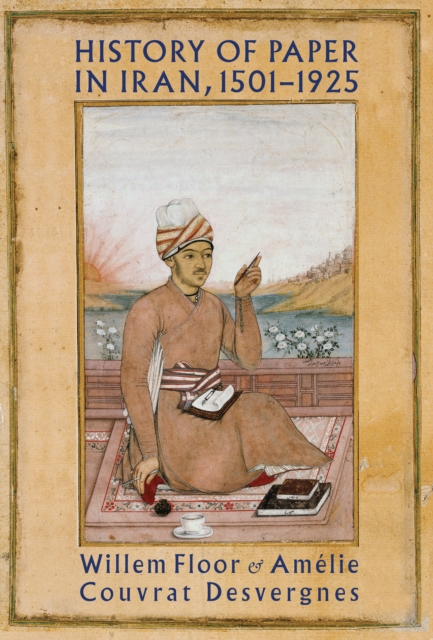
History of Paper in Iran, 1501–1925
The Chinese invented papermaking, which by the 8th century had reached the Muslim world in Samarkand and Baghdad, and Spain by the 11th century. Much later at the end of the 18th century onwards, modern, industrial papermaking was developed by the Europeans. The History of Paper in Iran, 1501 to 1925 sets out for the reader the types of paper made in Iran during the Safavid and Qajar periods and the crucial role imported paper played in the country. The Iranian government attempted to introduce modern European paper production technology, first by sending students abroad to learn about this technology and then by purchasing equipment to set up a paper industry. However, during the 19th century, domestic Iranian paper production came under increasing pressure from paper imports, and the government abandoned its efforts to modernize the domestic paper industry. The authors, renowned scholar Willem Floor in collaboration with Amélie Couvrat Desvergnes a museum conservator of artworks on paper and books, identify and illustrate the watermarks and/or countermarks of the various paper producers and provide examples of the diversity of quality, composition, and nature of the different types of paper used by various strata of the Iranian society. Also provided are detailed import data, showing which country exported paper to Iran, via which routes, as well as their changing market position over time. Finally, the various end uses of paper, from books and farmans to paintings, and diverse packing and utilitarian paper are examined and, where possible, quantified data are presented. This book will reward scholars and general readers alike.
eBook


Democracy in Modern Iran
Can Islamic societies embrace democracy? In Democracy in Modern Iran, Ali Mirsepassi maintains that it is possible, demonstrating that Islam is not inherently hostile to the idea of democracy. Rather, he provides new perspective on how such a political and social transformation could take place, arguing that the key to understanding the integration of Islam and democracy lies in concrete social institutions rather than pre-conceived ideas, the every day experiences rather than abstract theories. Mirsepassi, an Iranian native, provides a rare inside look into the country, offering a deep understanding of how Islamic countries like Iran and Iraq can and will embrace democracy.Democracy in Modern Iran challenges readers to think about Islam and democracy critically and in a far more nuanced way than is done in black-and-white dichotomies of Islam vs. Democracy, or Iran vs. the West. This essential volume contributes important insights to current discussions, creating a more complex conception of modernity in the Eastern world and, with it, Mirsepassi offers to a broad Western audience a more accurate, less cliched vision of Iran's political reality.
eBook


The Alevis in Turkey
This is the only volume dedicated to the Alevis available in English and based on sustained fieldwork in Turkey. The Alevis now have an increasingly high profile for those interested in the diverse cultures of contemporary Turkey, and in the role of Islam in the modern world. As a heterodox Islamic group, the Alevis have no established doctrine. This book reveals that as the Alevi move from rural to urban sites, they grow increasingly secular, and their religious life becomes more a guiding moral culture than a religious message to be followed literally. But the study shows that there is nothing inherently secular-proof within Islam, and that belief depends upon a range of contexts.
Introduction 1. Setting the Scene: Religion and Social Change in Modern Turkey 2. The Alevis and their Place in the Republic: An Overview 3. An Alevi Community 4. Religion, Ritual and Belief among Alevis 5. Social Change and the Alevi Communities 6. The Alevi, the State, and the Future 7. Theoretical and Comparative Reflections Appendices: Primary Material on the Alevis
David Shankland lectures in the Dept of Social Anthropology at the Univeristy of Wales, Lampeter, and was formerly Assistant and Acting Director of the British Institute of Archaeology at Ankara, Turkey. For many years a specialist on Turkey, he has published widely on the subject.
eBook

Secularism and state religion in modern Turkey : law, policy-making and the Diyanet
The Diyanet is the 'Presidency of Religious Affairs', the official face of Islam and highest religious authority in Turkey, and is a governmental department established in 1924 after the break-up of the Ottoman Empire. In this book, Emir Kaya offers an in-depth multidisciplinary analysis of this vital institution. Focusing on the role of the Diyanet in society, Kaya explores the balance the institution has to strike between the Islamic traditions of the Turkish population and the officially secular creed of the Turkish state. By examining the various laws that either bolstered or hindered the Diyanet's budgets and activities, Kaya highlights the institutional mindsets of the Diyanet membership as well as evaluating its successes and failures as a governmental department that has to consistently operate within the context of the religiosity of Turkish society. By situating all of this within the context of the two competing but often complimentary concepts of religion and secularism, Kaya offers a book that is important for those researching the role of religion and the state in society in the Middle East and beyond.
Book
Europe's Encounter with Islam
In the last few years, the Muslim presence in Europe has been increasingly perceived as 'problematic'. Events such as the French ban on headscarves in public schools, the publication of the so-called 'Danish cartoons', and the speech of Pope Benedict XVI at the University of Regensburg have hit the front pages of newspapers the world over, and prompted a number of scholarly debates on Muslims' capacity to comply with the seemingly neutral and pluralistic rules of European secularity.
Luca Mavelli argues that this perspective has prevented an in-depth reflection on the limits of Europe's secular tradition and its role in Europe's conflictual encounter with Islam. Through an original reading of Michel Foucault's spiritual notion of knowledge and an engagement with key thinkers, from Thomas Aquinas to Jurgën Habermas, Mavelli articulates a contending genealogy of European secularity. While not denying the latter's achievements in terms of pluralism and autonomy, he suggests that Europe's secular tradition has also contributed to forms of isolation, which translate into Europe's incapacity to perceive its encounter with Islam as an opportunity rather than a threat.
Drawing on this theoretical perspective, Mavelli offers a contending account of some of the most important recent controversies surrounding Islam in Europe and investigates the 'postsecular' as a normative model to engage with the tensions at the heart of European secularity. Finally, he advances the possibility of a Europe willing to reconsider its established secular narratives which may identify in the encounter with Islam an opportunity to flourish and cultivate its democratic qualities and postnational commitments.
This work will be of great interest to students and scholars of religion and international relations, social and political theory, and Islam in Europe.
eBook