
Catalogue Search | MBRL


Are you sure you want to remove the book from the shelf?

{{itemTitle}}
1,554
result(s) for
"Islam-History"
Sort by:

Imagining the Arabs
Investigating the core questions about Arab identity and history, this book tackles the time-honoured stereotypes that depict Arabs as ancient Arabian Bedouin, and reveals the stories to be a myth: tales told by Muslims to recreate the past to explain the meaning of Islam and its origins.
eBook

The Death of a Prophet
The oldest Islamic biography of Muhammad, written in the mid-eighth century, relates that the prophet died at Medina in 632, while earlier and more numerous Jewish, Christian, Samaritan, and even Islamic sources indicate that Muhammad survived to lead the conquest of Palestine, beginning in 634-35. Although this discrepancy has been known for several decades, Stephen J. Shoemaker here writes the first systematic study of the various traditions. Using methods and perspectives borrowed from biblical studies, Shoemaker concludes that these reports of Muhammad's leadership during the Palestinian invasion likely preserve an early Islamic tradition that was later revised to meet the needs of a changing Islamic self-identity. Muhammad and his followers appear to have expected the world to end in the immediate future, perhaps even in their own lifetimes, Shoemaker contends. When the eschatological Hour failed to arrive on schedule and continued to be deferred to an ever more distant point, the meaning of Muhammad's message and the faith that he established needed to be fundamentally rethought by his early followers. The larger purpose ofThe Death of a Prophetexceeds the mere possibility of adjusting the date of Muhammad's death by a few years; far more important to Shoemaker are questions about the manner in which Islamic origins should be studied. The difference in the early sources affords an important opening through which to explore the nature of primitive Islam more broadly. Arguing for greater methodological unity between the study of Christian and Islamic origins, Shoemaker emphasizes the potential value of non-Islamic sources for reconstructing the history of formative Islam.
eBook
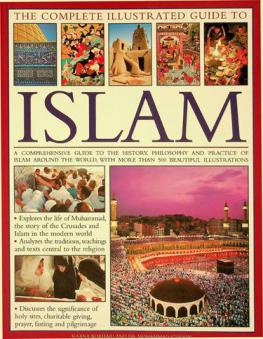
The complete illustrated guide to Islam : a comprehensive guide to the history, philosophy and practice of Islam around the world, with more than 500 beautiful illustrations
Features the traditions, teachings and texts central to the religion and discusses the significance of holy sites, prayer and pilgrimage.
Book

A Prophet Has Appeared
Early Islam has emerged as a lively site of historical
investigation, and scholars have challenged the traditional
accounts of Islamic origins by drawing attention to the wealth of
non-Islamic sources that describe the rise of Islam. A Prophet
Has Appeared brings this approach to the classroom. This
collection provides students and scholars with carefully selected,
introduced, and annotated materials from non-Islamic sources dating
to the early years of Islam. These can be read alone or alongside
the Qur'an and later Islamic materials. Applying
historical-critical analysis, the volume moves these invaluable
sources to more equal footing with later Islamic narratives about
Muhammad and the formation of his new religious movement.
Included are new English translations of sources by twenty
authors, originally written in not only Greek and Latin but also
Syriac, Georgian, Armenian, Hebrew, and Arabic and spanning a
geographic range from England to Egypt and Iran. Ideal for the
classroom and personal library, this sourcebook provides readers
with the tools to meaningfully approach a new, burgeoning area of
Islamic studies.
eBook

Women and the Transmission of Religious Knowledge in Islam
Asma Sayeed's book explores the history of women as religious scholars from the first decades of Islam through the early Ottoman period. Focusing on women's engagement with hadīth, this book analyzes dramatic chronological patterns in women's hadīth participation in terms of developments in Muslim social, intellectual and legal history. It challenges two opposing views: that Muslim women have been historically marginalized in religious education, and alternately that they have been consistently empowered thanks to early role models such as 'Ā'isha bint Abī Bakr, the wife of the Prophet Muhammad. This book is a must-read for those interested in the history of Muslim women as well as in debates about their rights in the modern world. The intersections of this history with topics in Muslim education, the development of Sunnī orthodoxies, Islamic law and hadīth studies make this work an important contribution to Muslim social and intellectual history of the early and classical eras.
eBook


The Popularisation of Sufism in Ayyubid and Mamluk Egypt, 1173-1325
In the 12th – 14th centuries, Sufism (‘Islamic mysticism’) became extraordinarily popular across Egypt. Elites and non-elites, rulers and ruled, the wealthy and the poor, even Jews, all embraced a variety of Sufi ideas and practices. This book is the first systematic investigation of how and why this popularisation occurred. It surveys several Sufi groups, from different regions of Egypt, and details how each of them promulgated, performed, and popularised their specific Sufi doctrines and practices. This popularisation would have a profound impact on the Egyptian religious landscape and on the subsequent history of Islam more broadly.
eBook