
Catalogue Search | MBRL


Are you sure you want to remove the book from the shelf?

{{itemTitle}}
87
result(s) for
"Islamic philosophy Influence."
Sort by:

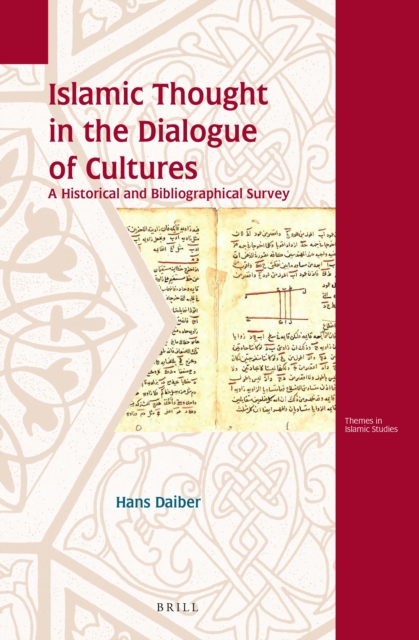
Islamic thought in the dialogue of cultures : a historical and bibliographical survey
The monograph aims at a historical and bibliographical survey of the qurʾānic and rational world-view of early Islam, of the period of translations from Greek into Syriac and Arabic, and of the impact of Islamic thought on Europe.
eBook

Aristotle and the Arabic tradition
\"This volume of essays by scholars in ancient Greek, medieval, and Arabic philosophy examines the full range of Aristotle's influence upon the Arabic tradition. It explores central themes from Aristotle's corpus, including logic, rhetoric and poetics, physics and meteorology, psychology, metaphysics, ethics and politics, and examines how these themes are investigated and developed by Arabic philosophers including al-Kindمi, al-Fمarمabمi, Avicenna, al-Ghazمalمi, Ibn Bمajja and Averroes. The volume also includes essays which explicitly focus upon the historical reception of Aristotle, from the time of the Greek and Syriac transmission of his texts into the Islamic world to the period of their integration and assimilation into Arabic philosophy. This rich and wide-ranging collection will appeal to all those who are interested in the themes, development and context of Aristotle's enduring legacy within the Arabic tradition.\"-- Back cover.
BOOK

Alfarabi, Avicenna, and Averroes, on intellect : their cosmologies, theories of the active intellect, and theories of human intellect
The distinction between the potential intellect and the active intellect was first drawn by Aristotle. Medieval Islamic, Jewish, Christian philosophers, and European philosophers in the sixteenth century considered it a possible key to deciphering the nature of man and the universe. In this book, Herbert Davidson examines the treatment of intellect in Alfarabi (d. 950), Avicenna (980–1037) and Averroes (1126–1198), with particular attention to the way in which they addressed the tangle of issues that grew up around the active intellect.
eBook

Philosophers, sufis, and caliphs : politics and authority from Cordoba to Cairo and Baghdad
What was the relationship between government and religion in Middle Eastern history? In a world of caliphs, sultans, and judges, who exercised political and religious authority? In this book, Ali Humayun Akhtar investigates debates about leadership that involved ruling circles and scholars of jurisprudence and theology. At the heart of this story is a medieval rivalry between three caliphates: the Umayyads of Cordoba, the Fatimids of Cairo, and the Abbasids of Baghdad. In a fascinating revival of Late Antique Hellenism, Aristotelian and Platonic notions of wisdom became a key component of how these caliphs debated their authority as political leaders. By tracing how these political debates impacted the theological scholars and their own conception of communal guidance, Akhtar offers a new picture of premodern political authority and the connections between Western and Islamic civilizations. It will be of use to students and specialists of the premodern and modern Middle East.
Book

A Jewish Philosopher of Baghdad
The volume gives a detailed account of the available data of the biography of the Jewish philosopher ʿIzz al-Dawla Ibn Kammūna (d. 683/1284), provides an outline of his philosophcial thought, and analyzes in detail the reception of his thought and his writings among later Muslim and Jewish philosophers. An inventory of his entire oeuvre provides detailed information on all extant manuscripts. The volume furthermore includes editions of nine of his writings.
eBook

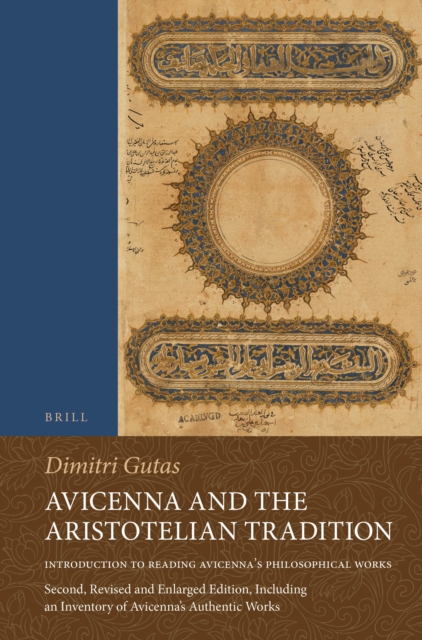
Avicenna and the Aristotelian Tradition
Through close study of Avicenna's statements and major works, Dimitri Gutas traces Avicenna's own sense of his place in the Aristotelian tradition and the history of philosophy in Islam, and provides an introduction to reading his philosophical works by delineating the approach most consistent with Avicenna's intention and purpose in philosophy. The second edition of this foundational work, which has quickened fruitful research into the philosopher in the last quarter century, is completely revised and updated, and adds a new final chapter summarizing Avicenna's philosophical project. It is also enlarged with the addition of a new appendix which offers a critical inventory of Avicenna's authentic works, updating the work of Mahdavi (1954) with additional information on all manuscripts and important editions and translations. Its usefulness enhanced, the book provides primary orientation to Avicenna's philosophy and works and constitutes an indispensable research tool for their study.Winner of the I. R. Iran World Award for the Book of the Year 2014
eBook

Wissen über Grenzen
Die MISCELLANEA MEDIAEVALIA präsentieren seit ihrer Gründung durch Paul Wilpert im Jahre 1962 Arbeiten des Thomas-Instituts der Universität zu Köln. Das Kernstück der Publikationsreihe bilden die Akten der im zweijährigen Rhythmus stattfindenden Kölner Mediaevistentagungen, die vor über 50 Jahren von Josef Koch, dem Gründungsdirektor des Instituts, ins Leben gerufen wurden. Der interdisziplinäre Charakter dieser Kongresse prägt auch die Tagungsakten: Die MISCELLANEA MEDIAEVALIA versammeln Beiträge aus allen mediävistischen Disziplinen - die mittelalterliche Geschichte, die Philosophie, die Theologie sowie die Kunst- und Literaturwissenschaften sind Teile einer Gesamtbetrachtung des Mittelalters.
eBook

Social Movements, Indigenous Politics and Democratisation in Guatemala, 1985-1996
Drawing on social movement theory, this book presents a comprehensive analysis of the evolution of collective action during Guatemala's democratic transition (1985-1996) and the accompanying impact of social movements on democratisation, focusing on three indigenous peoples' social movement organisations.
eBook