
Catalogue Search | MBRL


Are you sure you want to remove the book from the shelf?

{{itemTitle}}
4,665
result(s) for
"Islamic theology"
Sort by:


Religions in al-Ḥarāllī’s Sufi Hermeneutics: An Apolemical Understanding of the Qurʾān
This article analyzes the three introductory epistles to Sufi hermeneutics written by al-Ḥarāllī, a mystic of Andalusian origin from the seventh/thirteenth century. According to this author, the objective of the Scriptures is to explain human beings to themselves. The revelation, received through a particular understanding called fahm, contains transformative knowledge that can change the life of the reader. In this foundational work, al-Ḥarāllī explains the relationship between the Qurʾān and preceding Scriptures, recognizing in the Qurʾān their unity and fulfillment. Dedicating the final chapter of the third epistle to the seven religions mentioned in the Qurʾān, which are, rather, ethical prototypes, he seeks to internalize the Qurʾānic critique expounded on each of these categories. In a reading that goes beyond polemics and offers significant elements to the Islamic theology of religions, al-Ḥarāllī demonstrates how the aim of the Qurʾānic narratives is not to present information about the past but rather to provide moral education for the Islamic community and the reader.
Journal Article
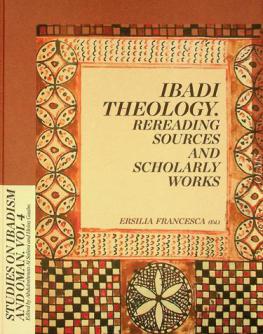
Ibadi theology : rereading sources and scholarly works
The aim of this volume is to explore different issues of Ibadi theology from the early beginnings until the present day. Ibadi Islam emerged in the early Islamic period and played a pivotal role in the development of Islamic law and theology. Today, it continues to be an influential force in the contemporary Middle East and North Africa. Despite its antiquity, Ibadi Islam – and particularly Ibadi theology – remains little known and has often been misunderstood. Up to now only few prominent book-length works devoted to Ibadi theology in European language; this volume aims at redressing this gap by introducing the distinctive theological teachings of this influential Islamic school to a broad public, specialists and non-specialists alike. Dealing with a series of cases, from different periods and different sources and using an interdisciplinary approach, the authors address questions such as dogma and creed, conception of faith, theological controversies, reassessment of theological sources, the Ibadi “modernism” in last century Oman and North Africa. Medieval Ibadi sources are crucial to understand the early development of the movement and the doctrinal and political disputes which differentiate Ibadi doctrine from Sunni Islam, on the other hand the volume emphasize the importance of also focusing on the 19th and 20th centuries Ibadi sources, when the Ibadi reform movement started looking for reconciliation between Islam and modernity.
Book

Locating ‘Praxis’ in Islamic Liberation Theology: God, Scripture, and the Problem of Suffering in Egyptian Prisons
The paper examines the tenability of a project for Islamic liberation theology by exploring the religious lives of Egyptian prisoners—with an emphasis on their encounters with the Qur’an, devotional and contentious contemplation, and theodicy. It employs an ethnographic approach to the study of Islam in Egyptian prisons by interviewing former political prisoners incarcerated after the 2013 military coup. By examining the work of key liberation theologians Farid Esack (b. 1959), Hamid Dabashi (b. 1951), and Asghar Ali Engineer (b. 1939), I ask: can a justice-oriented hermeneutics, concerned with pluralism and breaking down binaries, be a meaningful starting point to those struggling under oppression? I posit that the concern with developing hermeneutics can potentially limit the praxis whereby the faithful struggle with the text in the very moment of suffering. It shows how Egyptian prisoners’ devotional (and contentious) contemplation (taddabur) of the Qur’an—rather than reading liberation into the Qur’an—allowed for emancipatory embodiments of scripture. Furthermore, I show how prisoners stripped of their agentic power come to understand human action and divine action in history and how the metaphysical responses to human suffering inevitably shaped how they view both structures of inequality and domination as well as their potential liberation from it.
Journal Article
Islamic Liberation Theology and Decolonial Studies: The Case of Hindutva Extractivism
Decolonial studies define the coloniality of power as a complex assemblage of dominance and hegemony that emerged during the modern era or the era of colonialism, which stretches from the conquest of the Americas to the present. This article argues that, as part of the critical dialogue between decolonial studies and Islamic liberation theology, the latter should position itself in a decolonial political praxis around the preferential option for the poor that takes both a decolonial turn and a decolonial option seriously. There is a tendency to appropriate certain brands of decolonial studies to engage with forms of nationalism, such as Hindutva, to build a “decolonial option” in the global South by undermining the key insights of the “decolonial turn”. This article specifically engages with the claims of “decolonial Hindutva” to critique the nationalist appropriation in decolonial studies, thereby marking its divergence from decolonial Islamic liberation theology.
Journal Article
Tawhid Paradigm and an Inclusive Concept of Liberative Struggle
Building on previous studies on a mid- and late-twentieth-century recasting of Islam’s doctrine of monotheism, or tawhid, as a distinctly Islamic framework for liberative praxis, this article considers the interplay between the particular and the universal in the tawhidic paradigms of Iranian lay theologian Ali Shariati (1933–1977) and African-American pro-faith and pro-feminist theologian amina wadud (b. 1952). The article proposes that although it was developed in a distinctly Islamic register by means of Quranic exegesis and intrareligious conversations, the tawhidic paradigm has always been conversant with a range of non-Islamic liberative paradigms, and these conversations have been integral to the negotiation of a more inclusive concept of tawhid. To continue to recast tawhid in a more inclusive register, the article further argues, requires taking account of the non-Muslim ‘other’ as an equal moral agent in liberative struggles and embracing Islam’s theological and ideological ‘others’ as equally significant repositories of liberative potential.
Journal Article

Demystifying Islam
Despite heightened interest in the study of the Muslim faith, for many people Islam remains shrouded in mystery and confusion. What really is Shariah law? How is a Muslim to understand Jihad? Does Islam oppose Western values such as free speech or freedom of religion? What place do women have according to Islam? Understanding that this confusion has as much to do with the behavior and words of Muslims as it does with allegations made by anti-Islam activists, Demystifying Islam offers refreshingly bold answers to provocative questions about Islam today. Author Harris Zafar—lecturer, writer, teacher and national spokesperson for Ahmadiyya Muslim Community USA—is forthright about issues where Muslims disagree, and he digs into history through vast research and scholarship to track the origins of differing beliefs. From the burqa to the role of Jesus in Islam, Demystifying Islam is an essential resource and concise guide to understanding the fastest growing religion in the world.
eBook

Modern Islamic Thought in a Radical Age
Among traditionally educated scholars in the Islamic world there is much disagreement on the crises that afflict modern Muslim societies and how best to deal with them, and the debates have grown more urgent since 9/11. Through an analysis of the work of Muhammad Rashid Rida and Yusuf al-Qaradawi in the Arab Middle East and a number of scholars belonging to the Deobandi orientation in colonial and contemporary South Asia, this book examines some of the most important issues facing the Muslim world since the late nineteenth century. These include the challenges to the binding claims of a long-established scholarly consensus, evolving conceptions of the common good, and discourses on religious education, the legal rights of women, social and economic justice and violence and terrorism. This wide-ranging study by a leading scholar provides the depth and the comparative perspective necessary for an understanding of the ferment that characterizes contemporary Islam.
eBook