
Catalogue Search | MBRL


Are you sure you want to remove the book from the shelf?

{{itemTitle}}
180,029
result(s) for
"Israel"
Sort by:

Violent Acts and Urban Space in Contemporary Tel Aviv
Violent acts over the past fifteen years have profoundly altered civil rituals, cultural identity, and the meaning of place in Tel Aviv. Three events in particular have shed light on the global rule of urban space in the struggle for territory, resources, and power: the assassination of Prime Minister Rabin in 1995 in the city council square; the suicidal bombing at the Dolphinarium Discothque along the shoreline in 2001; and bombings in the Neve Shaanan neighborhood in 2003. Tali Hatuka uses an interdisciplinary framework of urban theory and sociopolitical theory to shed light on the discourse regarding violent events to include an analysis of the physical space where these events take place. She exposes the complex relationships among local groups, the state, and the city, challenging the national discourse by offering a fresh interpretation of contesting forces and their effect on the urban environment. Perhaps the most valuable contribution of this book is its critical assessment of the current Israeli reality, which is affected by violent events that continually alter the everyday life of its citizens. Although these events have been widely publicized by the media, there is scant literature focusing on their impact on the urban spaces where people live and meet. In addition, Hatuka shows how sociopolitical events become crucial defining moments in contemporary lived experience, allowing us to examine universal questions about the way democracy, ideology, and memory are manifested in the city.
eBook


Latino Migrants in the Jewish State
In the 1990s, thousands of non-Jewish Latinos arrived in Israel as
undocumented immigrants. Based on his fieldwork in South America and Israel, Barak
Kalir follows these workers from their decision to migrate to their experiences
finding work, establishing social clubs and evangelical Christian churches, and
putting down roots in Israeli society. While the State of Israel rejected the
presence of non-Jewish migrants, many citizens accepted them. Latinos grew to favor
cultural assimilation to Israeli society. In 2005, after a large-scale deportation
campaign that drew criticism from many quarters, Israel made the historic decision
to legalize the status of some undocumented migrant families on the basis of their
cultural assimilation and identification with the State. By doing so, the author
maintains, Israel recognized the importance of practical belonging for understanding
citizenship and national identity.
eBook
Debating Khirbet Qeiyafa : a fortified city in Judah from the time of King David
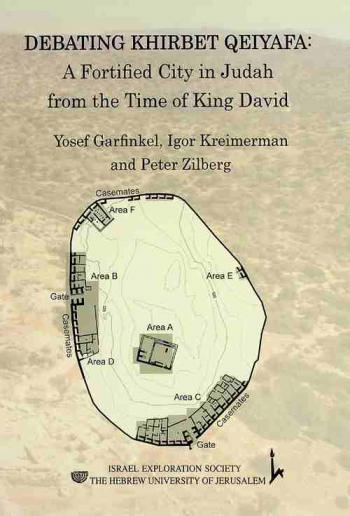
In 2007 the name \"Khirbet Qeiyafa\" was still unknown both to professional archaeologists and to the public. In 2008 Khirbet Qeiyafa became world-famous. This spectacular success is entirely due to the figure of King David, who is so well known from the biblical tradition but is a very elusive figure from the archaeological or historical point of view. Nowhere else had an archaeological layer that can be related to this king been uncovered, not even in Jerusalem. For the first time in the archaeology of Judah, a fortified city from the time of King David had been exposed. The date of the site was obtained by accurate radiometric measurements conducted on short-lived samples of burned olive pits. The location in the Elah Valley, just one day's walk from Jerusalem, places the site in the core area of the Kingdom of Judah. Moreover, it is exactly in this area and this era that the biblical tradition places the famous combat between the inexperienced and anonymous young shepherd David and the well-equipped giant Philistine warrior Goliath. Khirbet Qeiyafa has become the point of contact between archaeology, biblical studies, ancient history and mythology. The fieldwork at Khirbet Qeiyafa lasted seven seasons, from 2007 to 2013. This book, written at the end of the excavation phase, summarizes the main results, supplies answers to various issues concerning the site that have been raised over the last few years, and presents a comprehensive interim report. The authors use this opportunity to discuss various methodological issues that relate to archaeology and the biblical tradition, and how to combine the two.--Cover.
Book

1948
This history of the foundational war in the Arab-Israeli conflict is groundbreaking, objective, and deeply revisionist. A riveting account of the military engagements, it also focuses on the war's political dimensions. Benny Morris probes the motives and aims of the protagonists on the basis of newly opened Israeli and Western documentation. The Arab side-where the archives are still closed-is illuminated with the help of intelligence and diplomatic materials.
Morris stresses thejihadicharacter of the two-stage Arab assault on the Jewish community in Palestine. Throughout, he examines the dialectic between the war's military and political developments and highlights the military impetus in the creation of the refugee problem, which was a by-product of the disintegration of Palestinian Arab society. The book thoroughly investigates the role of the Great Powers-Britain, the United States, and the Soviet Union-in shaping the conflict and its tentative termination in 1949. Morris looks both at high politics and general staff decision-making processes and at the nitty-gritty of combat in the successive battles that resulted in the emergence of the State of Israel and the humiliation of the Arab world, a humiliation that underlies the continued Arab antagonism toward Israel.
eBook

Fighting for Rights
Leaders around the globe have long turned to the armed forces as
a \"school for the nation.\" Debates over who serves continue to
arouse passion today because the military's participation policies
are seen as shaping politics beyond the military, specifically the
politics of identity and citizenship. Yet how and when do these
policies transform patterns of citizenship? Military service,
Ronald R. Krebs argues, can play a critical role in bolstering
minorities' efforts to grasp full and unfettered rights. Minority
groups have at times effectively contrasted their people's
battlefield sacrifices to the reality of inequity, compelling state
leaders to concede to their claims. At the same time, military
service can shape when, for what, and how minorities have engaged
in political activism in the quest for meaningful citizenship.
Employing a range of rich primary materials, Krebs shows how the
military's participation policies shaped Arab citizens' struggles
for first-class citizenship in Israel from independence to the
mid-1980s and African Americans' quest for civil rights, from World
War I to the Korean War. Fighting for Rights helps us make sense of
contemporary debates over gays in the military and over the virtues
and dangers of liberal and communitarian visions for society. It
suggests that rhetoric is more than just a weapon of the weak, that
it is essential to political exchange, and that politics rests on a
dual foundation of rationality and culture.
Leaders around the globe have long turned to the armed forces as
a \"school for the nation.\" Debates over who serves continue to
arouse passion today because the military's participation policies
are seen as shaping politics beyond the military, specifically the
politics of identity and citizenship. Yet how and when do these
policies transform patterns of citizenship? Military service,
Ronald R. Krebs argues, can play a critical role in bolstering
minorities' efforts to grasp full and unfettered rights. Minority
groups have at times effectively contrasted their people's
battlefield sacrifices to the reality of inequity, compelling state
leaders to concede to their claims. At the same time, military
service can shape when, for what, and how minorities have engaged
in political activism in the quest for meaningful citizenship.
Employing a range of rich primary materials, Krebs shows how the
military's participation policies shaped Arab citizens' struggles
for first-class citizenship in Israel from independence to the
mid-1980s and African Americans' quest for civil rights, from World
War I to the Korean War. Fighting for Rights helps us make
sense of contemporary debates over gays in the military and over
the virtues and dangers of liberal and communitarian visions for
society. It suggests that rhetoric is more than just a weapon of
the weak, that it is essential to political exchange, and that
politics rests on a dual foundation of rationality and culture.
eBook


Good Arabs
Based on his reading of top-secret files of the Israeli police and the prime minister's office, Hillel Cohen exposes the full extent of the crucial, and, until now, willfully hidden history of Palestinian collaboration with Israelis-and of the Arab resistance to it. Cohen's previous book, the highly acclaimedArmy of Shadows,told how this hidden history played out from 1917 to 1948, and now, inGood Arabshe focuses on the system of collaborators established by Israel in each and every Arab community after the 1948 war. Covering a broad spectrum of attitudes and behaviors, Cohen brings together the stories of activists, mukhtars, collaborators, teachers, and sheikhs, telling how Israeli security agencies penetrated Arab communities, how they obtained collaboration, how national activists fought them, and how deeply this activity influenced daily life. When this book was first published in Hebrew, it became a bestseller and has evoked bitter memories and intense discussions among Palestinians in Israel and prompted the reclassification of many of the hundreds of documents Cohen viewed to uncover a story that continues to unfold to this day.
eBook