
Catalogue Search | MBRL


Are you sure you want to remove the book from the shelf?

{{itemTitle}}
129
result(s) for
"Israel -- Emigration and immigration -- Social aspects"
Sort by:

The Rise of the Individual in 1950s Israel
In this sharply argued volume, Orit Rozin reveals the flaws in the conventional account of Israeli society in the 1950s, which portrayed the Israeli public as committed to a collectivist ideology. In fact, major sectors of Israeli society espoused individualism and rejected the state-imposed collectivist ideology. Rozin draws on archival, legal, and media sources to analyze the attitudes of black-market profiteers, politicians and judges, middle-class homemakers, and immigrants living in transit camps and rural settlements. Part of a refreshing trend in recent Israeli historiography to study the voices, emotions, and ideas of ordinary people, Rozin's book provides an important corrective to much extant scholarly literature on Israel's early years.
eBook
A Queer Way Out
Winner of the 2019 Association for Middle East Women's
Studies Book Award The very language of Zionism prizes the
concept of immigration to Israel ( aliyah , literally
ascending) while stigmatizing emigration from Israel
( yerida , descending). In A Queer Way Out , Hila
Amit explores the as-yet-untold story of queer Israeli emigrants.
Drawing on extensive fieldwork in Berlin, London, and New York, she
examines motivations for departure and feelings of unbelonging to
the Israeli national collective. Amit shows that sexual orientation
and left-wing political affiliation play significant roles in
decisions to leave. Queer Israeli emigrants question national and
heterosexual norms such as army service, monogamy, and
reproduction. Amit argues that emigration itself is not only a
political act, but one that pioneers a deliberately unheroic form
of resistance to Zionist ideology. This fascinating study enriches
our understandings of migration, political activism, and queer
forms of living in Israel and beyond.
eBook
The modern Israeli and Palestinian diasporas : a comparative approach
A comparative study of contemporary Israeli and Palestinian diasporas.Exilic and diasporic experience have become ubiquitous in recent decades.Jews, lacking a homeland, spread to various parts of the world, making the Jewish diaspora paradigmatic.
eBook
The Israel Defence Force and the foundation of Israel
This book discusses the contribution of the Israel Defence Forces (IDF) to the building of the social and educational foundations of the country, and its role in the area of immigrant absorption and settlement during the first years of the Israeli State. The author examines how under the guidance of David Ben-Gurion Israel was able to utilize the values of military organization to combat severe, economic, and social difficulties, and build a civil society to underpin the new state.
eBook

Planning in the Face of Crisis
Critics of urban and regional planning argue that it is best suited to manage incremental change. Can a planner's skills and expertise be effective in handling a major crisis and large-scale change? The mass immigration from the former Soviet Union to Israel in the 1990s offers the opportunity to study one of the largest-scale (non-disaster) crisis situations in a democratic, advanced-economy country. This book recounts the fascinating saga of how policymakers and planners at both the national and local levels responded to the formidable demand for housing and massive urban growth. Planners forged new housing and land-use policies, and applied a streamlined (but controversial) planning law. The outputs were impressive. The outcomes and impacts changed the landscape and human-scape of Israel, heightening dilemmas of land use and urban policy in this high-density country.
eBook

Transnational Palestine : migration and the right of return before 1948
Tens of thousands of Palestinians migrated to the Americas in the final decades of the nineteenth century and early decades of the twentieth. By 1936, an estimated 40,000 Palestinians lived outside geographic Palestine. Transnational Palestine is the first book to explore the history of Palestinian immigration to Latin America, the struggles Palestinian migrants faced to secure Palestinian citizenship in the interwar period, and the ways in which these challenges contributed to the formation of a Palestinian diaspora and to the emergence of Palestinian national consciousness.
Nadim Bawalsa considers the migrants' strategies for economic success in the diaspora, for preserving their heritage, and for resisting British mandate legislation, including citizenship rejections meted out to thousands of Palestinian migrants. They did this in newspapers, social and cultural clubs and associations, political organizations and committees, and in hundreds of petitions and pleas delivered to local and international governing bodies demanding justice for Palestinian migrants barred from Palestinian citizenship. As this book shows, Palestinian political consciousness developed as a thoroughly transnational process in the first half of the twentieth century—and the first articulation of a Palestinian right of return emerged well before 1948.
eBook
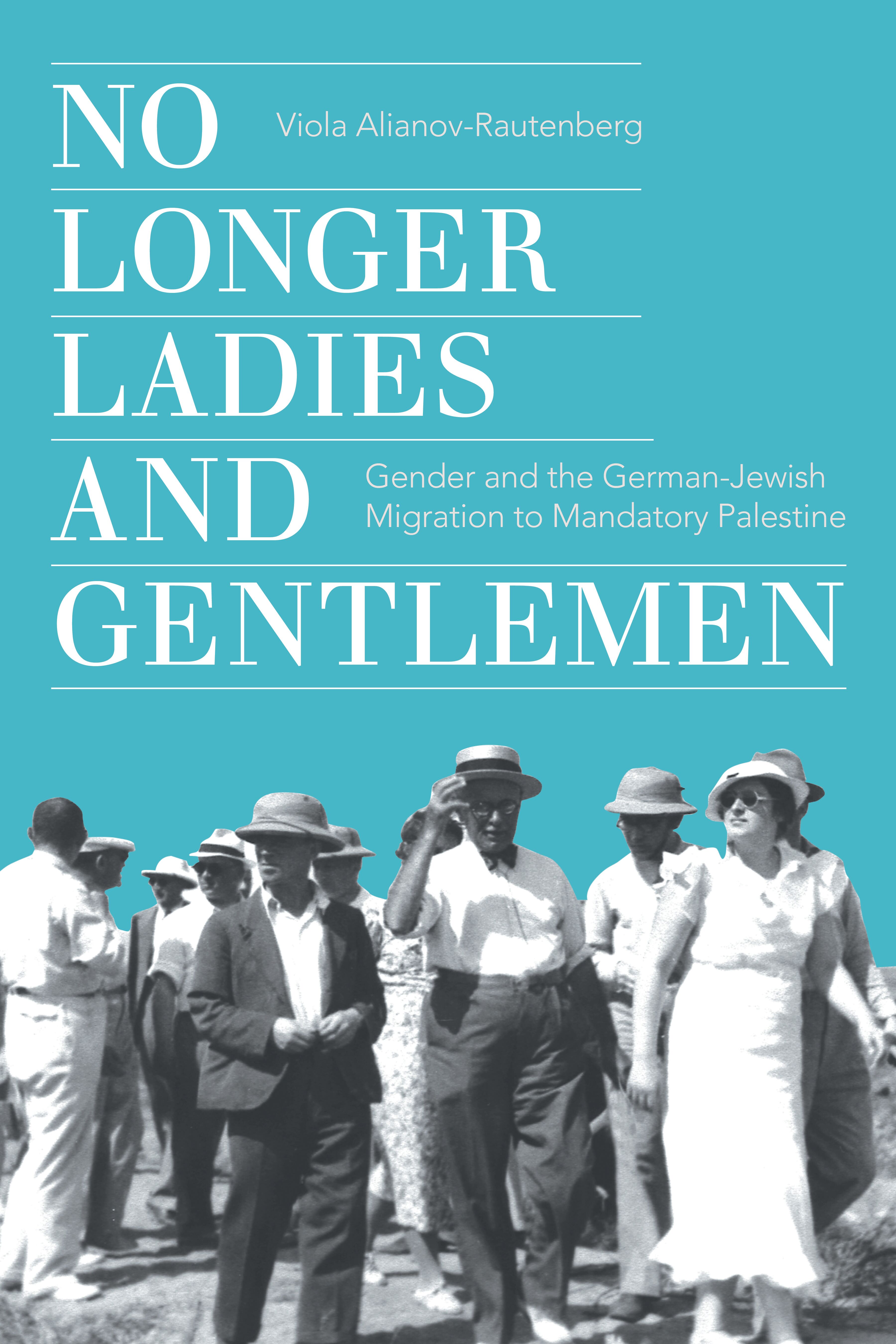
No Longer Ladies and Gentlemen
For the sixty thousand German Jews who escaped Nazi Germany and
found refuge in Mandatory Palestine between 1933 and 1941,
migration meant radical changes: it transformed their professional
and cultural lives and confronted them with a new language,
climate, and society. Bridging German-Jewish and Israeli history,
this book tells the story of German-Jewish migration to Mandatory
Palestine/Eretz Israel as gender history. It argues that this
migration was shaped and structured by gendered policies and
ideologies and experienced by men and women in a gendered form-from
the decision to immigrate and the anticipation of change, through
the outcomes for family life, body, self-image, and sexuality.
Immigration led to immediate transformations in allocations of
tasks within the family, concepts of masculinity and femininity,
and participation in the labor market and domestic life. Through a
close examination of archival materials in German, English, and
Hebrew, including administrative records, personal documents,
newspapers, and oral history interviews conducted by the author,
this book follows Jewish migrants along their journey from Germany
and into the workplaces, living rooms, and kitchens of their new
homeland, providing a new perspective on everyday life in Mandatory
Palestine. Viola Alianov-Rautenberg's work illuminates key issues
at the intersection of migration studies, German-Jewish studies,
and Israeli history, demonstrating how the lens of gender enriches
our understanding of social change, power, ethnicity, and
nation-building.
eBook

African Jewish Communities in the Diaspora and the Homeland: The Case of South Africa
As part of this Special Issue devoted to research on the Jewish communities in Africa and their diaspora, we focus on the case of South African Jews who emigrated to Israel. First, we analyze the socio-religious and cultural context in which a Jewish diaspora developed and marked the ethno-religious identity of South African Jews both as individuals and as a collective. Second, we examine the role of ethno-religious identification as the main motive for migrating to Israel, and third, we show the role of ethno-religious identity in the integration of South African Jews into Israeli life. This study relies on data from a survey of South Africans and their descendants living in Israel in 2008, and in-depth interviews. The findings provide evidence for a strong Jewish community in South Africa that created a strong sense of belonging to the Jewish people and a strong attachment to Israel. As expected, two of the key reasons for the decision to move to Israel were ideology and religion. The immigrants wanted to live in a place where they could feel part of the majority that was culturally and religiously Jewish. Finally, ethno-religious identities (Jewish and Zionist) influenced not only the decision making of potential immigrants but also their process of integration into Israeli life.
Journal Article
