
Catalogue Search | MBRL


Are you sure you want to remove the book from the shelf?

{{itemTitle}}
5,782
result(s) for
"Israel Foreign relations United States."
Sort by:

Israel and the United States
This unique volume intensively studies the nature and extent of US - Israeli relations, from 1948 through the Bush and Obama administrations. Leading experts in the field (including Israeli and North American scholars from a variety of political perspectives) contribute original essays on the principal political, religious, ethnic, military, economic, and juridical connections between the United States and Israel. Specific topics covered in this new book include: the pro-Israel lobby in the United States; the US Jewish community and its relations to Israel; evangelical Christians and Israel; military and economic ties between the United States and Israel; the threat of a nuclear Iran for both countries; and the impact of American jurisprudence on Israel. Section introductions from the editor effectively contextualize the issues and provide students with an in-depth understanding of the past, present, and future of the US - Israel relationship.
eBook

The Future of the Jews
In The Future of the Jews, Stuart E.Eizenstat, a senior diplomat of international reputation, surveys the major geopolitical, economic, and security challenges facing the world in general, and the Jewish world and the United States in particular.
eBook


Tested by Zion
This book tells the full inside story of the Bush Administration and the Israeli-Palestinian conflict. Written by a top National Security Council officer who worked at the White House with Bush, Cheney, and Rice and attended dozens of meetings with figures like Sharon, Mubarak, the kings of Jordan and Saudi Arabia, and Palestinian leaders, it brings the reader inside the White House and the palaces of Middle Eastern officials. How did 9/11 change American policy toward Arafat and Sharon's tough efforts against the Second Intifada? What influence did the Saudis have on President Bush? Did the American approach change when Arafat died? How did Sharon decide to get out of Gaza, and why did the peace negotiations fail? In the first book by an administration official to focus on Bush and the Middle East, Elliott Abrams brings the story of Bush, the Israelis, and the Palestinians to life.
eBook


Iran, Israel, and the United states
This book analyzes the process of evaluating Iran’s nuclear project and the efforts to roll it back, resulting in the 2015 nuclear agreement known as the Joint Comprehensive Plan of Action (JCPA). Despite its aura of scientific exactitude, nuclear intelligence is complex and susceptible to methodological disagreements and political bias at the international oversight level—the International Atomic Energy Agency (IAEA)—and within the countries involved in the rollback project – Israel and the United States. To highlight both the technological problems of assessing compliance and the politicization, each chapter in the book uses a real-time comparison of the nuclear developments in Iran, and the perception of Israel and the United States. This methodology yielded some significant results. Essentially, two camps had formed in each country; those who were pushing for an agreement with Iran and those who opposed it. The Israeli intelligence agencies – the Mossad and the Military Intelligence – as well as the highly secretive Israeli Atomic Energy Commission (IAEC) which advised them considered the program to be weak and slow moving. The right-wing government of Benjamin Netanyahu suggested that Iran was steps away from the “point of no return,” making it an existential threat to Israel. A virtually identical split emerged in Washington. While the intelligence community and the advising scientists from the National Nuclear Laboratories, considered Iran progress to be relatively modest, the Republicans and the Israel lobby - the Jewish organizations and the Christian Zionists— warned of the imminent danger of a nuclear Iran. With the Obama administration pushing for the JCPOA, a fierce debate took place in Congress. The Israeli intelligence and military chiefs led by the Mossad chief Meir Dagan, which had previously blocked Netanyahu from a preemptive action, quietly supported the agreement. In Washington, the Israel lobby, and the Republicans, helped by Netanyahu, mounted an all-out effort to defeat the deal in Congress. The pro-deal coalition fought back by mobilizing the scientific community, military and intelligence officials, the business lobby, and grassroots Democrats. The JCPOA represents the first successful effort of peaceful counterproliferation. At the same, excessive politicization has clouded its legitimacy and cast doubt about its future.
eBook
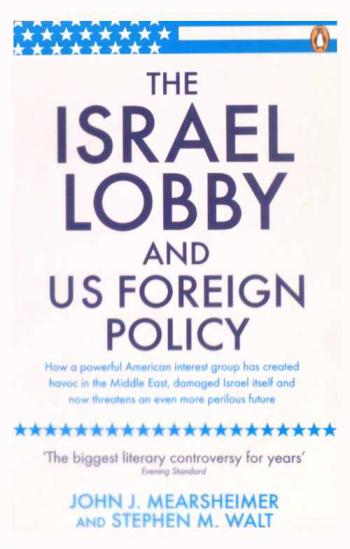
The Israel lobby and U.S. foreign policy
The Israel lobby is a loose coalition of right-wing individuals and organisations that actively works to shape U.S. foreign policy. Here, the authors claim that there is something deeply worrying about the Israel lobby's influence on U.S. foreign policy.
Book

Iran, Israel, and the United States : regime security vs. political legitimacy
Providing an unbiased analysis of the past, present, and future of the hostile relationship between Iran, Israel, and the United States, this book presents an up-to-date discussion of the security implications for each of the two states as well as the entire region. Ongoing tensions between Iran and Israel are highly dangerous for the Middle East and have the potential to spark another major war in the region, perhaps on a much larger scale than prior conflicts. Such a confrontation between the two nations would jeopardize regional and international security, and is of immediate concern for the United States. In this new book noted scholar Jalil Roshandel provides an in-depth look at topics such as Iranian state support for terrorism, its pursuit of nuclear capability and weapons, the implications of this activity for Israel, and their relations with the Iraqi Kurdish region. The United States' role in this conflict is also detailed, including a history if its relations with Iran, policy with Israel, and position as potential mediator. This book offers valuable context that explains the evolution of these relationships rather than simply summarizing the past and present situations, and concludes with thought-provoking policy alternatives for decision makers.
eBook