
Catalogue Search | MBRL


Are you sure you want to remove the book from the shelf?

{{itemTitle}}
648
result(s) for
"Israeli–Palestinian conflict"
Sort by:

Unholyland : the trilogy : a love story
\"Through the story of two lovers, Mosh and Jalilah, this verse novel encapsulates the personal tragedy of the Palestine-Israel conflict. Set in the popular music culture of modern Palestine, using rap rhythms and the sonnet form, Aidan Andrew Dun s new book is verbally accomplished and rhythmically creative, and yet gripping to read as the story unfolds in a fast-moving narrative of twists and turns. From a first meeting in an underground dive in the Galilee, through Jalilah s home life in Sabra and Shatila camp, and Mosh s capture and interrogation by Israeli security, the story builds to a climax in an improvised music gathering in the Sinai desert. This is a unique and original piece of writing. It will also appeal to younger readers through the use of rap rhythms and the inclusion of leading rap and reggae musicians in the narrative\"--Back cover.
Book

Entre guerre et paix : Israël au jour le jour
Cette étude examine en quoi la situation d’Israël se caractérise par un état de quasi-guerre. Partie intégrante du quotidien des citoyens israéliens et palestiniens, cet état crée une tension entre la normalité du quotidien et une atmosphère de quasi-guerre toujours présente. L’article montrera comment durant l’opération « Pilier de la Défense » en 2012, les résidents de la ville israélienne de Beer-Sheva et de ses environs ont lutté pour préserver une forme de routine journalière. L’observation des diverses réactions face à l’éruption de la violence dans la vie quotidienne amène à penser que ce que l’on croyait éphémère est devenu permanent, et à voir dans cet état intermédiaire entre la guerre et la paix, un mode de vie et d’être de plus en plus accepté et acceptable. This study explores the existential setting of Israel as a country almost at war. War readiness is integrated into the daily lives of Israeli and Palestinian citizens, creating a habitual tension between the normalcy of the everyday and an ever-present war-like atmosphere. The article shows how residents of the Israeli city of Beer-Sheva and its suburbs struggled to preserve some form of their daily routine during Operation Pillar of Defense in 2012. It presents their diverse reactions to violent eruptions of the mundane, and concludes that this state of between war and peace is increasingly becoming an accepted and acceptable way to live and be in Israel, as what was once believed to be ephemeral has become constant and permanent.
Journal Article


Zionism in Arab discourses
Zionism in Arab discourses presents a ground-breaking study of the Arab-Israeli conflict. Through analyses of hundreds of texts written by Arab Islamists and liberals from the late-nineteenth century to the 'Arab Spring', the book demonstrates that the Zionist enterprise has played a dual function of an enemy and a mentor. Islamists and liberals alike discovered, respectively, in Zionism and in Israeli society qualities they sought to implement in their sown homelands. Focusing on Palestinian, Egyptian, Syrian and Jordanian political discourses, this study uncovers fascinating and unexpected Arab points of views on different aspects of Zionism; from the first Zionist Congress to the First Lebanon War; from gardening in the early years of Tel Aviv to women's service in the Israeli Defence Forces; from the role of religion in the creation of the state to the role of democracy in its preservation. This study presents the debates between and within contesting Arab ideological trends on a conflict that has shaped, and is certain to continue and shape, one of the most complicated regions in the world.
eBook


Normes de dangers et production d’urbanités
À partir d’exemples tirés de deux terrains (Kaboul et Naplouse), cet article entreprend de réfléchir à la manière dont le danger organise les représentations et les usages de la ville, dans des villes en conflit armé. Malgré la diversité de ces situations, nous partons de l’hypothèse que les pratiques des habitants citadins pour « vivre avec » les dangers au quotidien comportent des caractéristiques communes. Après avoir présenté les contextes dans lesquels sont pensées les situations de danger, l’article décrit les éléments sensibles qui mènent à l’intériorisation de normes, ainsi que les dispositifs de familiarisation mis en place par les habitants. Enfin, il esquisse quelques pistes pour interroger la manière dont le danger peut agir comme analyseur de la ville, voire producteur d’urbanité.
Journal Article

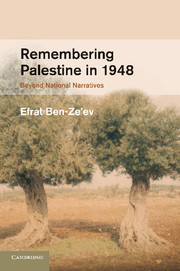
Remembering Palestine in 1948
The war of 1948 in Palestine is a conflict whose history has been written primarily from the national point of view. This book asks what happens when narratives of war arise out of personal stories of those who were involved, stories that are still unfolding. Efrat Ben-Ze'ev examines the memories of those who participated and were affected by the events of 1948, and how these events have been mythologized over time. This is a three-way conversation between Palestinian villagers, Jewish-Israeli veterans, and British policemen who were stationed in Palestine on the eve of the war. Each has his or her story to tell. These small-scale truths shed new light on the Palestinian-Israeli conflict, as it was then and as it has become.
eBook
Ethos Clash in Israeli Society
The question of whether Israel is capable of coping with long-term warfare has long haunted scholars of Israel studies. This book tackles the question through a thorough analysis of the Israeli national ethos. The national ethos of a people is the integrating element that defines a nation's identity and bonds it into a coherent social group. However, in the Israeli case, two competing forms of national ethos threaten to tear society apart and weaken it: a republican ethos that cherishes the national group and a liberal ethos that puts the individual above all.
In creating an account of Israel's ability to fight possible future wars, this book carefully examines these two competing forms of national ethos that create an ideological dichotomy in Israel. Each ethos has its reasoning, its inherent logic, its historic origins, and theories of social science that can explain the background for its development. This book offers a comprehensive analysis of each ethos that takes account of the environment, setting, and circumstances through which it ought to be understood.
The deep inquiry into the dynamics of Israel's national ethos enables a new comprehension of the wobbliness of Israeli politics, and leads to certain conclusions about the fatal question that this book set out to find—whether Israel will eventually survive its international struggles or perish.
eBook