
Catalogue Search | MBRL


Are you sure you want to remove the book from the shelf?

{{itemTitle}}
86
result(s) for
"Israelis West Bank"
Sort by:

The Settlers
The controversy over settlements in the occupied territories is a far more intractable problem for Israel than is widely perceived, Gadi Taub observes in this illuminating book. The clash over settlement is no mere policy disagreement, he maintains, but rather a struggle over the very meaning of Zionism. The book presents an absorbing study of religious settlers' ideology and how it has evolved in response to Israel's history of wars, peace efforts, assassination, the pull-out from Gaza, and other tumultuous events.
Taub tracks the efforts of religious settlers to reconcile with mainstream Zionism but concludes that the project cannot succeed. A new Zionist consensus recognizes that Israel must pull out of the occupied territories or face an unacceptable alternative: the dissolution of Israel into a binational state with a Jewish minority.
eBook

Lords of the land : the war over Israel's settlements in the occupied territories, 1967-2007
The 1967 Arab-Israeli War was a devastating triumph for Israel, which immediately began to establish settlements in the newly conquered territories. Those settlements, and the movement that made them possible, have utterly transformed Israel, and yet until now the full history of the occupation has never been told. Lords of the Land tells that tragic story, and reveals what a catastrophe it has been for both Israel and the Palestinians.
eBook


The Legitimation Process of the Hilltop Youth
Abstract Over the years, the ‘hilltop youth’ have acted in opposition to both Israeli state authorities and the settler leadership. Israeli society viewed them as a group acting to realize an extremist religious ideology while violating Israeli law and ignoring the state's decisions. However, after coming to feel that their social position was making it difficult for them to realize their vision, they embarked upon a process of trying to gain political legitimacy. By turning to mass media and by disseminating messages with which the public at large could identify, they have worked to move closer to Israeli consensus opinion. We identify the steps through which this was carried out and trace its success. The process reached a significant point in 2023 when politicians identified with the hilltop youth took up important ministerial positions in government, marking their transition from actors who opposed the state to ones responsible for its decisions.
Journal Article

The Limits of the Land
Was Israel's occupation of the West Bank inevitable? From 1949-1967, the West Bank was the center of the Arab-Israeli conflict. Many Israelis hoped to conquer it and widen their narrow borders, while many Arabs hoped that it would serve as the core of a future Palestinian state. InThe Limits of the Land, Avshalom Rubin presents a sophisticated new portrait of the Arab-Israeli struggle that goes beyond partisan narratives of the past. Drawing on new evidence from a wide variety of sources, many of them only recently declassified, Rubin argues that Israel's leaders indeed wanted to conquer the West Bank, but not at any cost. By 1967, they had abandoned hope of widening their borders and adopted an alternative strategy based on nuclear deterrence. In 1967, however, Israel's new strategy failed to prevent war, convincing its leaders that they needed to keep the territory they conquered. The result was a diplomatic stalemate that endures today.
eBook

Super-Israel
A careful examination of Palestinian service work in Israeli settlements and of everyday settler-Palestinian contact demonstrates how these encounters play a key role in normalizing the presence and dominance of settlers in the occupied West Bank. Based on ethnographic fieldwork at a settlement supermarket, this article shows that Palestinians are called upon to perform customer service in a setting where they are not only subjugated but are also coerced to help create the ultranationalist climate of their occupiers’ holidays. In addition to being compelled to normalize Israeli dominance, Palestinian workers are also the object of a seemingly contradictory orientation, one that favors not having Palestinians around at all. The article thus weighs in on the broader contemporary significance of Palestinian labor for the settler-colonial logics of Zionism.
Journal Article
Who Controls the Israeli Policing Army?
Abstract Since the 2000s, a fundamental structural change has led to the development of two armies within the IDF. In co-existence with the ‘official’ army, a ‘policing’ force has emerged in the West Bank. Ostensibly subordinated to political authority, it has evolved into a quasi-militia force, enacting policies that often deviate from the official line. The question of who controls this policing army is central to this article. I argue that this policing army, unlike the official army, is controlled by a matrix rather than a hierarchical structure. Characterized by a web of mostly extra-military mechanisms, it is embedded within the civilian communities of the Jewish settlers, and this embeddedness shapes the form of control by creating several control mechanisms. Therefore, this policing army is only partially controlled by the official echelon of command.
Journal Article
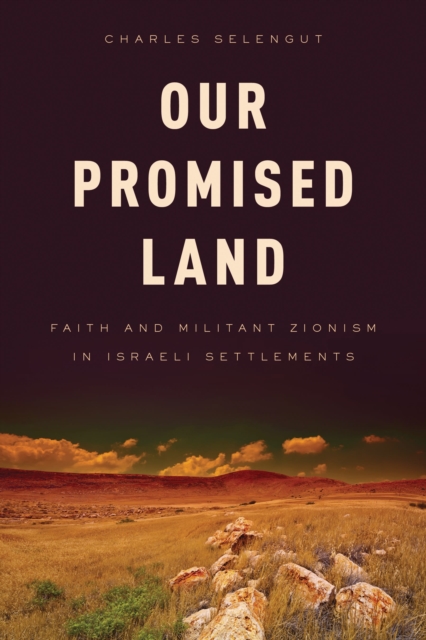
Our promised land
This book takes readers inside radical Israeli settlements to explore how these settlements were formed, what the people in them believe, and their role in the Middle East today. Drawing on three years of research in these settlements, Selengut offers an in-depth exploration of a topic that is often mentioned in headlines but little understood.
eBook

An Unlikely Day in Court? Legal Challenges for the Prosecution of Israeli Settlements under the Rome Statute
This article analyses the scope of the jurisdiction of the International Criminal Court (ICC) over the Israeli settlement enterprise in the West Bank. The author has found that this scope differs fundamentally between acts of direct transfer and indirect transfer because of Israel's status as a non-member state of the Rome Statute of the ICC and the specific nature of Article 8(2)(b)(viii). Whereas procedural arguments relating to third party rights do not prove to be valid jurisdictional obstacles, the Court's temporal and territorial jurisdiction could nevertheless be limited to acts of direct population transfer committed after April 2015. In conclusion, the article argues that the most promising strategy for the Office of the Prosecutor would be to focus on recent large-scale instances of direct transfer.
Journal Article