
Catalogue Search | MBRL


Are you sure you want to remove the book from the shelf?

{{itemTitle}}
55,556
result(s) for
"Italian"
Sort by:


Italian Immigrant Radical Culture
·\"An important contribution to the history of the Italian-American left.\" - Fraser Ottanelli, Professor of History, University of South Florida
·\"A welcome introduction to the poorly understood immigrantsovversivi.\" - Donna Gabaccia, University of Minnesota
·\"A superb analysis of radical working-class poetry, drama, and art.\" - Nunzio Pernicone, author ofItalian Anarchism, 1864-1892
·\"Anyone interested in the topic will benefit from Bencivenni's deep understanding of her subject, her exhaustive research, and her clear organization and writing.\" - R.J. Goldstein,Choice
·\"An impressive book that nicely complements existing studies… It deserves a wide audience.\" - Mike Rosenow,H-Net Reviews
·\"Bencivenni's superb analysis… ensure[s] that the works of these men and women will have a lasting legacy.\" - Diane C. Vecchio, Furman University
·\"A great book that will benefit well-established scholars, newly minted Ph.D.'s, and graduate students.\" - Caroline Merithew,Italian American Review
·\"Sheds illuminating light on a part of that history that is often overlooked.\" - Stefan Bosworth
eBook

Widow City
Widow City: Gender, Emotion, and Community in the Italian Renaissance investigates the ever-evolving role of the widow in medieval and early modern Italian literature, from canonical authors such as Dante, Petrarch, and Boccaccio, to the numerous widowed writers who rose to prominence in the sixteenth century—including Vittoria Colonna, Veronica Gambara, and Francesca Turina—and radically changed the conversation on public mourning. Engaging with broader intellectual discussions around gender, the history of emotions, the politics of mourning, and the construction of community, Widow City argues that widows served as key models demonstrating to readers not just how to mourn, but how to live well after devastating loss. At the same time, widows were figures of great anxiety: their status as unattached women, and the public performance of their grief, were viewed as very real threats to the stability of the social order. They are thus key to broader intellectual understandings of community and civic life in the Italian Middle Ages and Renaissance.
eBook


The Italian American Table
Looking at the historic Italian American community of East Harlem in the 1920s and 30s, Simone Cinotto recreates the bustling world of Italian life in New York City and demonstrates how food was at the center of the lives of immigrants and their children. Drawing on a vast array of resources including fascinating, rarely explored primary documents and fresh approaches in the study of consumer culture, Cinotto argues that Italian immigrants created a distinctive culture of food as a symbolic response to the needs of immigrant life, from the struggle for personal and group identity to the pursuit of social and economic power. Adding a transnational dimension to the study of Italian American foodways, Cinotto recasts Italian American food culture as an American \"invention\" resonant with traces of tradition.
eBook


The Romance Epics of Boiardo, Ariosto, and Tasso
InThe Romance Epics of Boiardo, Ariosto, and Tasso, Jo Ann Cavallo attempts a new interpretation of the history of the renaissance romance epic in northern Italy, focusing on the period's three major chivalric poets. Cavallo challenges previous critical assumptions about the trajectory of the romance genre, especially regarding questions of creative imitation, allegory, ideology, and political engagement.
In tracing the development of the romance epic against the historical context of the Ferrarese court and the Italian peninsula, Cavallo moves from a politically engaged Boiardo, whose poem promotes the tenets of humanism, to an individualistic Tasso, who opposed the repressive aspects of the counter-reformation culture he is often thought to represent. Ariosto is read from the vantage of his predecessor Boiardo, and Cavallo describes his cynicism and later mellowing attitude toward the real-world relevance of his and Boiardo's fiction.The Romance Epics of Boiardo, Ariosto, and Tassois the first critical study to bring together the three poets in a coherent vision that maps changes while uncovering continuities.
eBook
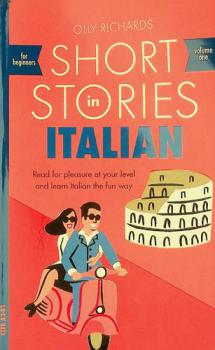
Short stories in Italian : read for pleasure at your level and learn Italian the fun way
Short Stories in Italian for Beginners has been written especially for students from beginner to intermediate level, designed to give a sense of achievement, and most importantly - enjoyment! These eight captivating stories will both entertain you, and give you a feeling of progress when reading. As a result, you will be able to focus on enjoying reading, delighting in your improved range of vocabulary and grasp of the language, without ever feeling overwhelmed or frustrated. From science fiction to fantasy, to crime and thrillers, Short Stories in Italian for Beginners will make learning Italian easy and enjoyable.

Migration Italy
In terms of migration, Italy is often thought of as a source country - a place from which people came rather than one to which people go. However, in the past few decades, Italy has indeed become a destination for many people from poor or war-torn countries seeking a better life in a stable environment. Graziella Parati'sMigration Italyexamines immigration to Italy in the past twenty years, and explores the processes of cultural hybridization that have occurred.
Working from a cultural studies viewpoint, Parati constructs a theoretical framework for discussing Italy as a country of immigration. She gives special attention to immigrant literature, positing that it functions as an act of resistance, a means to talk back to the laws that regulate the lives of migrants. Parati also examines Italian cinema, demonstrating how native and non-native filmmakers alike create parallels between old and new migrations, complicating the definitions of sameness and difference.
These definitions and the complexities inherent in the different cultural, legal, and political positions of Italy's people are at the heart ofMigration Italy, a unique work of immense importance for understanding society in both modern-day Italy and, indeed, the entire European continent.
eBook