
Catalogue Search | MBRL


Are you sure you want to remove the book from the shelf?

{{itemTitle}}
380
result(s) for
"Italian language Texts"
Sort by:
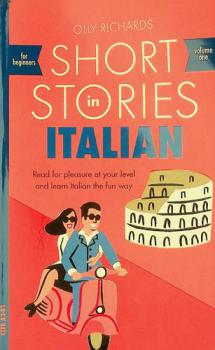
Short stories in Italian : read for pleasure at your level and learn Italian the fun way
Short Stories in Italian for Beginners has been written especially for students from beginner to intermediate level, designed to give a sense of achievement, and most importantly - enjoyment! These eight captivating stories will both entertain you, and give you a feeling of progress when reading. As a result, you will be able to focus on enjoying reading, delighting in your improved range of vocabulary and grasp of the language, without ever feeling overwhelmed or frustrated. From science fiction to fantasy, to crime and thrillers, Short Stories in Italian for Beginners will make learning Italian easy and enjoyable.

L'Italia verso il Duemila
An outstanding collection of readings in Italian designed to introduce language students to contemporary Italian culture while developing their skills in reading, speaking, writing, and listening.
eBook
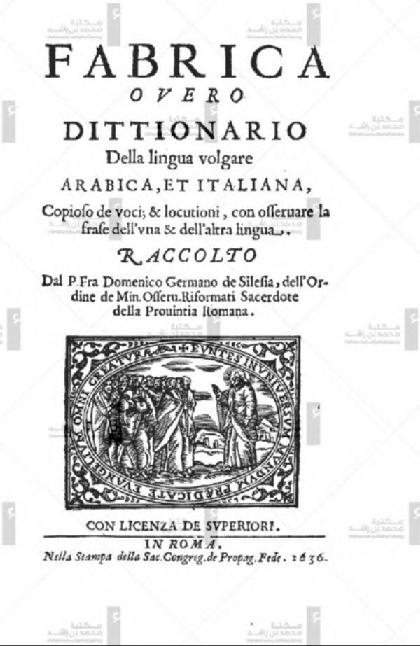
Fabrica overo dittionario della lingua volgare arabica, et italiana
Dominicus Germanus de Silesia (1588--1670) was a German priest and missionary. Born in Schurgast (present-day Skorogoszcz, Poland), he entered the Franciscan order in 1624 and devoted himself to learning Arabic, Persian, and Turkish. In 1630 he went to Palestine as a pastor, where he continued with his language studies. In 1635 he returned to Rome where he joined the Sacra Congregatio de Propaganda de Fide (Sacred Congregation for the Propagation of the Faith). In 1636 he became a teacher at the Mission of San Pietro in Montorio, Rome, and published his grammar of Arabic and Italian, Fabrica overo dittionario della lingua volgare arabica, et italiana (Fabrica, or dictionary of vernacular Arabic and Italian language). Shown here is the rare first edition of his Fabrica, printed by the press of the Propagande de Fide. Dominicus was also the editor of the famous Arabic--Latin dictionary printed at the same press in 1639, and the author of a polemical work, Antitheses Fidei, published in 1638. In 1645 he was sent to Persia on a political mission by King Wladyslaw IV of Poland. Although his destination was Samarkand, he appears to have reached no further than Isfahan, where he remained, studying Persian and Turkish, before returning to Rome in 1651. In 1652 he went to Spain to the court of Philip IV as teacher and translator. A number of his translations survive at the Escorial Palace. In Madrid he completed a translation of the Bible into Arabic, which the Vatican published in 1671. His translation of the Qurʼan appears to have been incomplete at his death in 1670, in Madrid.
Rare Book


An AI framework to support decisions on GDPR compliance
The Italian Public Administration (PA) relies on costly manual analyses to ensure the GDPR compliance of public documents and secure personal data. Despite recent advances in Artificial Intelligence (AI) have benefited many legal fields, the automation of workflows for data protection of public documents is still only marginally affected. The main aim of this work is to design a framework that can be effectively adopted to check whether PA documents written in Italian meet the GDPR requirements. The main outcome of our interdisciplinary research is INTREPID (artI ficial iNT elligence for gdpR compliancE of P ublic admI nistration D ocuments), an AI-based framework that can help the Italian PA to ensure GDPR compliance of public documents. INTREPID is realized by tuning some linguistic resources for Italian language processing (i.e. SpaCy and Tint) to the GDPR intelligence. In addition, we set the foundations for a text classification methodology to recognise the public documents published by the Italian PA, which perform data breaches. We show the effectiveness of the framework over a text corpus of public documents that were published online by the Italian PA. We also perform an inter-annotator study and analyse the agreement of the annotation predictions of the proposed methodology with the annotations by domain experts. Finally, we evaluate the accuracy of the proposed text classification model in detecting breaches of security.
Journal Article

BART-IT: An Efficient Sequence-to-Sequence Model for Italian Text Summarization
The emergence of attention-based architectures has led to significant improvements in the performance of neural sequence-to-sequence models for text summarization. Although these models have proved to be effective in summarizing English-written documents, their portability to other languages is limited thus leaving plenty of room for improvement. In this paper, we present BART-IT, a sequence-to-sequence model, based on the BART architecture that is specifically tailored to the Italian language. The model is pre-trained on a large corpus of Italian-written pieces of text to learn language-specific features and then fine-tuned on several benchmark datasets established for abstractive summarization. The experimental results show that BART-IT outperforms other state-of-the-art models in terms of ROUGE scores in spite of a significantly smaller number of parameters. The use of BART-IT can foster the development of interesting NLP applications for the Italian language. Beyond releasing the model to the research community to foster further research and applications, we also discuss the ethical implications behind the use of abstractive summarization models.
Journal Article

A survey on text classification: Practical perspectives on the Italian language
Text Classification methods have been improving at an unparalleled speed in the last decade thanks to the success brought about by deep learning. Historically, state-of-the-art approaches have been developed for and benchmarked against English datasets, while other languages have had to catch up and deal with inevitable linguistic challenges. This paper offers a survey with practical and linguistic connotations, showcasing the complications and challenges tied to the application of modern Text Classification algorithms to languages other than English. We engage this subject from the perspective of the Italian language, and we discuss in detail issues related to the scarcity of task-specific datasets, as well as the issues posed by the computational expensiveness of modern approaches. We substantiate this by providing an extensively researched list of available datasets in Italian, comparing it with a similarly sought list for French, which we use for comparison. In order to simulate a real-world practical scenario, we apply a number of representative methods to custom-tailored multilabel classification datasets in Italian, French, and English. We conclude by discussing results, future challenges, and research directions from a linguistically inclusive perspective.
Journal Article