
Catalogue Search | MBRL


Are you sure you want to remove the book from the shelf?

{{itemTitle}}
5,912
result(s) for
"Italian art"
Sort by:

The lies of the artists : essays on Italian art, 1450-1750
\"A collection of often iconoclastic essays on a number of key Renaissance artists\"-- Provided by publisher.
BOOK

Art and the religious image in El Greco's Italy
Art and the Religious Image in El Greco's Italy is the first book-length examination of the early career of one of the early modern period's most notoriously misunderstood figures. Born around 1541, Domenikos Theotokopoulos began his career as an icon painter on the island of Crete. He is best known, under the name \"El Greco,\" for the works he created while in Spain, paintings that have provoked both rapt admiration and scornful disapproval since his death in 1614. But the nearly ten years he spent in Venice and Rome, from 1567 to 1576, have remained underexplored until now. Andrew Casper's examination of this period allows us to gain a proper understanding of El Greco's entire career and reveals much about the tumultuous environment for religious painting after the Council of Trent.
Art and the Religious Image in El Greco's Italy is a new book in the Art History Publication Initiative (AHPI), a collaborative grant from the Andrew W. Mellon Foundation. Thanks to the AHPI grant, this book will be available in popular e-book formats.
eBook


Postwar Italian Art History Today
Postwar Italian Art History Today brings fresh critical consideration to the parameters and impact of Italian art and visual culture studies of the past several decades. Taking its cue from the thirty-year anniversary of curator Germano Celant’s landmark exhibition at PS1 in New York – The Knot – this volume presents innovative case studies and emphasizes new methodologies deployed in the study of postwar Italian art as a means to evaluate the current state of the field. Included are fifteen essays that each examine, from a different viewpoint, the issues, concerns, and questions driving postwar Italian art history. The editors and contributors call for a systematic reconsideration of the artistic origins of postwar Italian art, the terminology that is used to describe the work produced, and key personalities and institutions that promoted and supported the development and marketing of this art in Italy and abroad.
eBook

Veiled presence : body and drapery from Giotto to Titian
This wide-ranging book elucidates the symbolism of veils and highlights the power of drapery in Italian art from Giotto to Titian. In the cities of the Renaissance, display of luxury dress was a marker of status. Florentines decked out their palaces and streets with textiles for public rituals. But cloths are also the stuff of fantasy: throughout the book, the author moves from the material to the metaphorical. Curtains and veils, swaddling and shrouds, evoke associations with birth and death. The central chapters address the sculpture of Ghiberti and Donatello, focusing on how they deployed drapery to dramatic effect. In the final chapters the focus shifts to the paintings of Bellini, Lotto, and Titian, where drapery both clothes the figures and composes the picture. In the work of Titian, the veiled presence of the body is absorbed within the materials of oil-paint on canvas: medium and subject become one.
Book

Between Renaissance and Baroque
Between Renaissance and Baroque is a stunning achievement – the first book to be written about the original painting commissions of the Jesuits in Rome. Offering a uniquely comprehensive and comparative analysis of the paintings and stuccoes which adorned all of the Jesuit foundations in the city during their first half century of existence, the study treats some of the most crucial monuments of late Renaissance painting including the original decorations of the church of the Gesù and the Collegio Romano, and the martyrdom frescoes at S. Stefano Rotondo.
Based on extensive new archival research from Rome, Florence, Parma, and Perugia, Gauvin Alexander Bailey's study presents an original, revisionist treatment of Italian painting in the last four decades of the sixteenth century, a critical transitional period between Renaissance and Baroque. Bailey relates the Jesuit painting cycles to the great religious and intellectual climate of the period, isolates the new stylistic trends which appeared after the Council of Trent, and looks at the different ways in which artists met the challenges for devotional art made by the religious climate of the post-Tridentine period.
Bailey also succeeds in providing the first ever written reconstructions of the Jesuit churches of S. Tommaso di Canterbury, S. Saba, and S. Apollinare, and the original novitiate complex of S. Andrea al Quirinale, the site of the most complex and original hospital decoration in late Renaissance Italy. Through these reconstructions, Bailey sheds new light on such works as Louis Richeôme's meditation manual on the paintings at S. Andrea, Le peinture spirituelle , a lively and detailed treatise on late Renaissance art that has never before been the subject of a thorough study. Ultimately, Bailey provides us with a new understanding of the stylistic and iconographic strands which shortly afterward were woven together to form the Baroque.
eBook

Green Worlds of Renaissance Venice
From celebrated gardens in private villas to the paintings and sculptures that adorned palace interiors, Venetians in the sixteenth century conceived of their marine city as dotted with actual and imaginary green spaces. This volume examines how and why this pastoral vision of Venice developed.
Drawing on a variety of primary sources ranging from visual art to literary texts, performances, and urban plans, Jodi Cranston shows how Venetians lived the pastoral in urban Venice. She describes how they created green spaces and enacted pastoral situations through poetic conversations and theatrical performances in lagoon gardens; discusses the island utopias found, invented, and mapped in distant seas; and explores the visual art that facilitated the experience of inhabiting verdant landscapes. Though the greening of Venice was relatively short lived, Cranston shows how the phenomenon had a lasting impact on how other cities, including Paris and London, developed their self-images and how later writers and artists understood and adapted the pastoral mode.
Incorporating approaches from eco-criticism and anthropology, Green Worlds of Renaissance Venice greatly informs our understanding of the origins and development of the pastoral in art history and literature as well as the culture of sixteenth-century Venice. It will appeal to scholars and enthusiasts of sixteenth-century history and culture, the history of urban landscapes, and Italian art.
eBook

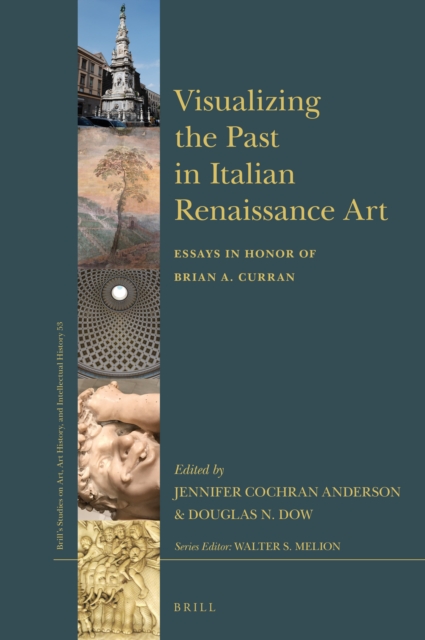
Visualizing the past in Italian Renaissance art : essays in honor of Brian A. Curran
The essays in Visualizing the Past in Italian Renaissance Art address a foundational concept that was as central to early modern thinking as it is to our own: that the past is always an important part of the present. Written by the friends, students, and colleagues of Dr. Brian Curran, former professor of Art History at the Pennsylvania State University, these authors demonstrate how reverberations of the past within the present are intrinsic to the ways in which we think about the history of art. Examinations of sculpture, painting, and architecture reveal the myriad ways that history has been appropriated, reinvented, and rewritten as subsequent generations—including the authors collected here—have attained new insight into the past and present. Contributors: Denise Costanzo, William E. Wallace, Theresa A. Kutasz Christensen, Ingrid Rowland, Anthony Cutler, Marilyn Aronberg Lavin, Louis Alexander Waldman, Elizabeth Petersen Cyron, Stuart Lingo, Jessica Boehman, Katherine M. Bentz, Robin L. Thomas, and John Pinto.
eBook