
Catalogue Search | MBRL


Are you sure you want to remove the book from the shelf?

{{itemTitle}}
8
result(s) for
"Italian drama 18th century History and criticism."
Sort by:

The dramaturgy of the spectator : Italian theatre and the public sphere, 1600-1800
\"The Dramaturgy of the Spectator: pioneers a shift in the way we think about theatre audience as both theoretical concept and historical phenomenon by examining the metomorphosis of spectators from an uncritical mass of early modern theatre-goers to an Enlightenment audience of experts and critics. This study argues for a gradual change in the self-conception of the spectatorship during the two\"golden\" centuries of Italian dramatic literature, outlining the dramatic strategies by which theatre called into being an adjusting audience capable of both aesthetics and political analysis. The author shows that, contrary to expectations, the public's progressive centrality to the theatre helped to create rather than hinder the playwrights's self-assertion and expression. At the same time, the discussion moves beyond spectatorship per se to consider a range of cultural assumptions and practices. These include the emergent public sphere, the power structures and social and cultural politics in Italy.\"-- Provided by publisher.
Book

The Dramaturgy of the Spectator
The Dramaturgy of the Spectatordescribes the development of the modern theatre spectator, the modern playwright, and their complex relationship with sovereignty, power structures, and the emergent public sphere in the seventeenth through the eighteenth century.
eBook
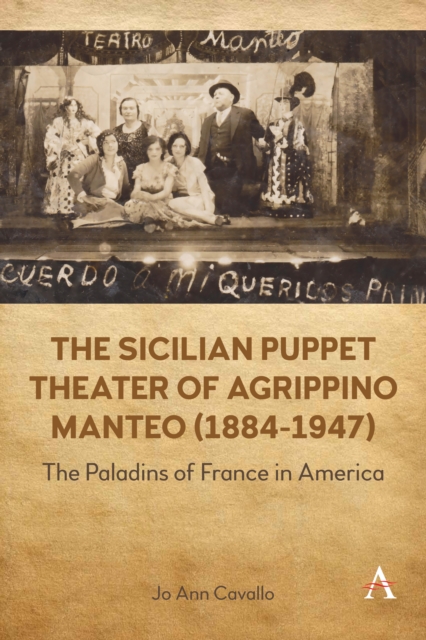
The Sicilian Puppet Theater of Agrippino Manteo (1884-1947)
Sicilian puppet theater was the predominant form of cultural expression for working-class southern Italians and Sicilians from the early 1800s until the proliferation of television in the 1950s. This form of dramatic prose theater also flourished in diasporic Italian urban communities, bringing immigrants together for nightly performances of the same deeply cherished chivalric stories. Agrippino Manteo's scripts, examined for the first time in this study, are testimony to the rich substance of the Paladins of France narratives dramatized on the traditional opera dei pupistage. Even beyond their historical and aesthetic value, the alternating episodes of love, enchantment, adventure, and warfare invite us to relive the passion, heartbreak, excitement, and magic of knights and damsels from around the globe – from Europe to North Africa to East Asia – who share the stage with a host of wizards, fairies, giants, and monsters. This study reconstructs the history of the Manteo family marionette theater in New York City across seven decades and three generations, provides translations of eight selected plays and 270 extant summaries, and offers comparative analyses uncovering the creative process of adaptation from Italian Renaissance masterpieces of chivalric poetry to nineteenth-century prose compilations to Agrippino Manteo's opera dei pupi dramatizations.
eBook

Animation, plasticity, and music in Italy, 1770-1830
This path-breaking study of stage works in Italian musical performances reconsiders a crucial period of music history. Through an interdisciplinary examination of the statue animated by music, Ellen Lockhart deftly shows how Enlightenment ideas influenced Italian theater and music, and vice versa. As Lockhart reveals, the animated statue became a fundamental figure within aesthetic theory and musical practice during the years spanning 1770-1830. Taking as its point of departure a repertoire of Italian ballets, melodramas, and operas from this period, Animation, Plasticity, and Music in Italy traces its core ideas between science, philosophy, theories of language, itinerant performance traditions, the epistemology of sensing, and music criticism.
eBook

The Baroque Libretto
The Baroque Librettocatalogues the Baroque Italian operas and oratorios in the Thomas Fisher Library at the University of Toronto and offers an analysis of how the study of libretto can inform the understanding of opera.
eBook

The Culture of Opera Buffa in Mozart's Vienna
Mozart's comic operas are among the masterworks of Western civilization, and yet the musical environment in which Mozart and his librettist Lorenzo da Ponte wrote these now-popular operas has received little critical attention. In this richly detailed book, Mary Hunter offers a sweeping, synthetic view of opera buffa in the lively theatrical world of late-eighteenth-century Vienna. Opera buffa (Italian-language comic opera) persistently entertained audiences at a time when Joseph was striving for a German national theater. Hunter attributes opera buffa's success to its ability to provide \"sheer\" pleasure and hence explores how the genre functioned as entertainment. She argues that opera buffa, like mainstream film today, projects a social world both recognizable and distinct from reality. It raises important issues while containing them in the \"merely entertaining\" frame of the occasion, as well as presenting them as a series of easily identifiable dramatic and musical conventions.
Exploring nearly eighty comic operas, Hunter shows how the arias and ensembles convey a multifaceted picture of the repertory's social values and habits. In a concluding chapter, she discussesCos\" fan tutteas a work profoundly concerned with the conventions of its repertory and with the larger idea of convention itself and reveals the ways Mozart and da Ponte pointedly converse with their immediate contemporaries.
eBook


Fortunes and Misfortunes of the Spanish Lyric Theater in the Eighteenth Century
Dowling reevaluates the history of opera in Spain, focusing discussing opera, semi-opera, lyric theater, and the zarzuela. He traces authors, works, political influences, and Italian influences.
Journal Article