
Catalogue Search | MBRL


Are you sure you want to remove the book from the shelf?

{{itemTitle}}
10,136
result(s) for
"Italian language."
Sort by:


Approaches to metaphony in the languages of Italy
This volume presents current work on a topic in Romance linguistics that still informs linguistic theory to this day: metaphony in the languages of Italy.Papers discuss fundamental research topics such as phonological opacity in the light of chain shifts, post-tonic harmony and consonant transparency, the role of morphosyntax in the typology of.
eBook


Iconicity and analogy in language change : the development of double object clitic clusters from medieval Florentine to Modern Italian
This book examines the alternation between accusative-dative and dative-accusative order in Old Florentine clitic clusters and its decline in favor of the latter. Based on an exhaustive analysis of data collected from medieval Florentine and Tuscan texts we offer a novel analysis of the rise of the variable order, the transition from one order to the other, and the demise of the alternation that relies primarily on iconicity and analogy. The book employs exophoric pragmatic iconicity, a language-external iconic relationship based on similarity between linguistic structure and the speaker/writer's conceptualization of reality, and endophoric iconicity, a language-internal iconic relationship where the iconic ground is construed between linguistic signs and structures. Analogy is viewed as a productive process that generalizes patterns or extends grammatical rules to formally similar structures, and obtains the form of the analogical relationship between the masculine singular definite article and the third person singular accusative clitic, which shared the same phonotactically constrained distribution patterns. The data indicate that exophoric pragamatic iconicity exploits and maintains the alternation, whereas endophoric iconicity and analogy conspire to end it.
eBook

Advances in Italian Dialectology
This volume is a collection of grammar sketches from several Italo-Romance languages and dialects. Each chapter describes a salient phenomenon for a given language, based on novel data, as well as the state-of-the art knowledge on the phenomenon.
eBook
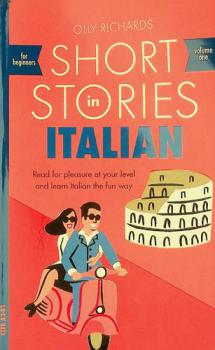
Short stories in Italian : read for pleasure at your level and learn Italian the fun way
Short Stories in Italian for Beginners has been written especially for students from beginner to intermediate level, designed to give a sense of achievement, and most importantly - enjoyment! These eight captivating stories will both entertain you, and give you a feeling of progress when reading. As a result, you will be able to focus on enjoying reading, delighting in your improved range of vocabulary and grasp of the language, without ever feeling overwhelmed or frustrated. From science fiction to fantasy, to crime and thrillers, Short Stories in Italian for Beginners will make learning Italian easy and enjoyable.

Towards a New Standard
In many European languages the National Standard Variety is converging with spoken, informal, and socially marked varieties. In Italian this process is giving rise to a new standard variety called Neo-standard Italian, which partly consists of regional features. This book contributes to current research on standardization in Europe by offering a comprehensive overview of the re-standardization dynamics in Italian. Each chapter investigates a specific dynamic shaping the emergence of Neo-standard Italian and Regional Standard Varieties, such as the acceptance of previously non-standard features, the reception of Old Italian features excluded from the standard variety, the changing standard language ideology, the retention of features from Italo-Romance dialects, the standardization of patterns borrowed from English, and the developmental tendencies of standard Italian in Switzerland. The contributions investigate phonetic/phonological, prosodic, morphosyntactic, and lexical phenomena, addressed by several empirical methodologies and theoretical vantage points. This work is of interest to scholars and students working on language variation and change, especially those focusing on standard languages and standardization dynamics.
eBook
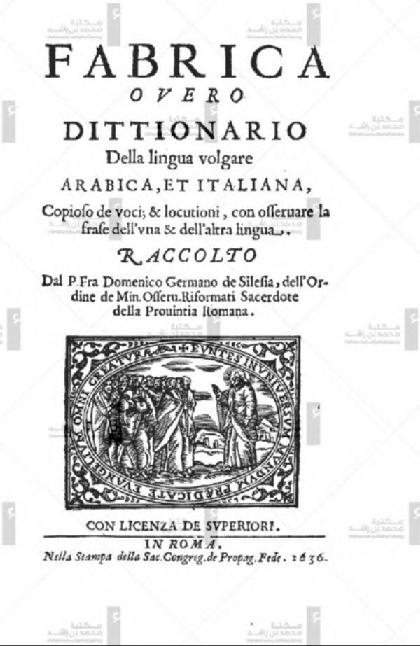
Fabrica overo dittionario della lingua volgare arabica, et italiana
Dominicus Germanus de Silesia (1588--1670) was a German priest and missionary. Born in Schurgast (present-day Skorogoszcz, Poland), he entered the Franciscan order in 1624 and devoted himself to learning Arabic, Persian, and Turkish. In 1630 he went to Palestine as a pastor, where he continued with his language studies. In 1635 he returned to Rome where he joined the Sacra Congregatio de Propaganda de Fide (Sacred Congregation for the Propagation of the Faith). In 1636 he became a teacher at the Mission of San Pietro in Montorio, Rome, and published his grammar of Arabic and Italian, Fabrica overo dittionario della lingua volgare arabica, et italiana (Fabrica, or dictionary of vernacular Arabic and Italian language). Shown here is the rare first edition of his Fabrica, printed by the press of the Propagande de Fide. Dominicus was also the editor of the famous Arabic--Latin dictionary printed at the same press in 1639, and the author of a polemical work, Antitheses Fidei, published in 1638. In 1645 he was sent to Persia on a political mission by King Wladyslaw IV of Poland. Although his destination was Samarkand, he appears to have reached no further than Isfahan, where he remained, studying Persian and Turkish, before returning to Rome in 1651. In 1652 he went to Spain to the court of Philip IV as teacher and translator. A number of his translations survive at the Escorial Palace. In Madrid he completed a translation of the Bible into Arabic, which the Vatican published in 1671. His translation of the Qurʼan appears to have been incomplete at his death in 1670, in Madrid.
Rare Book
