
Catalogue Search | MBRL


Are you sure you want to remove the book from the shelf?

{{itemTitle}}
26
result(s) for
"Italian poetry -- 16th century -- History and criticism"
Sort by:


The Sword and the Pen
In The Sword and the Pen: Women, Politics, and Poetry in Sixteenth-Century Siena, Konrad Eisenbichler analyzes the work of Sienese women poets, in particular, Aurelia Petrucci, Laudomia Forteguerri, and Virginia Salvi, during the first half of the sixteenth century up to the fall of Siena in 1555. Eisenbichler sets forth a complex and original interpretation of the experiences of these three educated noblewomen and their contributions to contemporary culture in Siena by looking at the emergence of a new lyric tradition and the sonnets they exchanged among themselves and with their male contemporaries. Through the analysis of their poems and various book dedications to them, Eisenbichler reveals the intersection of poetry, politics, and sexuality, as well as the gendered dialogue that characterized Siena's literary environment during the late Renaissance. Eisenbichler also examines other little-known women poets and their relationship to the cultural environment of Siena, underlining the exceptional role of the city of Siena as the most important center of women's writing in the first half of the sixteenth century in Italy, and probably in all of Europe.
This innovative contribution to the field of late Renaissance and early modern Italian and women's studies rescues from near oblivion a group of literate women who were celebrated by contemporary scholars but who have been largely ignored today, both because of a dearth of biographical information about them and because of a narrow evaluation of their poetry. Eisenbichler's analysis and reproduction of many of their poems in Italian and modern English translation are an invaluable contribution not only to Italian cultural studies but also to women's studies.
eBook

The Romance Epics of Boiardo, Ariosto, and Tasso
InThe Romance Epics of Boiardo, Ariosto, and Tasso, Jo Ann Cavallo attempts a new interpretation of the history of the renaissance romance epic in northern Italy, focusing on the period's three major chivalric poets. Cavallo challenges previous critical assumptions about the trajectory of the romance genre, especially regarding questions of creative imitation, allegory, ideology, and political engagement.
In tracing the development of the romance epic against the historical context of the Ferrarese court and the Italian peninsula, Cavallo moves from a politically engaged Boiardo, whose poem promotes the tenets of humanism, to an individualistic Tasso, who opposed the repressive aspects of the counter-reformation culture he is often thought to represent. Ariosto is read from the vantage of his predecessor Boiardo, and Cavallo describes his cynicism and later mellowing attitude toward the real-world relevance of his and Boiardo's fiction.The Romance Epics of Boiardo, Ariosto, and Tassois the first critical study to bring together the three poets in a coherent vision that maps changes while uncovering continuities.
eBook

The Quest for Epic
Translated here for the first time into English, Sergio Zatti'sThe Quest for Epicis a selection of studies on the two major poets of the Italian Renaissance, Ludovico Ariosto and Torquato Tasso, by one of the most important literary critics writing in Italy today. An original and challenging work,The Quest for Epicdocuments the development of Italian narrative from the chivalric romance at the end of the fifteenth century to the genre of epic in the sixteenth century.
Zatti focuses on Ariosto'sOrlando Furioso, written in the early 1500s, and progresses to Tasso'sJerusalem Delivered, written at the end of the century, but also touches briefly on Boiardo, Ariosto's great predecessor at the Estense court in Ferrara, as well as on Pulci, Trissino, and many other Italian writers of the period. Zatti highlights the critical debates over narrative form in the sixteenth century that become signposts on the way to literary modernity and the eventual rise of the modern novel. Albert Russell Ascoli's introduction provides context by mapping Zatti's criticism and situating it among Italian and Anglo-American literary critical studies, making a case for the contribution this book will have for English-language readers.
eBook
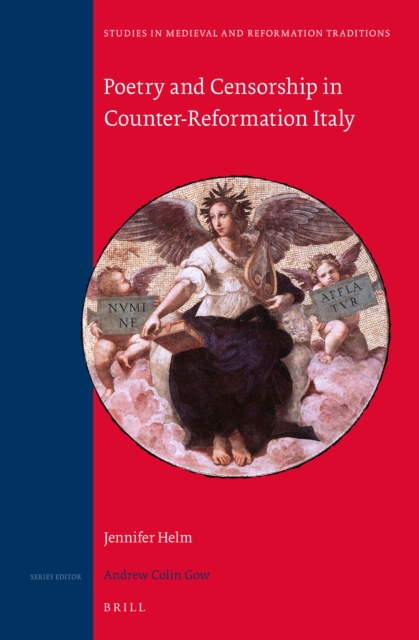
Poetry and Censorship in Counter-Reformation Italy
In Poetry and Censorship Jennifer Helm offers insight into motives and strategies of Counter-Reformation censorship of poetry in Italy. Materials of Roman censorial authorities reveal why the control of poetry and of its reception was crucial to Counter-Reformation cultural politics.
eBook

Laura Battiferra and Her Literary Circle: An Anthology
Internationally known during her lifetime, Laura Battiferra (1523-89) was a gifted and prolific poet in Renaissance Florence. The author of nearly 400 sonnets remarkable for their subtlety, intricate narrative structure, and learned allusions, Battiferra, who was married to the prominent sculptor and architect Bartolomeo Ammannati, traversed an elite literary and artistic network, circulating her verse in a complex and intellectually fecund exchange with some of the most illustrious figures in Italian history. In this bilingual anthology, Victoria Kirkham gathers Battiferra's most essential writing, including newly discovered poems, which provide modern readers with a valuable social chronicle of sixteenth-century Italy and the courtly culture of the Counter-Reformation.
eBook

Textual Masculinity and the Exchange of Women in Renaissance Venice
Based on archival work and Quaintance's exceptional knowledge of Venetian dialect poetry,Textual Masculinity and the Exchange of Women in Renaissance Venice is an unprecedented window into the understudied world of Venetian literature.
eBook


The Art of Meditation and the French Renaissance Love Lyric
The Art of Meditation and the French Renaissance Love Lyricexamines the poetics of meditation in the French love lyric at the height of the Lyonnais Renaissance as illustrated by one of the country's most prominent writers.
eBook

Between Repentance and Desire: Women Poets and the Word in Early Modern Italy
In early modern Italy, lyric poets of spiritual verse experimented with engaging and depicting the divine Word in novel ways. They aestheticized bodies, including that of Christ, and they imagined eroticized encounters between themselves and the Word made flesh. This article examines the sensual spiritual poetry of three early modern Italian women who, between 1530 and 1630, dedicated themselves to crafting and reinvigorating the poetic word and to expressing and (re)presenting the divine Word. Exploring the introspective and subjective spiritual lyrics of Vittoria Colonna (1492–1547), Laura Battiferri (1523–1589), and Francesca Turini Bufalini (1553–1641) in the context of the Italian literary Renaissance and Counter-Reformation, it aims to highlight and to elucidate the conflation of the sacred and the erotic in their verse. In so doing, this article reveals how these early modern female poets deployed the sensual strategically in their verse to elevate the erotic and how they raised the Italian religious lyric to new literary heights by spiritualizing the dominant poetic idiom.
Journal Article