
Catalogue Search | MBRL


Are you sure you want to remove the book from the shelf?

{{itemTitle}}
170
result(s) for
"Italy Genoa."
Sort by:

Genoa's freedom : entrepreneurship, republicanism, and the Spanish Atlantic
\"This study examines the history of medieval and early modern Genoa. It analyzes political, economic, and intellectual developments and argues that the Genoese civic character emerged from the entanglement of its unique form of republicanism and its entrepreneurial economic culture\"--Provided by publisher.
Book

Genoa's freedom
This book investigates the economic, intellectual and political history of late medieval and early modern Genoa and the historical origins of the Genoese presence in the Spanish Atlantic. Salonia describes Genoa's late medieval economic expansion and commercial networks through several case studies, from the Black Sea to southern England, and briefly compares it to the state-run military expansion of Venice&rsquo s empire. The author links the adaptability and entrepreneurial skills of Genoese merchants and businessmen to the constitutional history of the Genoese commune and to the specific idea of freedom progressively protected by its constitutions and embodied by institutions like the Bank of St. George. Moreover, this book offers an unprecedented account of the actions with which Ferdinand the Catholic protected Genoese merchants in his dominions and of the later, mutual understanding between the Genoese community and emperor Charles V during the Italian Wars, and in particular during the 1520s. These developments in Hispanic-Genoese diplomatic and economic relations are of great significance. The sixteenth-century Hispanic-Genoese alliance is important to understand the characteristics of Habsburg governance and the resilience of Genoa's republican conservatism. Genoa's republicanism (based on private wealth and private arms) contradicts historiographical narratives that assume the inevitability of the emergence of the modern, militarized and centralized state. It also shows the inadequacy of Tuscan-centric historical accounts of Renaissance republicanism. The last chapter of the book reveals the consequences of the 1528 Hispanic-Genoese alliance by considering case studies that illustrate the Genoese presence in the Spanish Americas, from Chile to Mexico, since the early stages of conquest and settlement.
eBook

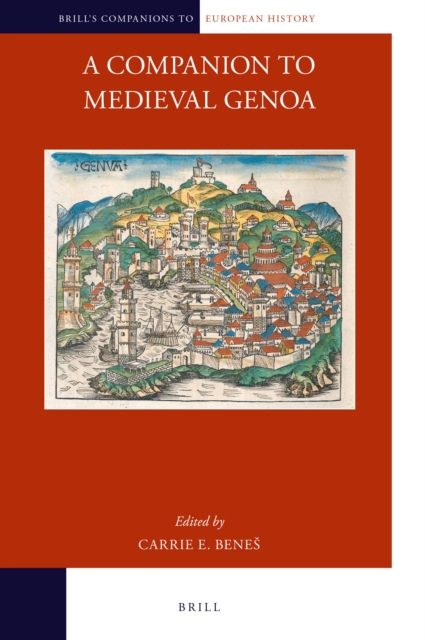
A Companion to Medieval Genoa
A Companion to Medieval Genoa introduces recent scholarship on the vibrant and source-rich medieval history of Genoa, with thematic chapters positioning the city and its people within the broader history of Italy and the Mediterranean ca. 1100-1500.
eBook

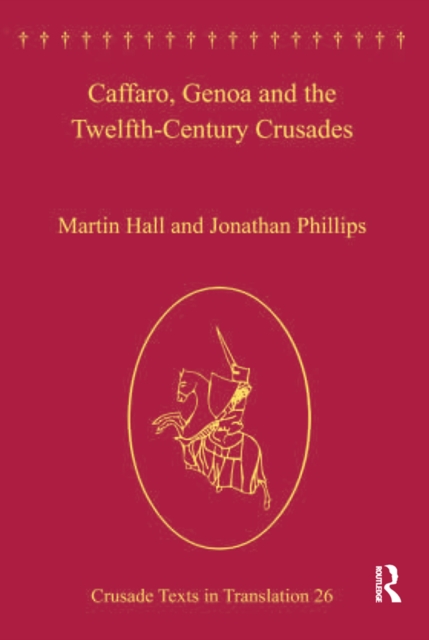
Caffaro, Genoa and the Twelfth-Century Crusades
This volume provides the first comprehensive English translation, with a substantial introduction and notes, of the writings of Caffaro of Genoa, as well as related texts and documents on Genoa and the crusades. The majority of early crusading historiography is from a northern European and clerical perspective. Here is a very different voice, one with a more secular, Mediterranean tone. To see the similarities and differences with the mainstream sources offers an exciting new dimension to our understanding of the reception of crusading ideas in the Mediterranean and, given Genoa's prominence in the commercial world, can help to illuminate the complex and controversial relationship between holy war and financial gain. Caffaro's main composition, the 'Annals' of Genoa, began with the First Crusade and extended down to 1163. It also covers the city's dealings with the Papacy, the German Empire, Sicily, Muslim Spain, and Pisa, as well as the development of Genoa itself. Sections from Caffaro's continuators take the story down to the Third Crusade. Caffaro's two other texts are exclusively about the crusades: 'The Liberation of the Cities of the East' and 'The Capture of AlmerÃa and Tortosa', while associated with him but of a later date is the 'Short History of Jerusalem'. Alongside these narratives are a number of charters and letters that relate to, and complement, the main texts. These relate to matters such as Genoese privileges in the Holy Land and form a valuable resource in their own right. Placed alongside Caffaro's narratives they can show the blend of commercial energy, civic pride and religious conviction that were the basis of Genoese activity in the complex world of the medieval Mediterranean.
eBook

La superba
\"Migration, legal and illegal, is at the center of this novel about a writer who becomes trapped in his walk on the wild side in mysterious and exotic Genoa, the labyrinthine port city nicknamed 'La Superba.'\" --publisher's description
Book
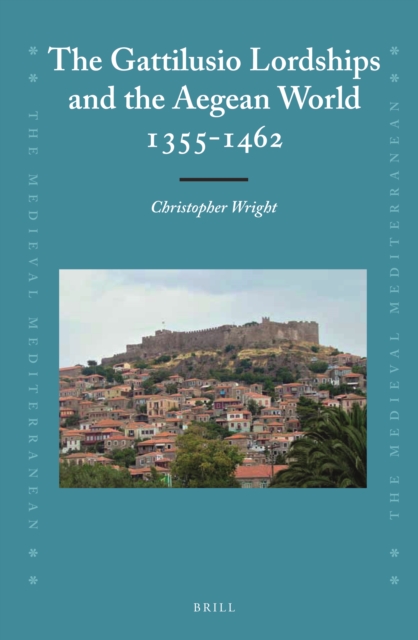
The Gattilusio Lordships and the Aegean World 1355-1462
In The Gattilusio Lordships, Christopher Wright offers a window into the culturally and politically diverse world of the late medieval Aegean, through the microcosm of one of the small and distinctive regimes that flourished in this fragmented environment.
eBook


Manganonewberyite, Mn(PO3OH)(H2O)3, the manganese analogue of newberyite from the Cassagna Mine, Italy
The new mineral manganonewberyite (IMA2024-004), Mn(PO3OH)(H2O)3, was found underground at the Cassagna mine, Liguria, Italy, where it is a secondary phase formed by the interaction of bat guano with Mn-rich rock. Manganonewberyite occurs with niahite, kutnohorite, sampleite and serrabrancaite on a tinzenite-quartz-braunite matrix. Crystals are prisms and blades, up to ∼0.15 mm long, elongated parallel to [001], flattened on {100} and exhibiting the forms {100}, {010} and {111}. Crystals are colourless and transparent, with vitreous lustre and white streak. The mineral is brittle with curved fracture. The Mohs hardness is ∼3. Cleavage is perfect on {010}. The density is 2.34(2) g·cm-3. Optically, manganonewberyite is biaxial (+) with α = 1.541(2), β = 1.547(2) and γ = 1.559(2) (white light). The 2V is 71.6(3)°. The optical orientation is X = a, Y = b and Z = c. The empirical formula is (Mn0.960Mg0.016Ca0.015)Σ0.991(H1.02P1.00O4)(H2O)3. Manganonewberyite is orthorhombic, space group Pbca, with cell parameters: a = 10.4273(6), b = 10.8755(8), c = 10.2126(4) Å, V = 1158.13(11) Å3 and Z = 8. The crystal structure (R1 = 2.79% for 892 I > 2σI reflections) is the same as that of newberyite with Mn in place of Mg.
Journal Article