
Catalogue Search | MBRL


Are you sure you want to remove the book from the shelf?

{{itemTitle}}
36
result(s) for
"Italy Murano."
Sort by:

Flora ad infinitum : Blühende Perlenkunst in Venedig und der Welt = Fiori di perline a Venezia e nel mondo
Glasperlen können auf Drähte aufgefädelt und zu Blumen geformt werden - ein historisches Kunsthandwerk, das in Venedig und dem berühmten Muranoglas beheimatet ist. In dem reich bebilderten Buch erzählt Georg Ragnar Levi die faszinierende Geschichte, wie es dazu kam, dass Perlenblumen geliebt und verachtet und irgendwann in der Geschichte sogar verboten wurden. Sogenannte Französische Perlenblumen wurden zu Hause, in Klöstern, Gefängnissen und Werkstätten hergestellt und bei Taufen, Hochzeiten und Beerdigungen zu ornamentalen und symbolischen Zwecken verwendet. Der Leser wird durch Historie, Techniken, Materialien und die persönlichen Geschichten hinter diesem Handwerk geführt. Levi zeigt, wie die Nachfrage nach Kränzen und Sträussen im frühen 20. Jh. zum Broterwerb vieler Familien in Europa wurde und die Glashütten von Murano und Böhmen aufblühen liess.
Book

Green Worlds of Renaissance Venice
From celebrated gardens in private villas to the paintings and sculptures that adorned palace interiors, Venetians in the sixteenth century conceived of their marine city as dotted with actual and imaginary green spaces. This volume examines how and why this pastoral vision of Venice developed.
Drawing on a variety of primary sources ranging from visual art to literary texts, performances, and urban plans, Jodi Cranston shows how Venetians lived the pastoral in urban Venice. She describes how they created green spaces and enacted pastoral situations through poetic conversations and theatrical performances in lagoon gardens; discusses the island utopias found, invented, and mapped in distant seas; and explores the visual art that facilitated the experience of inhabiting verdant landscapes. Though the greening of Venice was relatively short lived, Cranston shows how the phenomenon had a lasting impact on how other cities, including Paris and London, developed their self-images and how later writers and artists understood and adapted the pastoral mode.
Incorporating approaches from eco-criticism and anthropology, Green Worlds of Renaissance Venice greatly informs our understanding of the origins and development of the pastoral in art history and literature as well as the culture of sixteenth-century Venice. It will appeal to scholars and enthusiasts of sixteenth-century history and culture, the history of urban landscapes, and Italian art.
eBook

Falcon in the glass : a novel
\"Eleven-year-old Renzo must teach himself to blow glass with the help of a girl who has a mysterious connection to her falcon\"-- Provided by publisher.
Book

The Other Futurism
The Other Futurismlooks at particular examples of literature, visual arts, and the performing arts and, using a series of rare documents, sheds new light on the complex cultural and political issues at the heart of this neglected chapter in Italy's history.
eBook

Sargent, Whistler & Venetian glass : American artists and the magic of Murano
\"Experience the spectacle of Venice and its rich history as a glassmaking capital through Sargent, Whistler, and Venetian Glass: American Artists and the Magic of Murano. This exhibition catalogue is the first comprehensive examination of the American Grand Tour to Venice in the late nineteenth century, revealing the glass furnaces and their new creative boom as a vibrant facet of the city's allure. This gorgeously illustrated catalogue features paintings and prints by John Singer Sargent, James McNeill Whistler, Frank Duveneck, Thomas Moran, William Merritt Chase, Maurice Prendergast, Maxfield Parrish, Louise Cox, and Ellen Day Hale alongside rarely seen Venetian glass mosaic portraits and glass cups, vases, and urns by the leading Murano glassmakers. Reuniting these exquisitely crafted objects with paintings, etchings, and drawings from the same milieu, this catalogue recovers and explains their past significance. Five new essays from experts in the history of American art and of Venetian glass provide the first combined survey of fine and decorative arts from the Venetian Grand Tour, offering a unique and valuable contribution to the fields of American Art and nineteenth-century cultural history. Ultimately, this project demonstrates the lasting impact of the nineteenth-century Venetian glass revival on American art, literature, and education, as well as period concepts of gender and social class.\"-- Provided by publisher.
BOOK
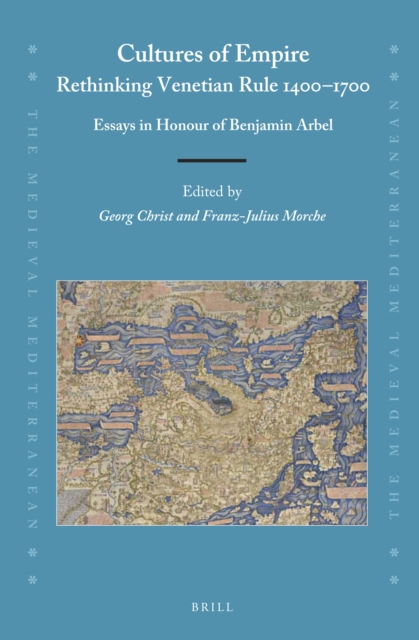
Cultures of Empire: Rethinking Venetian Rule, 1400-1700
This book investigates perceptions, modes, and techniques of Venetian rule in the early modern Eastern Mediterranean (1400-1700). Against the backdrop of the controversial notion of the Venetian realm as a colonial empire, essays from a range of specialists examine how Venice negotiated control over the territories, resources, and traditions of different empires (Byzantine, Roman, Mamluk, Ottoman) while developing its own claims of authority. Focusing in particular on questions of belonging and status in the Venetian overseas territories, the volume incorporates observations on the daily realities of Venetian rule: how did Venice negotiate claims of authority in light of former and ongoing imperial belongings? What was the status of colonial subjects and ships in the metropolis and in foreign territories? In what ways did Venice accept and continue old forms of imperial belonging? Did subordinate entities join in a shared communal identity? The volume opens new perspectives on Venetian rule at the crossroads of empire and early modern statehood: a polity negotiating and entangling empire. Contributors are Housni Alkhateeb Shehada, Georg Christ, Giacomo Corazzol, Nicholas Davidson, Renard Gluzman, Deborah Howard, David Jacoby (z''l), Marianna Kolyvà, Franz-Julius Morche, Reinhold C. Mueller, Monique O'Connell, Gerassimos D. Pagratis, Tassos Papacostas, Maria Pia Pedani (†), Dorit Raines, and E. Natalie Rothman.
eBook

Venetians in Constantinople
Historian Eric R Dursteler reconsiders identity in the early modern world to illuminate Veneto-Ottoman cultural interaction and coexistence, challenging the model of hostile relations and suggesting instead a more complex understanding of the intersection of cultures. Although dissonance and strife were certainly part of this relationship, he argues, coexistence and cooperation were more common.
Moving beyond the \"clash of civilizations\" model that surveys the relationship between Islam and Christianity from a geopolitical perch, Dursteler analyzes the lived reality by focusing on a localized microcosm: the Venetian merchant and diplomatic community in Muslim Constantinople.
While factors such as religion, culture, and political status could be integral elements in constructions of self and community, Dursteler finds early modern identity to be more than the sum total of its constitutent parts and reveals how the fluidity and malleability of identity in this time and place made coexistence among disparate cultures possible.
eBook

Ordering Customs
Ordering Customs explores how Renaissance Venetians sought to make sense of human difference in a period characterized by increasing global contact and a rapid acceleration of the circulation of information. Venice was at the center of both these developments. The book traces the emergence of a distinctive tradition of ethnographic writing that served as the basis for defining religious and cultural difference in new ways. Taylor draws on a trove of unpublished sources-diplomatic correspondence, court records, diaries, and inventories-to show that the study of customs, rituals, and ways of life not only became central in how Venetians sought to apprehend other peoples, but also had a very real impact at the level of policy, shaping how the Venetian state governed minority populations in the city and its empire. In contrast with the familiar image of ethnography as the product of overseas imperial and missionary encounters, the book points to a more complicated set of origins.
eBook

The Notorious Mrs Ebbsmith
'That is what marriage gives – the right to destroy years and years of life.' Venice, Easter 1895. In the cafes around St Mark's Square, all the gossip among the English ex-pat community is about two mysterious arrivals in the city. Agnes Ebbsmith is a young widow with a scandalous past. Travelling with her is Lucas Cleeve, an up-and-coming Tory MP who has abandoned his wife in London. Defying convention, Agnes and Lucas are refusing to marry, and living in a 'compact' together. But before long their peace is shattered by the arrival of Lucas's aristocratic family from London. The Notorious Mrs Ebbsmith is a dramatic, entertaining, and utterly enthralling play by one of the greatest Victorian dramatists. This playtext, slightly adapted from the original, was prepared for its first ever revival, presented by Primavera at Jermyn Street Theatre in 2014. The Notorious Mrs Ebbsmith was last performed by Mrs Patrick Campbell in the West End in 1895. With an introduction to the play and its historical context by Dr Sos Eltis.
eBook

Textual Masculinity and the Exchange of Women in Renaissance Venice
Based on archival work and Quaintance's exceptional knowledge of Venetian dialect poetry,Textual Masculinity and the Exchange of Women in Renaissance Venice is an unprecedented window into the understudied world of Venetian literature.
eBook