
Catalogue Search | MBRL


Are you sure you want to remove the book from the shelf?

{{itemTitle}}
19
result(s) for
"Italy Politics and government 1268-1559."
Sort by:


A Renaissance Architecture of Power
Urbino, Rome, Florence, Milan, Ferrara... but also Mantua and Imola, Carpi and Saluzzo, Naples and Sicily: a collection of case studies on the Renaissance renewal of Italian court palaces from a comparative perspective.
eBook

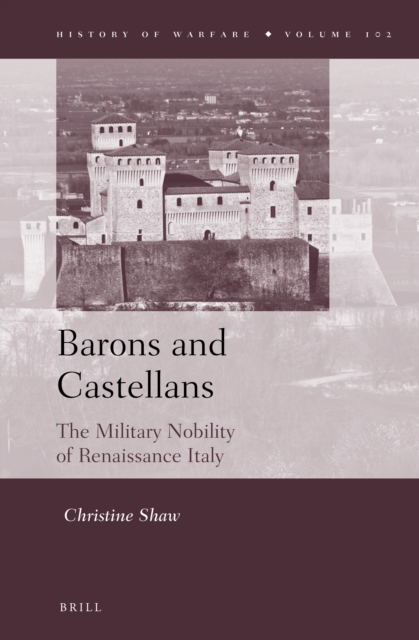
Barons and Castellans
In Barons and Castellans: The Military Nobility of Renaissance Italy, Christine Shaw provides the first comparative study of \"lords of castles\", great and small, throughout Italy, examining their military and political significance, and how their roles changed during the Italian Wars.
eBook

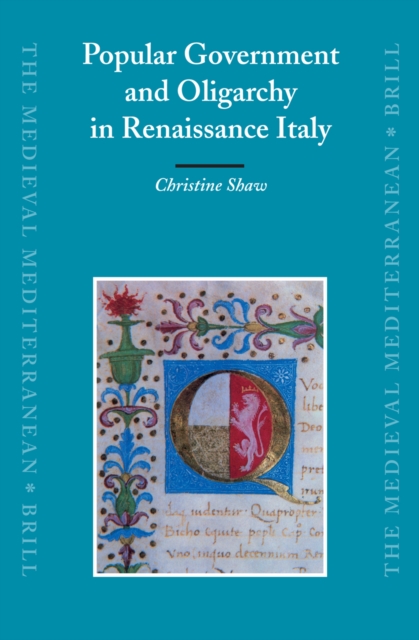
Popular government and oligarchy in Renaissance Italy
This book is an examination of the nature of the governments of towns and cities, great and small, in Renaissance Italy, and of why oligarchic regimes were becoming increasingly prevalent. Themes and questions arising from a case-study of the dramatic changes in the government of fifteenth-century Siena form the basis for the analysis of popular government and oligarchy throughout Italy, from Piedmont and the Veneto to Sicily, and of how they were shaped by social change, institutional developments and external threats and pressures, especially war. In a field dominated by local studies, this comparative approach provides a fresh understanding of the important problem of how and why broadly-based governments were losing ground to oligarchy throughout Italy.
eBook


The Italian Renaissance State
This magisterial study proposes a revised and innovative view of the political history of Renaissance Italy. Drawing on comparative examples from across the peninsula and the kingdoms of Sicily, Sardinia and Corsica, an international team of leading scholars highlights the complexity and variety of the Italian world from the fourteenth to early sixteenth centuries, surveying the mosaic of kingdoms, principalities, signorie and republics against a backdrop of wider political themes common to all types of state in the period. The authors address the contentious problem of the apparent weakness of the Italian Renaissance political system. By repositioning the Renaissance as a political, rather than simply an artistic and cultural phenomenon, they identify the period as a pivotal moment in the history of the state, in which political languages, practices and tools, together with political and governmental institutions, became vital to the evolution of a modern European political identity.
eBook

Renaissance mass murder : civilians and soldiers during the Italian wars
Renaissance Mass Murder' explores the devastating impact of war on the men and women of the Renaissance. In contrast to the picture of balance and harmony usually associated with the Renaissance, it uncovers in forensic detail a world in which sacks of Italian cities and massacres of civilians at the hands of French, German, Spanish, Swiss, and Italian troops were regular occurrences. 0The arguments presented are based on a wealth of evidence - histories and chronicles, poetry and paintings, sculpture and other objects - which together provide a new and startling history of sixteenth-century Italy and a social history of the Italian Wars. It outlines how massacres happened, how princes, soldiers, lawyers, and writers justified and explained such events, and how they were represented in contemporary culture. 0On this basis, Renaissance Mass Murder reconstructs the terrifying individual experiences of civilians in the face of war and in doing so offers a story of human tragedy which redresses the balance of the history of the Italian Wars, and of Renaissance warfare, in favour of the civilian and away from the din of battle. This volume also places mass murder in a broader historical context and challenges claims that such violence was unusual or in decline in early modern Europe. Finally,0it shows that women often suffered disproportionately from this violence and that immunity for them, as for their children, was often partially developed or poorly respected.
Book
Churchmen and Urban Government in Late Medieval Italy, c.1200–c.1450
Why, when so driven by the impetus for autonomy, did the city elites of thirteenth-century Italy turn to men bound to religious orders whose purpose and reach stretched far beyond the boundaries of their often disputed territories? Churchmen and Urban Government in Late Medieval Italy, c.1200–c.1450 brings together a team of international contributors to provide the first comparative response to this pivotal question. Presenting a series of urban cases and contexts, the book explores the secular-religious boundaries of the period and evaluates the role of the clergy in the administration and government of Italy's city-states. With an extensive introduction and epilogue, it exposes for consideration the beginnings of the phenomenon, the varying responses of churchmen, the reasons why practices changed and how politics and religious identity relate to each other. This important new study has significant implications for our understanding of power, negotiation, bureaucracy and religious identity.
eBook