
Catalogue Search | MBRL


Are you sure you want to remove the book from the shelf?

{{itemTitle}}
5
result(s) for
"Ivan IV, Czar of Russia, 1530-1584 -- In motion pictures"
Sort by:

This thing of darkness : Eisenstein's Ivan the Terrible in Stalin's Russia
\"Eisenstein's diaries and production notebooks show that he carefully planned Ivan the Terrible to be a devastating critique of Stalinism, a profound study of the tragedy of absolute power, and a wildly innovative use of montage, all wrapped inside a narrative that would receive Stalin's approval\"-- Provided by publisher.
BOOK

This Thing of Darkness
Sergei Eisenstein's unfinished masterpiece, Ivan the Terrible, was no ordinary movie. Commissioned by Joseph Stalin in 1941 to justify state terror in the sixteenth century and in the twentieth, the film's politics, style, and epic scope aroused controversy even before it was released. In This Thing of Darkness, Joan Neuberger offers a sweeping account of the conception, making, and reception of Ivan the Terrible that weaves together Eisenstein's expansive thinking and experimental practice with a groundbreaking new view of artistic production under Stalin. Drawing on Eisenstein's unpublished production notebooks, diaries, and manuscripts, Neuberger's riveting narrative chronicles Eisenstein's personal, creative, and political challenges and reveals the ways cinematic invention, artistic theory, political critique, and historical and psychological analysis went hand in hand in this famously complex film.
Neuberger's bold arguments and daring insights into every aspect of Eisenstein's work during this period, together with her ability to lucidly connect his wide-ranging late theory with his work on Ivan, show the director exploiting the institutions of Soviet artistic production not only to expose the cruelties of Stalin and his circle but to challenge the fundamental principles of Soviet ideology itself. Ivan the Terrible, she argues, shows us one of the world's greatest filmmakers and one of the 20th century's greatest artists observing the world around him and experimenting with every element of film art to explore the psychology of political ambition, uncover the history of recurring cycles of violence and lay bare the tragedy of absolute power.
eBook
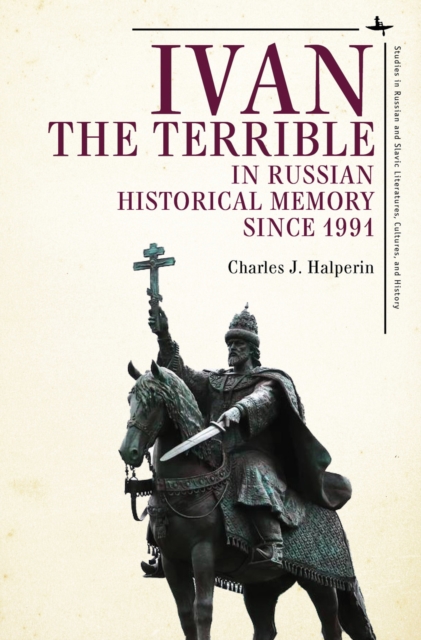
Ivan the Terrible in Russian historical memory since 1991
Tsar Ivan the Terrible (Ivan IV, 1533-1584) is one of the most controversial rulers in Russian history, infamous for his cruelty. He was the first Russian ruler to use mass terror as a political instrument, and the only Russian ruler to do so before Stalin. Comparisons of Ivan to Stalin only exacerbated the politicization of his image. Russians have never agreed on his role in Russian history, but his reign is too important to ignore. Since the abolition of censorship in 1991 professional historians and amateurs have grappled with this problem. Some authors have manipulated that image to serve political and cultural agendas. This book explores Russia's contradictory historical memory of Ivan in scholarly, pedagogical and political publications.
eBook

Ivan the Terrible in Russian Historical Memory since 1991
Tsar Ivan the Terrible (Ivan IV, 1533-1584) is one of the most
controversial rulers in Russian history, infamous for his cruelty.
He was the first Russian ruler to use mass terror as a political
instrument, and the only Russian ruler to do so before Stalin.
Comparisons of Ivan to Stalin only exacerbated the politicization
of his image. Russians have never agreed on his role in Russian
history, but his reign is too important to ignore. Since the
abolition of censorship in 1991 professional historians and
amateurs have grappled with this problem. Some authors have
manipulated that image to serve political and cultural agendas.
This book explores Russia's contradictory historical memory of Ivan
in scholarly, pedagogical and political publications.
eBook
