
Catalogue Search | MBRL


Are you sure you want to remove the book from the shelf?

{{itemTitle}}
6
result(s) for
"JPHF"
Sort by:

Monitoring democracy
In recent decades, governments and NGOs--in an effort to promote democracy, freedom, fairness, and stability throughout the world--have organized teams of observers to monitor elections in a variety of countries. But when more organizations join the practice without uniform standards, are assessments reliable? When politicians nonetheless cheat and monitors must return to countries even after two decades of engagement, what is accomplished? Monitoring Democracy argues that the practice of international election monitoring is broken, but still worth fixing. By analyzing the evolving interaction between domestic and international politics, Judith Kelley refutes prevailing arguments that international efforts cannot curb government behavior and that democratization is entirely a domestic process. Yet, she also shows that democracy promotion efforts are deficient and that outside actors often have no power and sometimes even do harm.
Analyzing original data on over 600 monitoring missions and 1,300 elections, Kelley grounds her investigation in solid historical context as well as studies of long-term developments over several elections in fifteen countries. She pinpoints the weaknesses of international election monitoring and looks at how practitioners and policymakers might help to improve them.
eBook

The message matters
The economy is so powerful in determining the results of U.S. presidential elections that political scientists can predict winners and losers with amazing accuracy long before the campaigns start. But if it is true that \"it's the economy, Stupid,\" why do incumbents in good economies sometimes lose? The reason, Lynn Vavreck argues, is that what matters is not just the state of the economy but how candidates react to it. By demonstrating more precisely than ever before how candidates and their campaigns affect the economic vote,The Message Mattersprovides a powerful new way of understanding past elections--and predicting future ones.
Vavreck examines the past sixty years of presidential elections and offers a new theory of campaigns that explains why electoral victory requires more than simply being the candidate favored by prevailing economic conditions. Using data from presidential elections since 1952, she reveals why, when, and how campaign messages make a difference--and when they can outweigh economic predictors of election outcomes.
The Message Mattersdoes more than show why candidates favored by the economy must build their campaigns around economic messages. Vavreck's theory also explains why candidates disadvantaged by the economy must try to focus their elections on noneconomic issues that meet exacting criteria--and why this is so hard to do.
eBook

A behavioral theory of elections
Most theories of elections assume that voters and political actors are fully rational. While these formulations produce many insights, they also generate anomalies--most famously, about turnout. The rise of behavioral economics has posed new challenges to the premise of rationality. This groundbreaking book provides a behavioral theory of elections based on the notion that all actors--politicians as well as voters--are only boundedly rational. The theory posits learning via trial and error: actions that surpass an actor's aspiration level are more likely to be used in the future, while those that fall short are less likely to be tried later.
Based on this idea of adaptation, the authors construct formal models of party competition, turnout, and voters' choices of candidates. These models predict substantial turnout levels, voters sorting into parties, and winning parties adopting centrist platforms. In multiparty elections, voters are able to coordinate vote choices on majority-preferred candidates, while all candidates garner significant vote shares. Overall, the behavioral theory and its models produce macroimplications consistent with the data on elections, and they use plausible microassumptions about the cognitive capacities of politicians and voters. A computational model accompanies the book and can be used as a tool for further research.
eBook

New faces, new voices
Making up 14.2 percent of the American population, Hispanics are now the largest minority group in the United States. Clearly, securing the Hispanic vote is more important to political parties than ever before. Yet, despite the current size of the Hispanic population, is there a clear Hispanic politics? Who are Hispanic voters? What are their political preferences and attitudes, and why? The first comprehensive study of Hispanic voters in the United States,New Faces, New Voicespaints a complex portrait of this diverse and growing population.
Examining race, politics, and comparative political behavior, Marisa Abrajano and R. Michael Alvarez counter the preconceived notion of Hispanic voters as one homogenous group. The authors discuss the concept of Hispanic political identity, taking into account the ethnic, generational, and linguistic distinctions within the Hispanic population. They compare Hispanic registration, turnout, and participation to those of non-Hispanics, consider the socioeconomic factors contributing to Hispanics' levels of political knowledge, determine what segment of the Hispanic population votes in federal elections, and explore the prospects for political relationships among Hispanics and non-Hispanics. Finally, the authors look at Hispanic opinions on social and economic issues, factoring in whether these attitudes are affected by generational status and ethnicity.
A unique and nuanced perspective on the Hispanic electoral population,New Faces, New Voicesis essential for understanding the political characteristics of the largest and fastest growing group of minority voters in the United States.
eBook

Electronic elections
Since the 2000 presidential election, the United States has been embroiled in debates about electronic voting. Critics say the new technologies invite tampering and fraud. Advocates say they enhance the accuracy of vote counts and make casting ballots easier--and ultimately foster greater political participation.Electronic Electionscuts through the media spin to assess the advantages and risks associated with different ways of casting ballots--and shows how e-voting can be the future of American democracy.
Elections by nature are fraught with risk. Michael Alvarez and Thad Hall fully examine the range of past methods and the new technologies that have been created to try to minimize risk and accurately reflect the will of voters. Drawing upon a wealth of new data on how different kinds of electronic voting machines have performed in recent elections nationwide, they evaluate the security issues that have been the subject of so much media attention, and examine the impacts the new computer-based solutions is having on voter participation. Alvarez and Hall explain why the benefits of e-voting can outweigh the challenges, and they argue that media coverage of the new technologies has emphasized their problems while virtually ignoring their enormous potential for empowering more citizens to vote. The authors also offer ways to improve voting technologies and to develop more effective means of implementing and evaluating these systems.
Electronic Electionsmakes a case for how e-voting can work in the United States, showing why making it work right is essential to the future vibrancy of the democratic process.
eBook
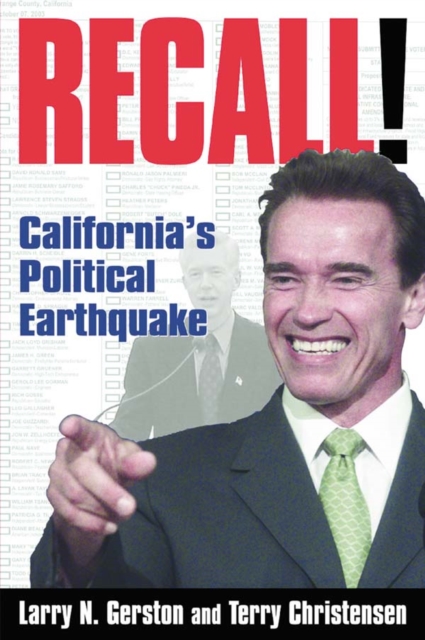
Recall!
In politics, as in so many other areas, California is unique. The state's economy - the largest in the nation, and sixth largest in the world - is given to dramatic swings. This work relates the latest and most dramatic chapter in the political history of the Golden State.
eBook