
Catalogue Search | MBRL


Are you sure you want to remove the book from the shelf?

{{itemTitle}}
10,728
result(s) for
"Jack Johnson"
Sort by:

Black Jack : the ballad of Jack Johnson
Art and poetry combine to tell the story of boxer Jack Johnson, who became the first African-American world heavyweight boxing champion in the early part of the twentieth century.
Book

Jack Johnson, rebel sojourner
In his day, Jack Johnson—born in Texas, the son of former slaves—was the most famous black man on the planet. As the first African American World Heavyweight Champion (1908–1915), he publicly challenged white supremacy at home and abroad, enjoying the same audacious lifestyle of conspicuous consumption, masculine bravado, and interracial love wherever he traveled. Jack Johnson, Rebel Sojourner provides the first in-depth exploration of Johnson's battles against the color line in places as far-flung as Sydney, London, Cape Town, Paris, Havana, and Mexico City. In relating this dramatic story, Theresa Runstedtler constructs a global history of race, gender, and empire in the early twentieth century.
eBook

Jack Johnson versus Jim Crow
Foundational to Jim Crow era segregation and discrimination in the United States was a “racialized reputational politics,” that constructed African Americans as not only inferior, but as villainous threats to the normative order, leading to the lynching of thousands of African Americans. While black villainy is a destructive force within society, we explore it is as basis for anti-racist politics, when appropriated by African Americans. There is a long history in African American folklore of celebrating the black outlaw who freely moves about and boldly violates moral and legal norms. Early 20th century American boxer Jack Johnson, who reigned as world heavy champion from 1908 to 1915, illustrates this complex and contested process of vilifying black bodies and reputations during the Jim Crow era. Our paper offers a critical, contextualized biographical analysis of Johnson, situating his struggles within the wider historical geography of violent US race relations and paying close attention to the controversial place he held within the white and black public imaginaries. Importantly, the African American fighter appropriated and manipulated Jim Crow villainy to challenge a white racist society and a conservative black establishment while also claiming the right to live on his own terms.
Fundacional a la segregación Jim Crow y a la discriminación en los EE.UU. era una “política reputacional racializada,” que no solo construyó a los afroamericanos como inferiores sino también como amenazas villanías al status quo, algo que contribuyó a los linchamientos de miles de afroamericanos. Mientras que la villanía es una fuerza destructiva dentro de la sociedad, en el presente artículo lo exploramos como posible fuente de una política anti-racista, cuando se apropia por los afroamericanos. Hay una larga historia en el folklórico afroamericano de celebrar el proscrito afroamericano quien se mueve libremente y quien rompe las normas morales y legales. El boxeador americano Jack Johnson del sigo XX, quien dominó como campeón mundial del boxeo pesado del 1908 al 1915, ilustra este contestado y complejo proceso de vilificar el cuerpo negro y las reputaciones de la era del Jim Crow. Nuestro artículo ofrece un análisis biográfica crítica contextualizada de Johnson, situando su desempeño dentro de la geografía histórica de las relaciones raciales violentas de los EE.UU. y prestando atención al lugar controversial que tuvo dentro del imaginario público de los blancos y los negros. El luchador afroamericano apropió y manipuló la villanía de la era Jim Crow para desafiar una sociedad racista blanca y un establecimiento conservador negro mientras reclamaba el derecho de vivir de sus propios términos.
Journal Article
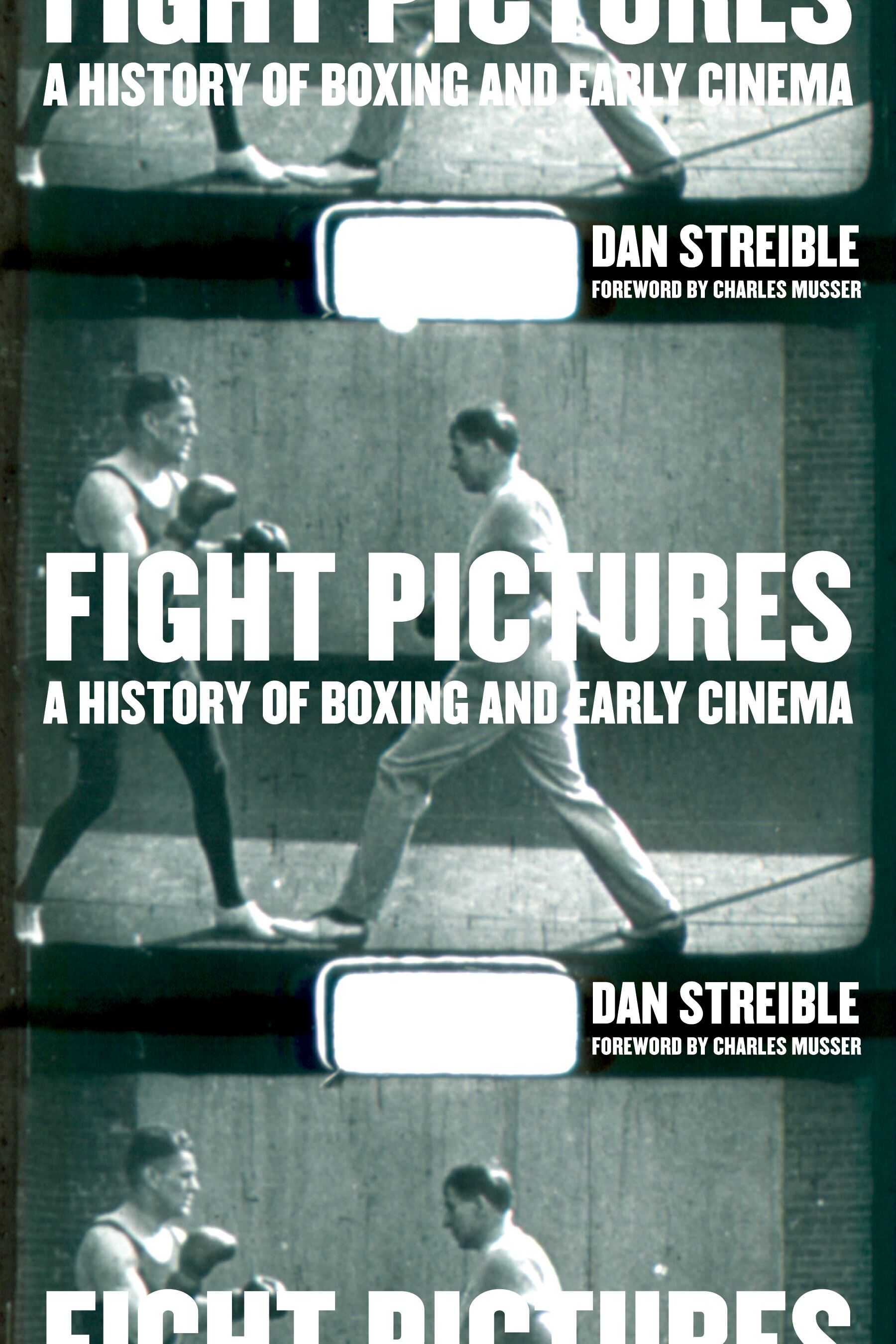
Fight Pictures
The first filmed prizefight, Veriscope's Corbett-Fitzsimmons Fight (1897) became one of cinema's first major attractions, ushering in an era in which hugely successful boxing films helped transform a stigmatized sport into legitimate entertainment. Exploring a significant and fascinating period in the development of modern sports and media, Fight Pictures is the first work to chronicle the mostly forgotten story of how legitimate bouts, fake fights, comic sparring matches, and more came to silent-era screens and became part of American popular culture.
eBook


Seeing without Feeling: Muybridge’s Boxing Pictures and the Rise of the Bourgeois Film Spectator
According to the underlying logic of this cartoon, fight films have the power to wrest attention from viewers who know better, to make them into credulous rubes against their will. [...]prizefight films were almost totally obliterated, leaving the films to underground exhibitions and distribution.
Journal Article

Fight Pictures
The first filmed prizefight, Veriscope's Corbett-Fitzsimmons Fight (1897) became one of cinema's first major attractions, ushering in an era in which hugely successful boxing films helped transform a stigmatized sport into legitimate entertainment. Exploring a significant and fascinating period in the development of modern sports and media, Fight Pictures is the first work to chronicle the mostly forgotten story of how legitimate bouts, fake fights, comic sparring matches, and more came to silent-era screens and became part of American popular culture.
eBook