
Catalogue Search | MBRL


Are you sure you want to remove the book from the shelf?

{{itemTitle}}
252
result(s) for
"Jameson, Fredric"
Sort by:


Fredric Jameson and film theory : Marxism, allegory, and geopolitics in world cinema
Frederic Jameson and Film Theory is the first collection of its kind, it assesses and critically responds to Fredric Jameson's remarkable contribution to film theory. The essays assembled explore key Jamesonian concepts-such as totality, national allegory, geopolitics, globalization, representation, and pastiche-and his historical schema of realism, modernism, and postmodernism, considering, in both cases, how these can be applied, revised, expanded and challenged within film studies. Featuring essays by leading and emerging voices in the field, the volume probes the contours and complexities of neoliberal capitalism across the globe and explores world cinema's situation within these forces by deploying and adapting Jamesonian concepts, and placing them in dialogue with other theoretical paradigms. The result is an innovative and rigorously analytical effort that offers a range of Marxist-inspired approaches towards cinemas from Asia, Latin America, Europe, and North America in the spirit of Jameson's famous rallying cry: 'always historicize!'.
eBook
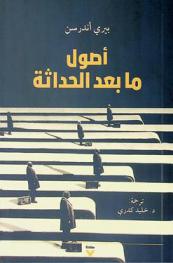
أصول ما بعد الحداثة
يتعقب بيري أندرسن في كتابه هذا (أصول مفهوم ما بعد الحداثة) وتطوراته المختلفة في حقول النقد الأدبي والتاريخ والمعمار والسوسيولوجيا والفلسفة، من الناقد الإسباني فيدريكو دي أونيس إلى عهد ثلاثينيات القرن الماضي مع فريدريك جيمسن الذي ربط المفهوم ورهاناته بتحولات الرأسمالية المعاصرة على نحو بديع لم يسبق له مثيل، منتئيا بمسافة سحيقة عن مواقف الماركسية التقليدية. وقد نذر بيري أندرسن معظم أجزاء كتابه لمناقشة هذه الدعوى.
Book

How to Fix this Intolerable Present with the Naked Eye; or, Periodizing the Contemporary
Fredric Jameson’s meditation on periodization highlights some of the challenges involved in any effort to think the contemporary. This essay argues that the best way to narrate the contemporary is through science fiction and further develops this insight through a reading of the comic book series (1980) and film adaptation (2014) of X-Men: Days of Future Past.
Journal Article


An Anti-Imperial Mythology
Abstract Critics have read Howards End as if Forster ‘specifically barred’ the poor from the novel (Trilling), so that only the middle classes are considered and not in a ‘truly radical’ way (Crews). Yet Forster does, after all, concern himself with the very poor in his depiction of Leonard Bast, Jacky and other characters, and extensively in the thoughts of Margaret. Furthermore, he creates the myth he says England lacks, and, considered in relationship to the main narrative events and to the novel's imagery, this takes the form of an anti-imperialist mythology. Mythic elements include epic journeys and battles, a symbolic sword and tree, a sacrificial death and a redemptive child. In the novel's poetic passages and in its account of Margaret's education on the ‘hard road of Henry's soul’, the nature of England's imperialism is revealed and defeated by an alternative radical and feminist vision of society.
Journal Article

Feeling Utopian: Demystification and the Management of Affect
Chew discusses the demystification and the management of affect based on the dialectic of utopia and ideology of Fredric Jameson, author of the book The Political Unconcious, with a reading of The Yiddish Policemen's Union by Michael Chabon. He explains the shared commitment of Chabon and Jameson to explore narrative's role in enabling people to remain open to the possibility of utopia in the face of overwhelming disappointment and failure. He highlights how Jameson fuels utopian affect with negative feelings provoked by the interpretive enactment of narrative's ideological failures while Chabon's novel stages the crucial role of the narrative's smaller-scale gratifications and pleasures in sustaining readers' affective relations to utopia.
Journal Article

Traveling Theory: Fredric Jameson’s Interpretations of the Cultural Revolution and Maoism
In her article, \"Traveling Theory: Fredric Jameson's Interpretations of the Cultural Revolution and Maoism,\" Xian Wang discusses how Jameson transformed or \"transcoded\" the Chinese Cultural Revolution into his notion of cultural revolution, regarding it as a radical means to achieve decolonization and national liberation. The Chinese Cultural Revolution therefore became a model for cultural revolution in different parts of the world, and an alternative vision of modernity. Jameson also associates Maoism and the Cultural Revolution with Antonio Gramsci's concept of subalternity, and considers cultural revolution as an ideological revolution for the oppressed classes. Taking Maoism as a traveling theory, this article argues that Jameson's theoretical intervention in Maoism and cultural revolution brings the Maoist utopian vision back to China. Jameson's understanding of the Cultural Revolution is also a significant component of his theory of globalization, postmodernism, and critique of the logic of late capitalism.
Journal Article
