
Catalogue Search | MBRL


Are you sure you want to remove the book from the shelf?

{{itemTitle}}
353
result(s) for
"Japan -- Intellectual life"
Sort by:


Beyond alterity
A comprehensive collection of essays that challenges orientalist notions by proposing East and West as complementary elements of global culture Provides a new perspective on the complex international relationships in Asian German studies The study encourages a move beyond a national approach to cultural studies Employs a wide range of approaches from postcolonial, globalization, media, and gender studies.
eBook

Uneven moments : reflections on Japan's modern history
\"Few scholars have done more than Harry Harootunian to shape the study of modern Japan. Incorporating Marxist critical perspectives on history and theoretically informed insights, his scholarship has been vitally important for the world of Asian studies. Uneven Moments presents a selection of Harootunian's essays on Japan's intellectual and cultural history from the late Tokugawa period to the present that span the many phases of his distinguished career and point to new directions for Japanese studies. Uneven Moments begins with reflections on area studies as an academic field and how we go about studying a region. It then moves into discussions of key topics in modern Japanese history. Harootunian considers Japan's fateful encounter with capitalist modernity and the implications of uneven development, examining the combinations of older practices with new demands that characterized the twentieth century. The book examines the making of modern Japan, the transformations of everyday life, and the collision between the production of forms of cultural expression and new political possibilities. Finally, Harootunian analyzes Japanese political identity and its forms of reckoning with the past. Exploring the shifting relationship among culture, the making of meaning, and politics in rich reflections on Marxism and critical theory, Uneven Moments presents Harootunian's intellectual trajectory and in so doing offers a unique assessment of Japanese history\"-- Provided by publisher.
Book

The challenge of linear time : nationhood and the politics of history in East Asia
The papers collected in this volume, although dealing with several different themes, congeal around a debate about the ways and extent of the dominance of linear time and progressive history and the concomitant delineation of the nation in Chinese and Japanese historiography.
eBook

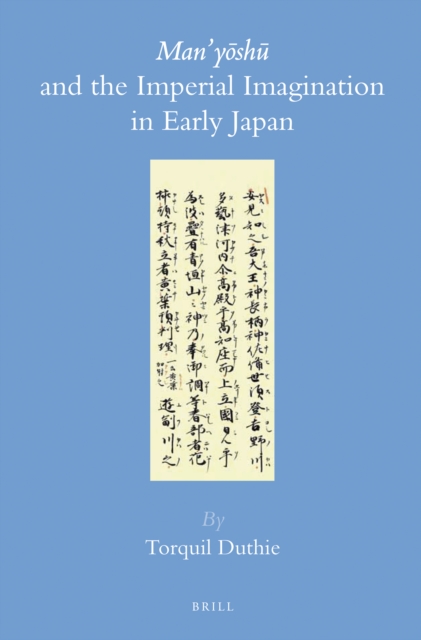
Man'yōshū and the imperial imagination in early Japan
In Man'yoshu and the Imperial Imagination in Early Japan, Torquil Duthie examines the literary representation of the late seventh-century Yamato court as a realm of \"all under heaven.\" Through close readings of the early volumes of the poetic anthology Man'yoshu (c. eighth century) and the last volumes of the official history Nihon shoki (c. 720), Duthie shows how competing political interests and different styles of representation produced not a unified ideology, but rather a \"bundle\" of disparate imperial imaginaries collected around the figure of the imperial sovereign. Central to this process was the creation of a tradition of vernacular poetry in which Yamato courtiers could participate and recognize themselves as the cultured officials of the new imperial realm.
eBook

A history of popular culture in Japan : from the seventeenth century to the present
\"The first historical overview of popular culture in Japan from its origins in the 17th century to the present day, exploring themes of conflict, power, identity, and meaning in Japanese history\"--Provided by publisher.
Book

Kokugaku in Meiji-period Japan : the modern transformation of 'national learning' and the formation of scholarly societies
Kokugaku in Meiji-period Japan elucidates kokugaku's gradual shift from a politico-religious movement to an educational and academic discipline. Michael Wachutka investigates numerous prominent kokugaku scholars and describes their new latitude for actively influencing the nation-oriented discourse in Meiji-period Japan.
eBook


Nationalism and Internationalism in Imperial Japan
Throughout the history of modern Japan there has been a continuous struggle to create an integrated conception of how a politically and/or culturally autonomous Japan might relate to a pluralistic and interactive world. The aim of this study is to scrutinise nationalist and internationalist rhetoric by means of comparatively constant factors such as personal views of humanity, civilisation, progress, the nation and the outside world, and thus to develop new approaches towards the question of the relationship between Japanese nationalism and internationalism. This project brings together a group of comparatively young scholars who analyse how different generations of opinion leaders in the Japanese pre-war modern era tried to solve what they perceived as the dilemma of nationalism and internationalism.
'This is a volume which will be valuable for historians, political scientists and general observers of the Japanese scene as the climate of debate changed in the 1930s.' - The Japan Society
'It would be invidious to draw special attention to any one study in this book. The standard of the research, writing and presentation is very high. It deals with an important aspect of Japan's prewar history and illustrates the doubts and uncertainties felt in intellectual circles. It illustrates a diversity which is a useful corrective to many studies of 1930s Japan.' - The Japan Society
eBook