
Catalogue Search | MBRL


Are you sure you want to remove the book from the shelf?

{{itemTitle}}
2,846
result(s) for
"Japan Military policy."
Sort by:

Creating Japan's Ground Self-Defense Force : a sword well made
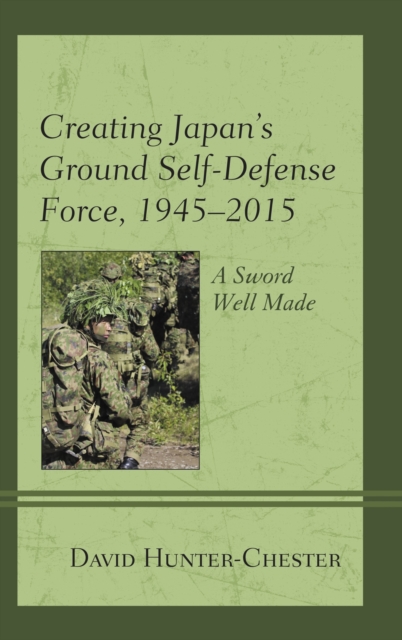
\"This work is the first of its kind to offer, in English, an institutional and organizational history focused on the GSDF [Ground Self-Defense Force] for the first 70 years of its existence. It takes on issues of policy and challenges the accepted history of the origin of Article 9. It is the first study to focus on the GSDF's creation of its own personal identity, and the first history to trace depictions, and the lack of depictions, of soldiers in Japan's postwar popular culture. As well, the history highlights understandings of and challenges to Japan's defense policy and defense identity in popular culture. The history of the creation of the Ground Self-Defense Force is complex, involving policymakers from two nations, a public that comes to desire a defense force that does not seem military, and most importantly, a military that wants to serve the public. The story begins with defeat, but is ultimately a story of victory; the victory of a dedicated group of soldiers and other public servants who, working through the difficulties enumerated in this study, manage to craft a professional, well-respected ground force that is committed to serving the nation of Japan and contributing to international security abroad and still seeks a consistently positive and active presence in their country's imagination\"--Page 23.
Book
Creating Japan's Ground Self-Defense Force, 1945-2015
Creating Japan’s Ground Self-Defense Force, 1945–2015 is a timely contribution to postwar Japan security studies. It is the first comprehensive account of Japan’s post-1945 army, including a comprehensive institutional history, together with the evolution of roles and missions and the adoption of successive professional identities. The organizational history is embedded within a thorough examination of Japan’s own defense policy, as well as of America’s policy of alliance with Japan. The book examines and challenges assumptions about the drafting and adoption of the War Renunciation clause of Japan’s postwar Peace Constitution, Article 9, which uniquely not only renounces war, but the arms to wage war. Thus Japan’s army is not called an army, but the Ground Self-Defense Force (GSDF). The work also examines the place of an army and soldiers in the formation of Japan’s national identity after its last devastating war, and explores the impact of constitutional, legal and policy restrictions, as well as the power of the legacy of the still-largely vilified Imperial Japanese Army on GSDF members who seek to serve because “there are people we want to protect.” The study is rounded by an examination of the place of soldiers in Japan’s popular culture, focused on movies, manga and anime, assessing the impact on the GSDF of a public imagination that most often ignores or villainizes soldiers, though ending with a note that some positive images of soldiers and of the GSDF members themselves have started to appear in the last few years. The book’s author, a retired U.S. Army soldier who spent more than twenty years working, studying and training with the GSDF, offers a broad-ranging exploration of a unique organization. This work is extensively researched, using English and Japanese sources, and will appeal to anyone interested in Japanese security studies, alliance studies, and military imagery in Japanese pop culture, as well as to students of military history, international security, international relations, and cultural identity.
eBook

Japan's Security Identity
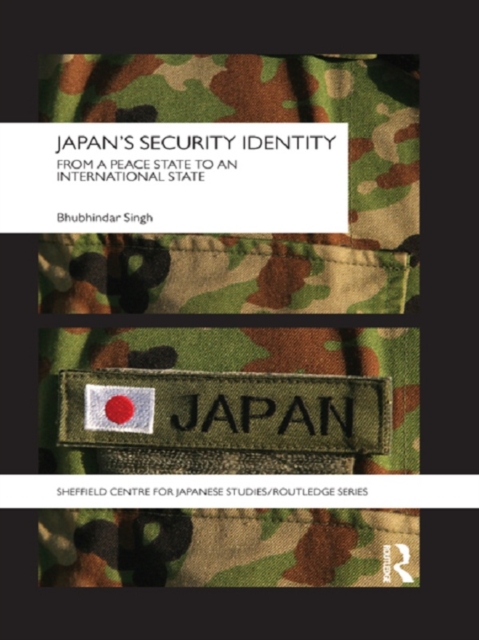
Since the end of the Cold War, there has been a significant change in Japanese security policy, as Japan's security identity has shifted from a peace state, to an international state. In this book, Bhubhindar Singh argues that from the 1990s onwards, the Japanese security policymaking elite recognized that its earlier approach to security policy which was influenced by the peace-state security identity was no longer appropriate. Rather, as a member of the international community, Japan had to carve out a responsible role in regional and international security affairs, which required greater emphasis on the role of the military in Japan's security policy.
To explore the change in Japan's security identity and its associated security behaviour, this book contrasts the three areas that define and shape Japanese security policy: Japan's conception (or definition) of national security; the country's contribution, in military terms, to regional and international affairs; and the changes to the security policy regime responsible for the security policy formulation. Further, it seeks to challenge the dominant realist interpretation of Japanese security policy by adopting an identity-based approach and showing how whilst realist accounts correctly capture the trajectory of Japanese post-Cold War security policy, they fail to explain the underlying causes of the change in Japanese security behaviour in the post-Cold War period.
This book is an important addition to the current literature on Japanese security policy, and will be of great use to students and scholars interested in Japanese and Asian politics, as well as security studies and international relations more broadly.
eBook

The Challenges of the U.S.-Japan Military Arrangement
This is an in-depth analysis of the U.S.-Japan security alliance and its implications for Japan and the Asia-Pacific region. It moves away from the official line that the alliance is a vital aspect of Japan's security policy and introduces issues and arguments that are often overlooked: American security policy has failed to achieve its goals; Japan's interests are not fully served by the alliance; the alliance itself is a source of instability in the region; and the arrangement has placed constraints on Japan's own political development. The author measures current developments in U.S. foreign policy against Japan's role in the region and Japan's own political development. He assesses the consequences of the alliance for the current regional situation in Northeast Asia, looks at future policy options for Japan, and makes the case for a neutralist security policy.
eBook

The Japanese empire : grand strategy from the Meiji Restoration to the Pacific War
\"The Japanese experience of war from the late-nineteenth to the mid-twentieth century presents a stunning example of the meteoric rise and shattering fall of a great power. As Japan modernized and became the one non-European great power, its leaders concluded that an empire on the Asian mainland required the containment of Russia. Japan won the First Sino-Japanese War (1894-5) and the Russo-Japanese War (1904-5) but became overextended in the Second Sino-Japanese War (1931-45), which escalated, with profound consequences, into World War II. A combination of incomplete institution building, an increasingly lethal international environment, a skewed balance between civil and military authority, and a misunderstanding of geopolitics explains these divergent outcomes. This analytical survey examines themes including the development of Japanese institutions, diversity of opinion within the government, domestic politics, Japanese foreign policy and China's anti-Japanese responses. It is an essential guide for those interested in history, politics and international relations\"-- Provided by publisher.
Book
Japan's nuclear disarmament policy and the U.S. security umbrella
This book explores the apparent contradictions behind Japan's stated goal of nuclear disarmament and its tacit acceptance of being protected by the U.S. nuclear umbrella.
eBook

Bridging the Atomic Divide : Debating Japan-US Attitudes on Hiroshima and Nagasaki
\"In this study, two scholars examine historical perceptions of the atomic bombings of Hiroshima and Nagasaki. Structured as a balanced dialogue, the authors analyze how the attacks are remembered by Japanese and others as well as the various debates surrounding the bombings.\"--Provided by publisher.
Book

Bridging the atomic divide : debating Japan-US attitudes on Hiroshima and Nagasaki
Harry Wray and Seishiro Sugihara transcend the one-sided Tokyo Trial view of the war in an effort to conduct a balanced exchange on historical perception.This will be of interest equally to both those inside and outside Japan who are perplexed by Japan's \"victimization consciousness.\" Through this impassioned and heartfelt dialogue, Wray.
eBook