
Catalogue Search | MBRL


Are you sure you want to remove the book from the shelf?

{{itemTitle}}
506
result(s) for
"Japanese authors"
Sort by:


Japanese Brazilian Saudades
Japanese Brazilian Saudades explores the self-definition of Nikkei discourse in Portuguese-language cultural production by Brazilian authors of Japanese ancestry. Ignacio López-Calvo uses books and films by twentieth-century Nikkei authors as case studies to redefine the ideas of Brazilianness and Japaneseness from both a national and a transnational perspective. The result suggests an alternative model of postcoloniality, particularly as it pertains to the post-World War II experience of Nikkei people in Brazil. López-Calvo addresses the complex creation of Japanese Brazilian identities and the history of immigration, showing how the community has used writing as a form of reconciliation and affirmation of their competing identities as Japanese, Brazilian, and Japanese Brazilian. Japanese in Brazil have employed a twofold strategic, rhetorical engineering: the affirmation of ethno-cultural difference on the one hand, and the collective assertion of citizenship and belonging to the Brazilian nation on the other. López-Calvo also grapples with the community's inclusion and exclusion in Brazilian history and literature, using the concept of \"epistemicide\" to refer to the government's attempt to impose a Western value system, Brazilian culture, and Portuguese language on the Nikkeijin, while at the same time trying to destroy Japanese language and culture in Brazil by prohibiting Japanese language instruction in schools, Japanese-language publications, and even speaking Japanese in public. Japanese Brazilian Saudades contributes to the literature criticizing the \"cognitive injustice\" that fails to acknowledge the value of the global South and non-Western ways of knowing and being in the world. With important implications for both Latin American studies and Nikkei studies, it expands discourses of race, ethnicity, nationality, and communal belonging through art and narrative.
eBook

Patient X : the case-book of Ryهunosuke Akutagawa
\"Haunting and evocative, brutal and surreal, these twelve connected tales evoke the life of the Japanese writer Ryknosuke Akutagawa (1892-1927), whose short story \"In the Grove\" served as an inspiration for Akira Kurosawa's famous film RashMmon, and whose narrative use of multiple perspectives and different versions of a single event influenced generations of storytellers. Writing out of his own obsession with Akutagawa, David Peace delves into the known facts and events of the writer's life and inner world--birth to a mother who was mentally ill and a father who died shortly thereafter; his own battles with mental illness; his complicated reaction to the beginnings of modernization and Westernization of Japan; his short but prolific writing career; his suicide at the age of thirty-five--and creates a stunningly atmospheric and deeply moving fiction that tells its own story of a singularly brilliant mind\" -- Amazon.
Book


Sexuality, maternity, and (re)productive futures : women's speculative fiction in contemporary Japan
Sexuality, Maternity, and (Re)productive Futures explores how contemporary Japanese female speculative fiction writers have challenged historical inequalities of sex, gender difference, and family roles by imagining alternative worlds where sexes are fluid and childbearing crosses the boundaries of male/female, biological/bioengineered, and human/nonhuman.
eBook

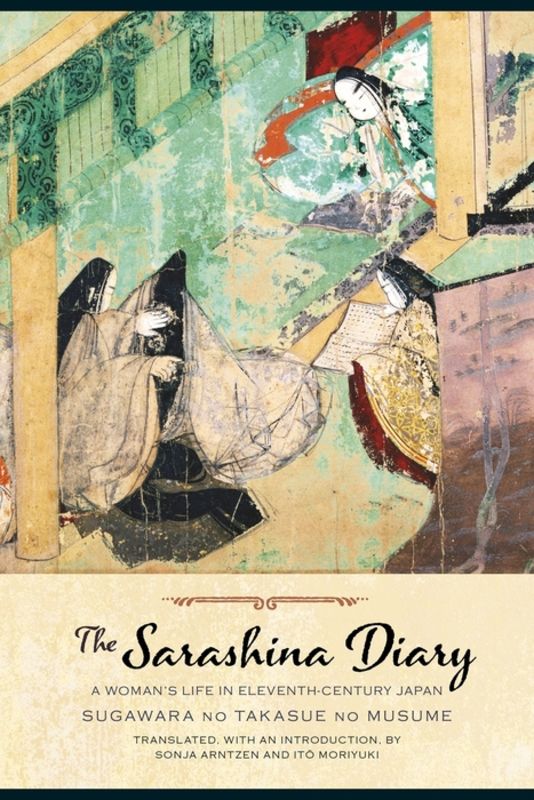
The Sarashina Diary
A thousand years ago, a young Japanese girl embarked on a journey from the wild East Country to the capital. She began a diary that she would continue to write for the next forty years and compile later in life, bringing lasting prestige to her family. Some aspects of the author's life and text seem curiously modern. She married at age thirty-three and identified herself as a reader and writer more than as a wife and mother. Enthralled by romantic fiction, she wrote extensively about the disillusioning blows that reality can deal to fantasy. The Sarashina Diary is a portrait of the writer as reader and an exploration of the power of reading to shape one's expectations and aspirations. As a person and an author, this writer presages the medieval era in Japan with her deep concern for Buddhist belief and practice. Her narrative's main thread follows a trajectory from youthful infatuation with romantic fantasy to the disillusionment of age and concern for the afterlife; yet, at the same time, many passages erase the dichotomy between literary illusion and spiritual truth. This new translation captures the lyrical richness of the original text while revealing its subtle structure and ironic meaning. The introduction highlights the poetry in the Sarashina Diary and the juxtaposition of poetic passages and narrative prose, which brings meta-meanings into play. The translators' commentary offers insight into the author's family and world, as well as the fascinating textual legacy of her work.
eBook

Novelist as a vocation
\"A charmingly idiosyncratic look at writing, creativity, and the author's own novels. Haruki Murakami's myriad fans will be delighted by this unique look into the mind of a master storyteller. In this engaging book, the internationally best-selling author and famously reclusive writer shares with readers what he thinks about being a novelist; his thoughts on the role of the novel in our society; his own origins as a writer; and his musings on the sparks of creativity that inspire other writers, artists, and musicians. Readers who have long wondered where the mysterious novelist gets his ideas and what inspires his strangely surreal worlds will be fascinated by this highly personal look at the craft of writing\"-- Provided by publisher.
Book

Handbook of Japanese Christian Writers
Although a century and a half of Christian proselytizing has only led to the conversion of about one percent of the Japanese population, the proportion of writers who have either been baptized or significantly influenced in their work by Christian teachings is much higher. The seventeen authors examined in this volume have all employed themes and imagery in their writings influenced by Christian teachings. Those writing between the 1880s and the start of World War II were largely drawn to the Protestant emphasis on individual freedom, though many of them eventually rejected sectarian affiliation. Since 1945, on the other hand, Catholicism has produced a number of religiously committed authors, led by figures such as Endo Shusaku, the most popular and influential Christian writer in Japan to date. The authors discussed in these essays have contributed in a variety of ways to the indigenization of the imported religion.
eBook