
Catalogue Search | MBRL


Are you sure you want to remove the book from the shelf?

{{itemTitle}}
8
result(s) for
"Japanese fiction 21st century History and criticism."
Sort by:


Sexuality, maternity, and (re)productive futures : women's speculative fiction in contemporary Japan
Sexuality, Maternity, and (Re)productive Futures explores how contemporary Japanese female speculative fiction writers have challenged historical inequalities of sex, gender difference, and family roles by imagining alternative worlds where sexes are fluid and childbearing crosses the boundaries of male/female, biological/bioengineered, and human/nonhuman.
eBook

The Earth writes : the Great Earthquake and the novel in post-3/11 Japan
\"This book explores how the tremendous earthquake on March 11, 2011 impacted literary authors in Japan and generated issues and perspectives previously unrecognized in Japanese literary and social culture. The disaster itself caused an earthquake, tsunami, and an nuclear accident, and provided the grounds for \"post 3/11\" literature in Japan\"-- Provided by publisher.
Book

The Columbia anthology of modern Japanese drama
This anthology is the first to survey the full range of modern Japanese drama and make available Japan's best and most representative twentieth- and early-twenty-first-century works in one volume. It opens with a comprehensive introduction to Meiji-period drama and follows with six chronological sections: \"The Age of Taisho Drama\"; The Tsukiji Little Theater and Its Aftermath\"; \"Wartime and Postwar Drama\"; \"The 1960s and Underground Theater\"; \"The 1980s and Beyond\"; and \"Popular Theater,\" providing a complete history of modern Japanese theater for students, scholars, instructors, and dramatists. The collection features a mix of original and previously published translations of works, among them plays by such writers as Masamune Hakucho (The Couple Next Door), Enchi Fumiko (Restless Night in Late Spring), Morimoto Kaoru (A Woman's Life), Abe Kobo (The Man Who Turned into a Stick), Kara Juro (Two Women), Terayama Shuji (Poison Boy), Noda Hideki (Poems for Sale), and Mishima Yukio (The Sardine Seller's Net of Love). Leading translators include Donald Keene, J. Thomas Rimer, M. Cody Poulton, John K. Gillespie, Mari Boyd, and Brian Powell. Each section features an introduction to the developments and character of the period, notes on the plays' productions, and photographs of their stage performances. The volume complements any study of modern Japanese literature and modern drama in China, Korea, or other Asian or contemporary Western nations.
eBook

Fuzzy Traumas
In Fuzzy Traumas
, Tyran Grillo critically examines the portrayal of
companion animals in Japanese literature in the wake of the 1990s
\"pet boom.\" Blurring the binary between human and
nonhuman, Grillo draws on Japanese science fiction, horror,
guide-dog stories, and a notorious essay on euthanasia, treating
each work as a case study of human-animal relationships gone
somehow awry. He makes an unprecedented case for Japan's pet boom
and how the country's sudden interest in companion animals points
to watershed examples of \"productive errors\" that provide necessary
catalysts for change.
Examining symbiotic concepts of \"humanity\" and \"animality,\"
Grillo challenges negative views of anthropomorphism as something
unethical, redefining it as a necessary rupture in, not a bandage
on, the thick skin of the human ego. Fuzzy Traumas
concludes by introducing the paradigm shift of \"postanimalism\" as a
detour from the current traffic jam of animal-centered
philosophies, arguing that humanity cannot move past
anthropocentricism until we reflect honestly on what it means for
the human condition.
eBook

Manga and the Representation of Japanese History
This edited collection explores how graphic art and in particular Japanese manga represent Japanese history.
The articles explore the representation of history in manga from disciplines that include such diverse fields as literary studies, politics, history, cultural studies, linguistics, narratology, and semiotics. Despite this diversity of approaches all academics from these respective fields of study agree that manga pose a peculiarly contemporary appeal that transcends the limitation imposed by traditional approaches to the study and teaching of history. The representation of history via manga in Japan has a long and controversial historiographical dimension. Thereby manga and by extension graphic art in Japanese culture has become one of the world's most powerful modes of expressing contemporary historical verisimilitude. The contributors to this volume elaborate how manga and by extension graphic art rewrites, reinvents and re-imagines the historicity and dialectic of bygone epochs in postwar and contemporary Japan.
Manga and the Representation of Japanese History will be of interest to students and scholars of Asian studies, Asian history, Japanese culture and society, as well as art and visual culture
eBook
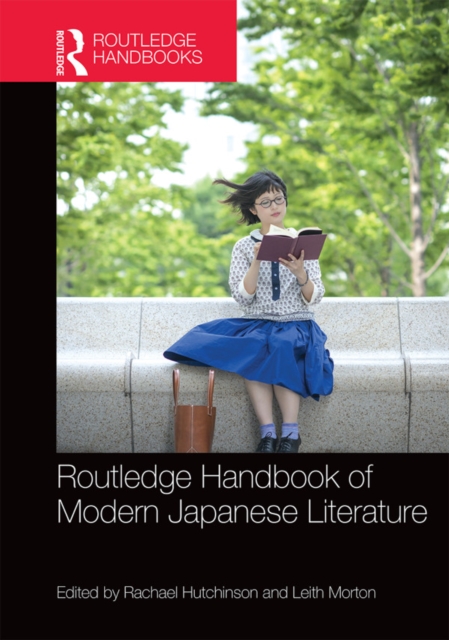
Routledge Handbook of Modern Japanese Literature
The Routledge Handbook of Modern Japanese Literature provides a comprehensive overview of how we study Japanese literature today. Rather than taking a purely chronological approach to the content, the chapters survey the state of the field through a number of pressing issues and themes, examining the ways in which it is possible to read modern Japanese literature and situate it in relation to critical theory.
The Handbook examines various modes of literary production (such as fiction, poetry, and critical essays) as distinct forms of expression that nonetheless are closely interrelated. Attention is drawn to the idea of the bunjin as a 'person of letters' and a more realistic assessment is provided of how writers have engaged with ideas - not labelled a 'novelist' or 'poet', but a 'writer' who may at one time or another choose to write in various forms. The book provides an overview of major authors and genres by situating them within broader themes that have defined the way writers have produced literature in modern Japan, as well as how those works have been read and understood by different readers in different time periods.
The Routledge Handbook of Modern Japanese Literature draws from an international array of established experts in the field as well as promising young researchers. It represents a wide variety of critical approaches, giving the study a broad range of perspectives. This handbook will be of interest to students and scholars of Asian Studies, Literature, Sociology, Critical Theory, and History.
eBook

NEW BRITAIN, OLD ENGLAND
Atonement's depiction of the anachronistic English country house contravenes suppositions that similar spaces nostalgically commemorate an oppressive history. The novel instead explores the house as a historical fiction that continues to structure contemporary English culture. It exposes the way \"New Britain\" both erases and reproduces many of the more pernicious aspects of English history, commodifying and revising history in much the same way that English Heritage has been accused of doing. The novel reopens the country house as a space that demands both a historical double take and skepticism toward preemptive celebrations of social progress.
Journal Article