
Catalogue Search | MBRL


Are you sure you want to remove the book from the shelf?

{{itemTitle}}
30
result(s) for
"Japanese language Orthography and spelling."
Sort by:

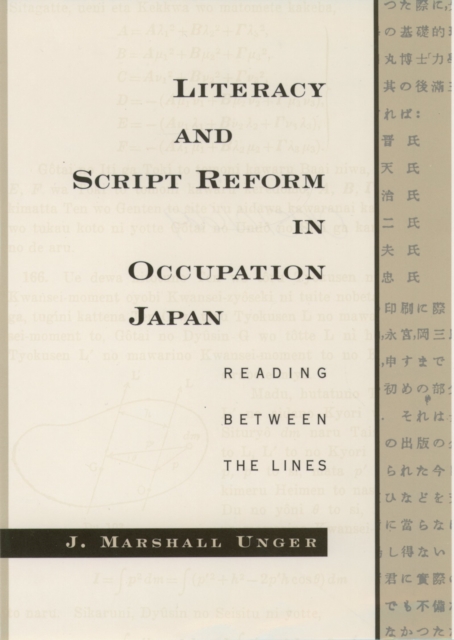
Literacy and script reform in occupation Japan : reading between the lines
Japanese writing intermingles three different sets of characters, making it difficult to adapt to new technology. Unger looks at why the Japanese have not reformed their orthography and specifically the efforts at script reform that took place after the Second World War, and how and why that movement was defeated.
eBook

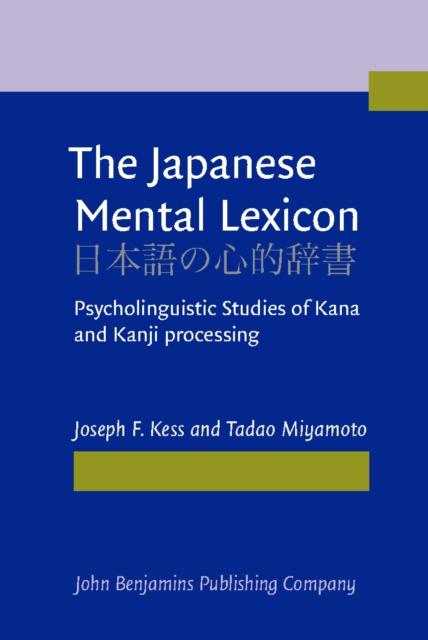
The Japanese mental lexicon : psycholinguistic studies of kana and kanji processing
This book surveys the psycholinguistic dimensions of lexical access to the mental lexicon in Japanese, and attempts to synthesize the diversity of Japanese psycholinguistic research into the nature of written word processing in Japanese. Ten chapters focus on the nature of such psycholinguistic inquiry and its history, the structural origins of the Japanese script types and their relative frequencies, lexical access studies in kanji, the hiragana and katakana syllabaries, romaji, and mixed text processing, laterality preferences in kana/kanji processing and their implications for scientific discussions of language and cognition, evidence from eye-movement studies, the acquisition of orthographic skills by Japanese children, and a review of the implications and conclusions that arise from the contributions of such research. The text is directed at filling the need for an overview of this research because of its importance to theoretical modelling in linguistics and psychology, as well as aphasiology, mathematical and statistical linguistics, educational practices and governmental intervention in respect to language policies, and studies of linguistic and cultural history.
eBook

Read Japanese kanji today : the easy way to learn 400 basic kanji
'Read Japanese Kanji Today' provides readers with a quick and simple method to learn kanji characters. Far from being a complex and mysterious script, Japanese writing is actually a simple and fascinating pictographic and ideographic system, easily understood and mastered. With the approach used in this easy-to-read, entertaining kanji book you'll soon be able to recognise and read over 400 kanji, whether or not you have any knowledge of Japanese grammar or the spoken Japanese language. The 400+ kanji characters stick in your mind thanks to an engaging text and illustrations that show the historical development and meaning of each character. The description of each kanji explains its origins and development, its modern uses, and how it is pronounced.
eBook

Phonology facilitates deeply opaque logographic writing
Phonological knowledge plays a pivotal role in many aspects of language processing, but it remains controversial whether it is required for writing. In the present study, we examined the issue by focusing on written production in an opaque logographic script (kanji) with highly irregular pronunciation rules, which allowed for a rigorous test of whether or not phonology contributes to writing. Using a phonological priming paradigm in two experiments, we measured response latency while participants orally named target pictures or wrote down their names in kanji. Each target was preceded by a phonographic character (kana) which represented the same sound (mora) as the beginning of the target name or a different mora. By manipulating the degree of phonological overlap between primes and target names (i.e., morae, consonants and vowels), we found that only the moraic overlap could speed up word production in logographic writing (Experiment 1). In contrast, naming response was facilitated by mora-overlap as well as vowel-overlap. This between-task difference in phonological encoding suggests that phonological codes for spoken production do not necessarily precede orthographic access during logographic writing. In Experiment 2, we further found that the facilitatory effects of moraic information did not differ in magnitude between writing and naming when primes were masked and presented more briefly, suggesting a net component of bottom-up phonological activation which contributes to logographic writing. Collectively, we propose that orthographic codes of kanji are accessed directly from semantics, whereas phonology plays a non-specific modulatory role to enhance neurocognitive systems involved in writing.
Journal Article

The role of phonology-to-orthography consistency in predicting the degree of pupil dilation induced in processing reduced and unreduced speech
The relationship between the ways in which words are pronounced and spelled has been shown to affect spoken word processing, and a consistent relationship between pronunciation and spelling has been reported as a possible cause of unreduced pronunciations being easier to process than reduced counterparts although reduced pronunciations occur more frequently. In the present study, we investigate the effect of pronunciation-to-spelling consistency for reduced and unreduced pronunciations in L1 and L2 listeners of a logographic language. More precisely, we compare L1 and L2 Japanese listeners to probe whether they use orthographic information differently when processing reduced and unreduced speech. Using pupillometry, the current study provides evidence that extends the hypothesis about the role of orthography in the processing of reduced speech. Orthographic realization matters in processing for L1 and L2 advanced listeners. More specifically, how consistent the orthographic realization is with its phonological form (phonology-to-orthography consistency) modulates the extent to which reduced pronunciation induces additional processing costs. The results are further discussed in terms of their implications for how listeners process reduced speech and the role of the orthographic form in speech processing.
Journal Article

Effects of orthography in the picture-word task: Evidence from Japanese scripts
The picture-word task presents participants with a number of pictured objects together with a written distractor word superimposed upon each picture, and their task is to name the depicted object while ignoring the distractor word. Depending on the specific picture and word combination, various effects, including the identity facilitation effect (e.g., DOG + dog) and the semantic interference effect (e.g., GOAT + cow), are often observed. The response patterns of the picture-word task in terms of naming latencies reflect the mechanisms underlying lexical selection in speech production. Research using this method, however, has typically focused on alphabetic languages, or involved bilingual populations, making it difficult to specifically investigate orthographic effects in isolation. In this paper, we report five experiments investigating the role of orthography in the picture-word task by varying distractor script (using the multiscriptal language Japanese, and pseudohomophonic spellings in English) across three different populations (Japanese monolinguals, Japanese-English bilinguals, and English monolinguals), investigating both the identity facilitation effect and the semantic interference effect. The results generally show that the magnitude of facilitation is affected by orthography even within a single language. The findings and specific patterns of results are discussed in relation to current theories on speech production.
Journal Article

English orthographic forms affect L2 English speech production in native users of a non-alphabetic writing system
There is growing evidence that the orthographic forms (spellings) of second language words affect second language (L2) speech production, but it is not known whether orthography affects L2 phonology in native users of a non-alphabetic writing system. To answer this question, this study tested the effects of number of letters on the duration of consonants and vowels in the English L2 speech production of Japanese–English sequential bilinguals. Japanese L1 –English L2 bilinguals and English native speakers (both n = 16) performed a delayed word repetition task, producing 16 English word pairs in which the same consonant or vowel was spelled either with a single letter or with double letters, as in city-kitty . The bilinguals produced the same English sound as longer or shorter depending on the number of letters in its spelling, confirming that L2 orthographic forms affect L2 speakers’ phonological representations of L2 words even when their L1 writing system is not alphabetical.
Journal Article

The Effects of Orthography on the Pronunciation of Nasal Vowels by L1 Japanese Learners of L3 French: Evidence from a Longitudinal Study of Speech in Interaction
In recent decades, a vast literature has documented crosslinguistic influences on the acquisition of L2 phonology and in particular the effects of spelling on pronunciation. However, articulating these research findings in terms of taking into account the effects of L1 phonology and spelling on L2 pronunciation in language teaching remains to be examined. These studies are based on experimental cross-sectional methods and mainly focus on L2 English learning by speakers of languages with an alphabetic system. In French, there are few studies on crosslinguistic influences on the acquisition of the nasal vowels (//, // and /ε~/) and few experimental studies that point to a possible effect of orthography on the pronunciation of these phonemes. The results of experimental studies are difficult to transpose to the language classroom because they are based on word or sentence reading and writing activities, which are quite far-removed from the conversational activities practised in the classroom in interaction with peers and the teacher. Hence, we opted here for a case study of the effect of spelling on the production of nasal vowels in interaction tasks. We conducted a longitudinal study during the first year of extensive learning of French (4 h 30 per week). The results of a perceptive analysis by expert listeners show that (i) learners spell nasal vowels with an or in 98% of the obligatory contexts; (ii) most nasal vowels are perceived as nasal vowels in speech (72%), the others being perceived as vowels followed by a nasal consonant (19.5%) or as oral vowels (8.5%); (iii) consonantisation is stronger when the learner spontaneously produces a word than when (s)he repeats it, (iv) which decreases with time (learning effect) and varies (v) according to the consonant, /ε~/ being less consonantised than // and //. Finaly, we propose a didactic discussion in the light of intelligibility and influence of orthography.
Journal Article