
Catalogue Search | MBRL


Are you sure you want to remove the book from the shelf?

{{itemTitle}}
114
result(s) for
"Japanese literature -- 20th century -- History and criticism"
Sort by:


The rise and fall of modern Japanese literature
The Rise and Fall of Modern Japanese Literature tells the story of Japanese literature from its start in the 1870s against the backdrop of a rapidly coalescing modern nation to the present. John Whittier Treat takes up both canonical and forgotten works, the non-literary as well as the literary, and pays special attention to the Japanese state's hand in shaping literature throughout the country's nineteenth-century industrialization, a half-century of empire and war, its post-1945 reconstruction, and the challenges of the twenty-first century to modern nationhood.
Beginning with journalistic accounts of female criminals in the aftermath of the Meiji civil war, Treat moves on to explore how woman novelist Higuchi Ichiy?'s stories engaged with modern liberal economics, sex work, and marriage; credits Natsume S?seki's satire I Am a Cat with the triumph of print over orality in the early twentieth century; and links narcissism in the visual arts with that of the Japanese I-novel on the eve of the country's turn to militarism in the 1930s. From imperialism to Americanization and the new media of television and manga, from boogie-woogie music to Yoshimoto Banana and Murakami Haruki, Treat traces the stories Japanese audiences expected literature to tell and those they did not. The book concludes with a classic of Japanese science fiction a description of present-day crises writers face in a Japan hobbled by a changing economy and unprecedented natural and manmade catastrophes. The Rise and Fall of Japanese Literature reinterprets the \"end of literature\"—a phrase heard often in Japan—as a clarion call to understand how literary culture worldwide now teeters on a historic precipice, one at which Japan's writers may have arrived just a moment before the rest of us.
eBook


Tokyo in transit : Japanese culture on the rails and road
Increased use of mass transportation in the early twentieth century enabled men and women of different social classes to interact in ways they had not before. Using a cultural studies approach that combines historical research and literary analysis, author Alisa Freedman investigates fictional, journalistic, and popular culture depictions of how mass transportation changed prewar Tokyo's social fabric and artistic movements, giving rise to gender roles that have come to characterize modern Japan.
Freedman persuasively argues that, through descriptions of trains and buses, stations, transport workers, and passengers, Japanese authors responded to contradictions in Tokyo's urban modernity and exposed the effects of rapid change on the individual. She shines a light on how prewar transport culture anticipates what is fascinating and frustrating about Tokyo today, providing insight into how people make themselves at home in the city. An approachable and enjoyable book, Tokyo in Transit offers an exciting ride through modern Japanese literature and culture, and includes the first English translation of Kawabata Yasunari's The Corpse Introducer, a 1929 crime novella that presents an important new side of its Nobel Prizewinning author.
eBook


The Dilemma of Faith in Modern Japanese Literature
iThe first book-length study to explore the links between Christianity and modern Japanese literature, this book analyzes the process of conversion of nine canonical authors, unveiling the influence that Christianity had on their self-construction, their oeuvre and, ultimately, the trajectory of modern Japanese literature.
Building significantly on previous research, which has treated the intersections of Christianity with the Japanese literary world in only a cursory fashion, this book emphasizes the need to make a clear distinction between the different roles played by Catholicism and Protestantism. In particular, it argues that most Meiji and Taishō intellectuals were exposed to an exclusively Protestant and mainly Calvinist derivation of Christianity and so it is against this worldview that the connections between the two ought to be assessed. Examining the work of authors such as Kitamura Tōkoku, Akutagawa Ryūnosuke and Nagayo Yoshirō, this book also contextualizes the spread of Christianity in Japan and challenges the notion that Christian thought was in conflict with mainstream literary schools. As such, this book explains how the dualities experienced by many modern writers were in fact the manifestation of manifold developments that placed Christianity at the center, rather than at the periphery, of their process of self-construction.
The Dilemma of Faith in Modern Japanese Literature will be of great interest to students and scholars of Japanese modern literature, as well as those interested in Religious Studies and Japanese Studies more generally.
eBook


Trauma, Dissociation and Re-enactment in Japanese Literature and Film
Japanese literature and film have frequently been approached using lenses such as language, genre and ideology. Yet, despite a succession of major social traumas that have marked, and in many ways shaped and defined much of modern Japan, Japanese fiction and cinema have not often been examined psychoanalytically.
In this book, David Stahl conducts in-depth readings and interpretations of a set of Japanese novels and film. By introducing the methodology of trauma/PTSD studies, Stahl seeks to provide a better understanding of the insights of Japanese writers and directors into their societies, cultures and histories. In particular, by building on the work of practitioner-theoreticians, such as Pierre Janet and Judith Herman, Stahl analyses a number of key texts, including Kawabata Yasunari’s Sleeping Beauties (1961), Enchi Fumiko’s Female Masks (1958) and Imamura Shōhei’s Vengeance is Mine (1979). Consequently, through using concepts of social trauma, dissociation, failed mourning, revenge and narrative memory, this book sheds new light on the psychological aftereffects and transgenerational legacies of trauma depicted in Japanese works.
Trauma, Dissociation and Re-enactment in Japanese Literature and Film will be of interest to students and scholars of Japanese Literature and Cinema, as well as those interested in Japanese History and Trauma Studies.
eBook

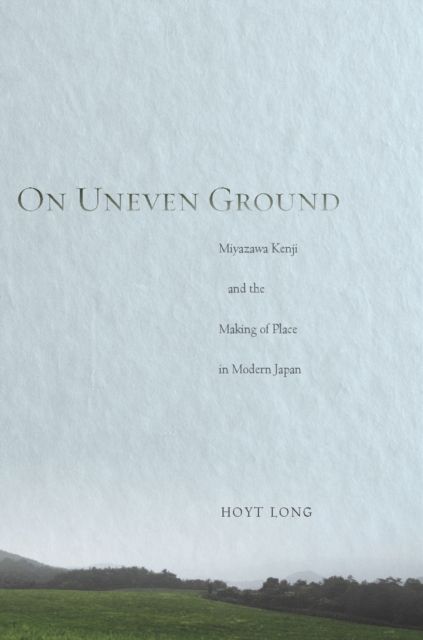
On Uneven Ground
The history of literary and artistic production in modern Japan has typically centered on the literature and art of Tokyo, yet cultural activity in the country's regional cities and rural towns was no less vibrant.On Uneven Ground recovers pieces of this neglected history through the figure of Miyazawa Kenji (1896-1933). While alive, he remained a mostly unknown and unread provincial author whose experiments with narrative fiction, amateur theater, and farmer's art reveal an intense determination to reimagine and remake his native place, in the northeast of Japan, meaningful.
Today, Miyazawa is one of the most recognized figures in Japan's modern literary canon. The story of his radical posthumous rise presents an opportunity to examine the larger history of how writing and other forms of artistic practice have intersected with place-based identity and the uneven geography of cultural production. The first book-length study of Miyazawa in English,On Uneven Ground centers on Miyazawa's life and writing to recreate a sense of what it was to write about and remake place from a spatially marginal position in the cultural field.
eBook