
Catalogue Search | MBRL


Are you sure you want to remove the book from the shelf?

{{itemTitle}}
46
result(s) for
"Jazz Discography History."
Sort by:

The Penguin jazz guide : the history of the music in the 1,001 best albums
Offers a chronologically arranged survey of jazz recordings, including biographical details and lineups.
Book

The studio recordings of The Miles Davis Quintet, 1965-68
The influence of Miles Davis's “second great quintet, ” consisting of Davis, Wayne Shorter, Herbie Hancock, Ron Carter, and Tony Williams continues to resonate. Jazz musicians, historians, and critics have celebrated the group for its improvisational communication, openness, and its transitional status between hard bop and the emerging free jazz of the 1960s, creating a synthesis described by one quintet member as “controlled freedom.” The book provides a critical analytical study of the Davis quintet studio recordings released between 1965 and 1968, including E.S.P., Miles Smiles, Sorcerer, Nefertiti, Miles in the Sky, and Filles de Kilimanjaro. In contrast to the quintet's live recordings, which included performances of older jazz standards, the studio recordings offered an astonishing breadth of original compositions. Many of these compositions have since become jazz standards, and all of them played a central role in the development of contemporary jazz composition. Using transcription and analysis, the author illuminates the compositional, improvisational, and collective achievements of the group. With additional sourcesthe book shows how the group in the studio shaped and altered features of the compositions. Despite the earlier hard bop orientation of the players, the Davis quintet compositions offered different responses to questions of form, melody, and harmonic structure, and they often invited other improvisational paths, ones that relied on an uncanny degree of collective rapport. And given the spontaneity of the recorded performances—often undertaken with a minimum of rehearsal—the players responded with any number of techniques to address formal, harmonic, or metrical discrepancies that arose while the tape was rolling.
eBook


Shaping jazz
There are over a million jazz recordings, but only a few hundred tunes have been recorded repeatedly. Why did a minority of songs become jazz standards? Why do some songs--and not others--get rerecorded by many musicians? Shaping Jazz answers this question and more, exploring the underappreciated yet crucial roles played by initial production and markets--in particular, organizations and geography--in the development of early twentieth-century jazz.
Damon Phillips considers why places like New York played more important roles as engines of diffusion than as the sources of standards. He demonstrates why and when certain geographical references in tune and group titles were considered more desirable. He also explains why a place like Berlin, which produced jazz abundantly from the 1920s to early 1930s, is now on jazz's historical sidelines. Phillips shows the key influences of firms in the recording industry, including how record companies and their executives affected what music was recorded, and why major companies would rerelease recordings under artistic pseudonyms. He indicates how a recording's appeal was related to the narrative around its creation, and how the identities of its firm and musicians influenced the tune's long-run popularity.
Applying fascinating ideas about market emergence to a music's commercialization, Shaping Jazz offers a unique look at the origins of a groundbreaking art form.
eBook

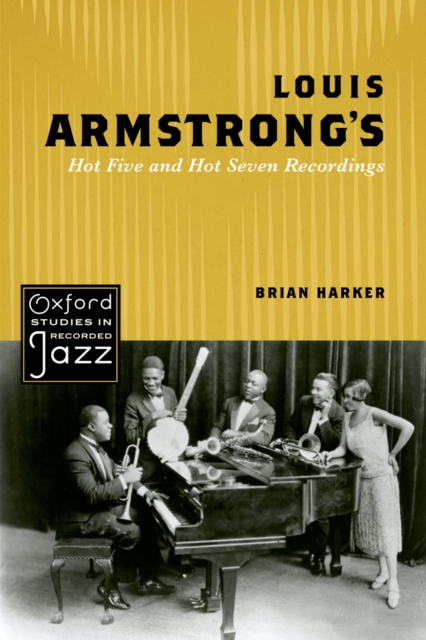
Louis Armstrong's Hot Five and Hot Seven Recordings
In Louis Armstrong's Hot Five and Hot Seven Recordings, Brian Harker strikes a unique balance between 1920s views of jazz and those of today. For the first time Armstrong's technical achievements are placed in a meaningful cultural context, yielding unexpected insights into these seminal documents of early jazz.
eBook


Encyclopedia of great popular song recordings
From John Philip Sousa to Green Day, from Scott Joplin to Kanye West, from Stephen Foster to Coldplay, The Encyclopedia of Great Popular Song Recordings covers the vast scope of its subject with virtually unprecedented breadth and depth. Approximately 1,000 key song recordings from 1889 to the present are explored in full, unveiling the stories behind the songs, the recordings, the performers, and the songwriters. Beginning the journey in the era of Victorian parlor balladry, brass bands, and ragtime with the advent of the record industry, readers witness the birth of the blues and the dawn of jazz in the 1910s and the emergence of country music on record and the shift from acoustic to electrical recording in the 1920s. The odyssey continues through the Swing Era of the 1930s; rhythm blues, bluegrass, and bebop in the 1940s; the rock oll revolution of the 1950s; modern soul, the British invasion, and the folk-rock movement of the 1960s; and finally into the modern era through the musical streams of disco, punk, grunge, hip-hop, and contemporary dance-pop. Sullivan, however, also takes critical detours by extending the coverage to genres neglected in pop music histories, from ethnic and world music, the gospel recording of both black and white artists, and lesser-known traditional folk tunes that reach back hundreds of years. This book is ideal for anyone who truly loves popular music in all of its glorious variety, and anyone wishing to learn more about the roots of virtually all the music we hear today. Popular music fans, as well as scholars of recording history and technology and students of the intersections between music and cultural history will all find this book to be informative and interesting.
eBook

