
Catalogue Search | MBRL


Are you sure you want to remove the book from the shelf?

{{itemTitle}}
536,043
result(s) for
"Jeans"
Sort by:


Rousseau Among the Moderns
Renowned for his influence as a political philosopher, a writer, and an autobiographer, Jean-Jacques Rousseau is known also for his lifelong interest in music. He composed operas and other musical pieces, invented a system of numbered musical notation, engaged in public debates about music, and wrote at length about musical theory. Critical analysis of Rousseau’s work in music has been principally the domain of musicologists, rarely involving the work of scholars of political theory or literary studies. In Rousseau Among the Moderns, Julia Simon puts forth fresh interpretations of The Social Contract, the Discourse on the Origin of Inequality, and the Confessions, as well as other texts. She links Rousseau’s understanding of key concepts in music, such as tuning, harmony, melody, and form, to the crucial problem of the individual’s relationship to the social order. The choice of music as the privileged aesthetic object enables Rousseau to gain insight into the role of the aesthetic realm in relation to the social and political body in ways often associated with later thinkers. Simon argues that much of Rousseau’s “modernism” resides in the unique role that he assigns to music in forging communal relations.
eBook


The Life of Wisdom in Rousseau's \Reveries of the Solitary Walker\
The Life of Wisdom in Rousseau's
\"Reveries of the Solitary Walker\" is the first complete
exegesis and interpretation of Rousseau's final and culminating
work, showing its full philosophic and moral teaching.
The Reveries has been celebrated as a work of literature
that is an acknowledged acme of French prose writing. Thomas L.
Pangle argues that this aesthetic appreciation necessitates an
in-depth interpretation of the writing's complex and multileveled
intended teaching about the normatively best way of life-and how
essential this is for a work that was initially bewildering.
Rousseau stands out among modern political philosophers in that
he restored, to political philosophy, what Socrates and his
students (from Plato and Xenophon through Aristotle and the Stoics
and Cicero) had made central-and that the previous modern,
Enlightenment philosophers had eclipsed: the study of the life and
soul of the exemplary, independent sage, as possessor of \"human
wisdom.\" Rousseau made this again the supreme theme and source of
norms for political philosophy and for humanity's moral as well as
civic existence.
In his analysis of The Reveries , Pangle uncovers
Rousseau's most profound exploration and articulation of his own
life, personality, soul, and thought as \"the man of nature
enlightened by reason.\" He describes, in Rousseau's final work, the
fullest embodiment of the experiential wisdom from which flows and
to which points Rousseau's political and moral philosophy, his
theology, and his musical and literary art.
eBook

A denim story : inspirations from boyfriends to bell bottoms
This style bible is a chic and sexy look at the myriad possibilities of blue jeans, the classic and ever-evolving fashion essential. Blue jeans are an iconic part of American culture. And, like the American dream, denim is constantly reinventing itself. A Denim Story showcases timeless images of blue jean style. Featuring such icons as Marilyn Monroe, Patti Smith, Jane Birkin, and Kate Moss, as well as dreamy inspiration boards from the authors' own work, this volume is full of ideas and inspirations. A pair of jeans always makes a statement, whether they are tight and purposeful or loose and frayed. Blue jeans can embody dreamy, girlish innocence or the best of boyishness, as when worn two sizes too big, low on the hips, and rolled up at the ankle. A Denim Story takes us on a journey through the most stylish looks of Americana culture, from the cutoffs and rolled-up cuffs of carefree summertime days to the simple ruggedness of overalls in the countryside, and from the rebelliously ripped jeans of rock 'n' roll to that beloved pair of faded and patched blue jeans we will never throw away. Denim is the material of independence and self-expression, timelessly cool, boasting an authenticity and function that transcend trends and is always sexy. Exquisitely curated by Current, Elliott, and Walsh, A Denim Story is a visual love song to blue jeans, sure to seduce everyone who picks it up.
Book
Rousseau's Republican Romance
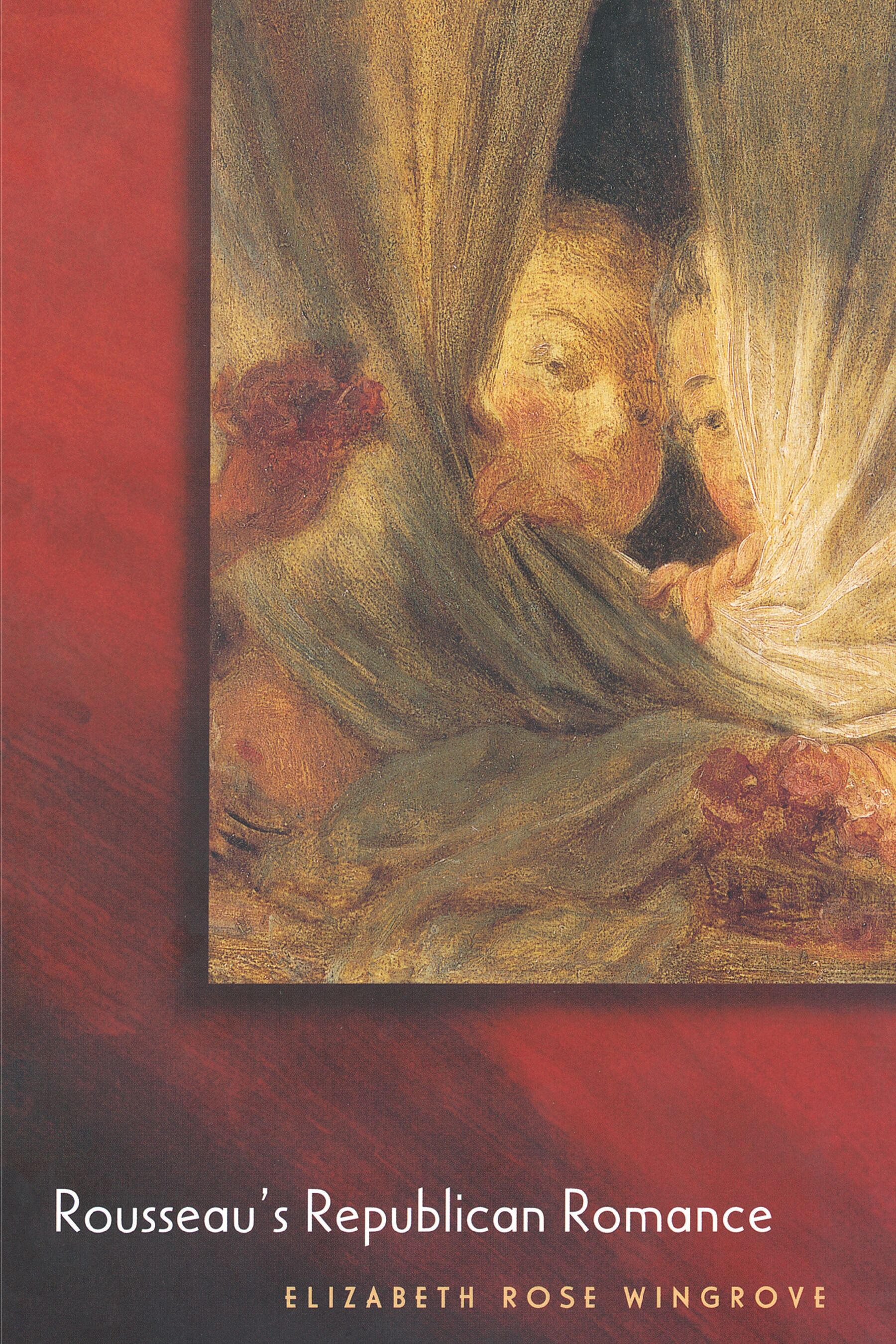
InRousseau's Republican Romance, Elizabeth Wingrove combines political theory and narrative analysis to argue that Rousseau's stories of sex and sexuality offer important insights into the paradoxes of democratic consent. She suggests that despite Rousseau's own protestations, \"man\" and \"citizen\" are not rival or contradictory ideals. Instead, they are deeply interdependent. Her provocative reconfiguration of republicanism introduces the concept of consensual nonconsensuality--a condition in which one wills the circumstances of one's own domination. This apparently paradoxical possibility appears at the center of Rousseau's republican polity and his romantic dyad: in both instances, the expression and satisfaction of desire entail a twin experience of domination and submission.
Drawing on a wide variety of Rousseau's political and literary writings, Wingrove shows how consensual nonconsensuality organizes his representations of desire and identity. She demonstrates the inseparability of republicanism and accounts of heterosexuality in an analysis that emphasizes the sentimental and somatic aspects of citizenship. In Rousseau's texts, a politics of consent coincides with a performative politics of desire and of emotion. Wingrove concludes that understanding his strategies of democratic governance requires attending to his strategies of symbolization. Further, she suggests that any understanding of political practice requires attending to bodily practices.
eBook


The information master
Jean-Baptiste Colbert saw governance of the state not as the inherent ability of the king, but as a form of mechanical mastery of subjects such as medieval legal history, physics, navigation, and the price lists of nails, sails, and gunpowder. In The Information Master , Jacob Soll shows how the legacy of Colbert’s encyclopedic tradition lies at the very center of the rise of the modern state. This innovative book argues that Colbert's practice of collecting knowledge originated in Renaissance Italy, where merchants recognized the power to be gained from merging scholarship and trade. By connecting historical literatures—archives, libraries, merchant techniques, and humanist pedagogy—that have usually remained separate, Soll has created an imaginative and refreshing work.
eBook

Blue jeans
\"Blue jeans may seem suited to every occasion, but their one-size-fits all appearance hides a history of contradictions\"-- Provided by publisher.
BOOK

Rousseau on Education, Freedom, and Judgment
In Rousseau on Education, Freedom, and Judgment, Denise Schaeffer challenges the common view of Rousseau as primarily concerned with conditioning citizens’ passions in order to promote republican virtue and unreflective patriotic attachment to the fatherland. Schaeffer argues that, to the contrary, Rousseau’s central concern is the problem of judgment and how to foster it on both the individual and political level in order to create the conditions for genuine self-rule. Offering both a detailed commentary on Rousseau’s major work on education, Emile, and wide-ranging analysis of the relationship between Emile and several of Rousseau’s other works, Schaeffer explores Rousseau’s understanding of what good judgment is, how it is learned, and why it is central to the achievement and preservation of human freedom. The model of Rousseauian citizenship that emerges from Schaeffer’s analysis is more dynamic and self-critical than is often acknowledged. This book demonstrates the importance of Rousseau’s contribution to our understanding of faculty of judgment, and, more broadly, invites a critical reevaluation of Rousseau’s understanding of education, citizenship, and both individual and collective freedom.
eBook