
Catalogue Search | MBRL


Are you sure you want to remove the book from the shelf?

{{itemTitle}}
44
result(s) for
"Jesaja"
Sort by:

Ein Vorschlag für ein neues Verständnis von Joh 12,39–40
John 12,40, a quote from Isaiah 6,10 (albeit in a wording which differs from the Septuagint), has been acknowledged as
. In order to make things easier to understand, some modern translations insert “God” as the subject of John 12,40a. This insertion is against all known Greek witnesses. Moreover, it is unnecessary and – since “God” is not the subject of John 12,40a – misleading. An analysis of syntax and semantics reveals the grammatical errors of the traditional view of John 12,39–40. The newly analysed text is the basis of a new translation. If this proposed new meaning of the text is used for interpretation, there is no
Journal Article

Jesaja 40:1-11. JHWH as trooster van trauma slagoffers
ISAIAH 40:1-11. YAHWEH AS COMFORTER OF THE TRAUMATISEDThis article aims to show that Yahweh acts as a comforter of the traumatised: the exiles in Babilon. Some of them are eager to return to Jerusalem although they know that the city was destroyed. The prologue of Isaiah 40 gives the wonderful message that Yahweh will comfort the exiles and the city of Jerusalem. The exiles may return to Jerusalem. Yahweh will accompany them. The city of Jerusalem will be rebuilt. Yahweh knows of their suffering. He will comfort them and provide strength, food and help. The comfort will help make the traumatic experience bearable.
Journal Article
Ein Vorschlag für ein neues Verständnis von Joh 12,39–40
John 12,40, a quote from Isaiah 6,10 (albeit in a wording which differs from the Septuagint), has been acknowledged as crux interpretum. In order to make things easier to understand, some modern translations insert “God” as the subject of John 12,40a. This insertion is against all known Greek witnesses. Moreover, it is unnecessary and – since “God” is not the subject of John 12,40a – misleading. An analysis of syntax and semantics reveals the grammatical errors of the traditional view of John 12,39–40. The newly analysed text is the basis of a new translation. If this proposed new meaning of the text is used for interpretation, there is no crux interpretum.
Journal Article
A cognitive semantic approach to Redeemer (Gō'ēl) in Deutero-Isaiah
This study draws on cognitive semantics to explore the radial category nature of Redeemer (Gō'ēl) as depicted by Holy One of Israel in Deutero-Isaiah and the thematic commonalties of the passages involved. The earthly office of Gō'ēl exhibits a radial structure of four models that entail several senses of the concept the people of Israel associated with the office of redeemer, these are: 1) Pentateuchal Model; 2) Royal Model; 3) Marital Model; and 4) Avenger Model. Pertinent to the discussion is the way in which Isaiah extends the title by pairing Redeemer with the Holy One of Israel six times in chapters 41, 43, 47, 48, 49, and 54 suggesting Gō'ēl fulfills a sacred office associated with restoring the broken covenant relationship between Yahweh and Israel. A fifth structural component to the sacred office, the Holiness Model, is proposed which suggests a five model structure for the category of Redeemer.
Journal Article
The Formation of Isaiah 40-55
No detailed description available for \"The Formation of Isaiah 40-55\".
eBook
New Visions of Isaiah
This collection of essays arises from the lively discussions in the Formation of the Book of Isaiah Seminar of the Society of Biblical Literature. The essays exhibit the diversity that has always been present in the Seminar. Each contributor has a unique perspective and thus extends the frontiers of research on the book of Isaiah. Yet, taken as a whole, the essays fall into two broad groups, being either 'objective' in their approach to the text-embracing historical-critical method or a synchronic approach in which text rather than reader is the focus-or 'postmodern', in the sense that meaning is in no small degree located in what the reader does. In addition to the editors, the contributors are Mark Biddle, David Carr, Edgar Conrad, Chris Franke, Kathryn Pfisterer Darr, Rolf Rendtorff, Gerald Sheppard, Benjamin Sommer, Gary Stansell, and Roy Wells.
eBook
LXX-Isaiah as Translation and Interpretation
This book offers a fresh understanding of how Isaiah was translated into Greek, arguing that the translator attempted a cohesive representation of Isaiah for his Greek-speaking co-religionists, utilizing interpretative ploys applied to Homer by the Alexandrian grammatikoi.
eBook
Until the Spirit Comes: The Spirit of God in the Book of Isaiah
The surge of the Pentecostal movement in this century has brought new relevance to the study of the Spirit of God in the Old Testament. Surprisingly, however, this theme has been largely neglected by Pentecostal scholars. Ma seeks to fill this gap by providing an in-depth study of the spirit of God in the Isaianic traditions. He argues that the Old Testament concept of the Spirit of God has more than one root, and that the development of the various spirit traditions can be fruitfully traced. The study utilizes a synchronic approach together with historical analyses in order to elucidate the message of the book of Isaiah. The author concludes that the concept of the Spirit of God retains a strong eschatological significance throughout the book.
eBook
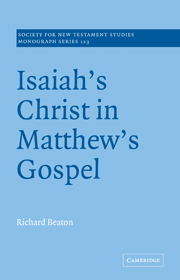
Isaiah's Christ in Matthew's Gospel
Matthew's Jesus is typically described as the humble, compassionate messiah. This 2002 book argues that this is, however, only half the story. Matthew's theologically rich quotation of Isaiah 42.1–4, traditionally considered one of the four servant songs, underscores that manifest in Jesus' powerful message and deeds, particularly his healings and inclusion of the marginalized, is the justice that was thought to accompany the arrival of the kingdom of God. The study explores modifications to the text-form of the Isaianic citations, their relationship to the surrounding context, and the rhetorical force of the final form. It argues that the quotations are bi-referential, functioning on both a narrative and theological level, and also explores the issues surrounding the troublesome 'extraneous' content. It arrives at the conclusion that this citation was central to Matthew's understanding of Jesus' life and mission. All totalled, this study offers a refreshing exploration of Matthew's high, ethical Christology.
eBook

Until the Spirit Comes
The surge of the Pentecostal movement in this century has brought new relevance to the study of the Spirit of God in the Old Testament.Surprisingly, however, this theme has been largely neglected by Pentecostal scholars.Ma seeks to fill this gap by providing an in-depth study of the spirit of God in the Isaianic traditions.
eBook