
Catalogue Search | MBRL


Are you sure you want to remove the book from the shelf?

{{itemTitle}}
143
result(s) for
"Jesuits China."
Sort by:

Matteo Ricci
Matteo Ricci (1552–1610), the first of the early Jesuit missionaries of the China mission, is widely considered the most outstanding cultural mediator of all time between China and the West. This engrossing and fluid book offers a thorough, knowledgeable biography of this fascinating and influential man, telling a deeply human and captivating story that still resonates today. Michela Fontana traces Ricci's travels in China in detail, providing a rich portrait of Ming China and the growing importance of cultural exchanges between China and the West. She shows how Ricci incorporated his ideas of \"cultural accommodation\" into both his life and his writings aimed at the Chinese elite. Her biography is the first to highlight Ricci's immensely important scientific work and that of key Christian converts, such as Xu Guangqi, who translated Euclid's Elements together with Ricci. Exploring the history of science in China and the West as well as their dramatically different cultural attitudes toward religious and philosophical issues, Michela Fontana introduces not only Ricci's life but the first significant encounter between Western and Chinese civilizations.
eBook
The mandate of heaven : strategy, revolution, and the first European translation of Sunzi's Art of War (1772)
\"The Mandate of Heaven examines the first European version of Sunzi's Art of War, which was translated from Chinese by Joseph Amiot, a French missionary in Beijing, and published in Paris in 1772. His work is presented in English for the first time. Amiot undertook this project following the suppression of the Society of Jesus in France with the aim of demonstrating the value of the China mission to the French government. He addressed his work to Henri Bertin, minister of state, beginning a thirty-year correspondence between the two men. Amiot framed his translation in order to promote a radical agenda using the Chinese doctrine of the \"mandate of heaven.\" This was picked up within the sinophile and radical circle of the physiocrats, who promoted China as a model for revolution in Europe. The work also arrived just as the concept of strategy was emerging in France. Thus Amiot's Sunzi can be placed among seminal developments in European political and strategic thought on the eve of the revolutionary era\"-- Provided by publisher.
BOOK
Making the New World Their Own
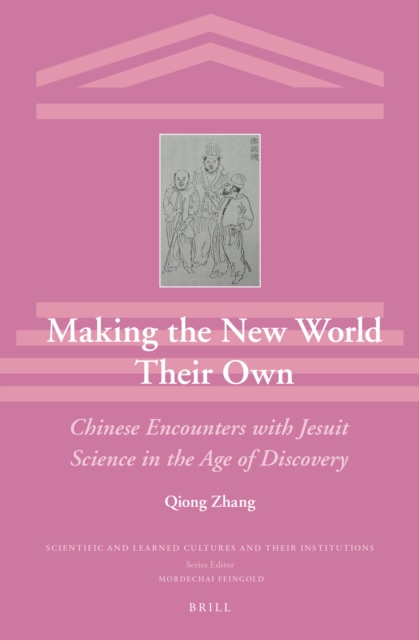
Making the New World Their Own offers a systematic study of how Chinese scholars came to understand that the earth is shaped as a globe. This notion arose from their encounters with the Jesuit missionaries in the seventeenth century.
eBook

China at the center : Ricci and Verbiest world maps
\"Global exploration in the sixteenth and seventeenth centuries led to new interactions between Europe and Asia. Jesuit priests were instrumental in spreading knowledge of the world to China and information about China to Europe. China at the Center focuses on two masterpieces of seventeenth-century map-making that illustrate this exchange of information (and misinformation). The first map is the Kunyu wanguo quantu, or Map of the Ten Thousand Countries of the Earth, also known as the 1602 Ricci map, after Matteo Ricci, the Jesuit priest who helped create it. The second is the 1674 Verbiest world map, which was also made by a Jesuit priest, Ferdinand Verbiest, for the Chinese court. These two maps are among the earliest, rarest, and largest woodblock-printed maps to survive from the period. They will be examined through the lens of the development of cartography in China and through the biographies of the fascinating men who were instrumental in their production. Maps are political objects, and the inclusion of elaborate and extensive notations on both these maps illustrate the fascinating relationships between the Jesuits and the Chinese courts. These maps represent the meeting of two worldviews, and the information they contain provided Europeans with greater knowledge of China and the Chinese with new ideas about geography, astronomy, and the natural sciences. This book accompanies the exhibition China at the Center, at the Asian Art Museum March 4-May 8, 2016, which brings together the 1602 Ricci map from the James Ford Bell Trust in Minneapolis and the 1674 Verbiest map from the Library of Congress in Washington D.C\"-- Provided by publisher.
Book
In the light and shadow of an Emperor : Tomás Pereira, SJ (1645-1708), the Kangxi Emperor and the Jesuit mission in China
The present collection was written to commemorate the third centenary of the death of the Portuguese Jesuit, Tomás Pereira (16451708). Dealing with some of the most decisive and controversial moments in the history of the Jesuit mission in China during the Kangxi era (16621722), these essays were produced by an international team of scholars and cover a wide range of topics that reflect a permanent academic interest, in Europe and America as well as in China, in the history of the Catholic.
eBook

State of the Field Report XV: Contemporary Chinese Studies of the Scholastic-Aristotelian Soul in Late-Ming and Early-Qing China
The Jesuit China mission coincided with a sophisticated attempt to place Chinese and Western concepts of human nature in dialogue with Confucianism. The Jesuits believed that they could facilitate evangelization by drawing upon Confucian concepts to explain the soul. In so doing, they and their Chinese collaborators also pioneered a genre of hybrid philosophical texts, which used Aristotelian conceptions of the soul to critique and supplement autochthonous Chinese conceptions of human nature. These texts are not just of significance for Chinese Christian theology, but also anthropology, psychology, and even medicine, given the role played by the soul in both Chinese and Western conceptions of human physiology at the time. Until recently these texts have been little studied except by missiologists who were more interested in their relevance for mission history than for comparative philosophy. Scholarship has perhaps also been hampered by the immense linguistic demands of studying texts that sit between the Chinese and Western intellectual traditions. Recently, however, a number of Chinese scholars have turned their attention to these texts, intrigued by novel philosophical ideas contained therein and their complex relationship to both the Western and Chinese intellectual and religious traditions. Since many of these Chinese-language contributions are published in volumes which are not easily accessible outside of China, they have not enjoyed great visibility in Western-language scholarship. This article will review the major developments in Chinese scholarship and will conclude with suggestions for future research.
Journal Article
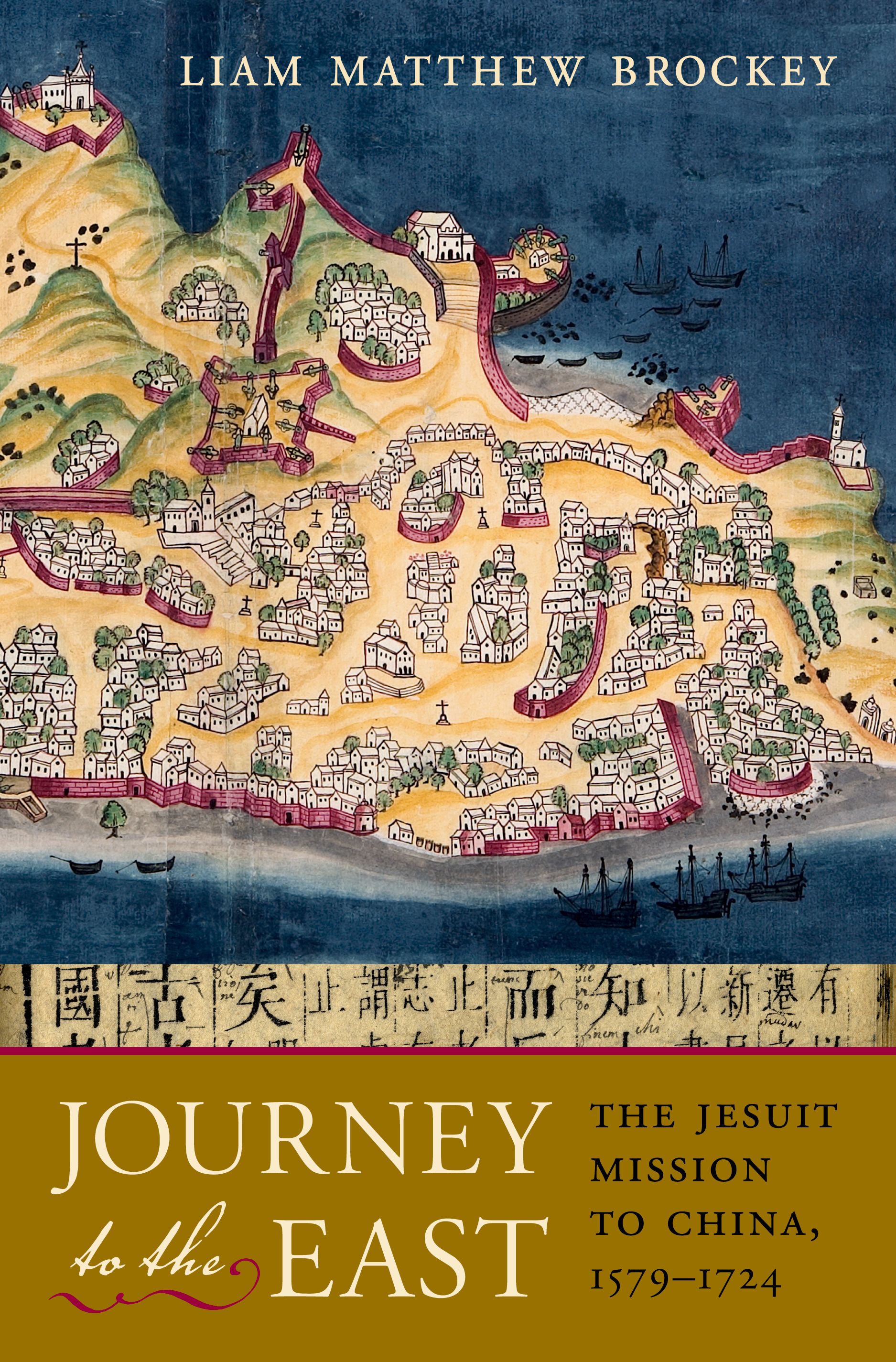
Journey to the East : the Jesuit mission to China, 1579-1724
It was one of the great encounters of world history: highly educated European priests confronting Chinese culture for the first time in the modern era. This \"journey to the East\" is explored by Liam Brockey as he retraces the path of the Jesuit missionaries who sailed from Portugal to China, believing that, with little more than firm conviction and divine assistance, they could convert the Chinese to Christianity. Moving beyond the image of Jesuits as cultural emissaries, his book shows how these priests, in the first concerted European effort to engage with Chinese language and thought, translated Roman Catholicism into the Chinese cultural frame and eventually claimed two hundred thousand converts.
The first narrative history of the Jesuits' mission from 1579 until the proscription of Christianity in China in 1724, this study is also the first to use extensive documentation of the enterprise found in Lisbon and Rome. The peril of travel in the premodern world, the danger of entering a foreign land alone and unarmed, and the challenge of understanding a radically different culture result in episodes of high drama set against such backdrops as the imperial court of Peking, the villages of Shanxi Province, and the bustling cities of the Yangzi Delta region. Further scenes show how the Jesuits claimed conversions and molded their Christian communities into outposts of Baroque Catholicism in the vastness of China. In the retelling, this story reaches across continents and centuries to reveal the deep political, cultural, scientific, linguistic, and religious complexities of a true early engagement between East and West.
eBook

Alexandre de la Charme’s Chinese–Manchu Treatise Xingli zhenquan tigang (Sing lii jen ciyan bithei hešen) in the Early Entangled History of Christian, Neo-Confucian, and Manchu Shamanic Thought and Spirituality as Well as Early Sinology
The work Xingli zhenquan tigang (Sing lii jen ciyan bithei hešen) was written in Chinese and Manchu by the French Jesuit Alexandre de la Charme (1695–1767) and published in Beijing in 1753. The first two sections of this paper provide an introduction to de la Charme’s work biography and to further textual and historical contexts, explore the peculiarities of the subsequent early German reception of the work almost 90 years later, and introduce the content from an overview perspective. The third section explores the most essential contents of Book 1 (of 3) of the Manchu version. The investigation is based on Hans Conon von der Gabelentz’s (1807–1874) German translation from 1840. Camouflaged as a Confucian educational dialogue, and by blurring his true identity in his publication, de la Charme criticizes Neo-Confucian positions from an implicitly Cartesian and hidden Christian perspective, tacitly blending Cartesian views with traditional Chinese concepts. In addition, he alludes to Manchu shamanic views in the same regard. De la Charme’s assimilating rhetoric “triangulation” of three different cultural and linguistic horizons of thought and spirituality proves that later Jesuit scholarship reached out into the inherent ethnic and spiritual diversity of the Qing intellectual and political elites. Hidden allusions to Descartes’s dualistic concepts of res cogitans and res extensa implicitly anticipate the beginnings of China’s intellectual modernization period one and a half centuries later. This work also provides an example of how the exchange of intellectual and religious elements persisted despite the Rites Controversy and demonstrates how the fading Jesuit mission influenced early German sinology. I believe that this previously underexplored work is significant in both systematic and historical respects. It is particularly relevant in the context of current comparative research fields, as well as transcultural and interreligious intellectual dialogue in East Asia and around the world.
Journal Article

A cross-cultural archery analogy in Matteo Ricci's Tianzhu shiyi
In the sixth chapter of his Tianzhu shiyi (天主實義, “The True Meaning of the Lord of Heaven”), Matteo Ricci offers a critique of the anti-intentionalistic thread that he detects in the Chinese philosophical tradition. In this brief essay, I offer an analysis of a noteworthy archery analogy that Ricci employs to describe the nature of ethical action as an intentional process with a conscious aim. I trace how Ricci skilfully combines Western and Chinese images and categories to craft this simile. Before that, I set the stage by offering some preliminary comments that contextualize Ricci's interest in the question of intentional vs. non-intentional conduct.
Journal Article