
Catalogue Search | MBRL


Are you sure you want to remove the book from the shelf?

{{itemTitle}}
26
result(s) for
"Jeux et technologie."
Sort by:

Playing with reality : how games have shaped our world
\"A wide-ranging intellectual history that reveals how important games have been to human progress, and what's at stake when we forget what games we're really playing. We play games to learn about the world, to understand our minds and the minds of others, and to make predictions about the future. Games are an essential aspect of humanity and a powerful tool for modeling reality. They're also a lot of fun. But games can be dangerous, especially when we mistake the model worlds of games for reality itself and let gamification co-opt human decision making. Playing with Reality explores the riveting history of games since the Enlightenment, weaving an unexpected path through military theory, political science, evolutionary biology, the development of computers and AI, cutting-edge neuroscience, and cognitive psychology. Neuroscientist and physicist Kelly Clancy shows how intertwined games have been with the arc of history. War games shaped the outcomes of real wars in nineteenth and twentieth century Europe. Game theory warped our understanding of human behavior and brought us to the brink of annihilation-yet still underlies basic assumptions in economics, politics, and technology design. We used games to teach computers how to learn for themselves, and now we are designing games that will determine the shape of society and future of democracy. In this revelatory new work, Clancy makes the bold argument that the human fascination with games is the key to understanding our nature and our actions\"-- Provided by publisher.
Book

Children's Games in the New Media Age
The result of a unique research project exploring the relationship between children's vernacular play cultures and their media-based play, this collection challenges two popular misconceptions about children's play: that it is depleted or even dying out and that it is threatened by contemporary media such as television and computer games. A key element in the research was the digitization and analysis of Iona and Peter Opie's sound recordings of children's playground and street games from the 1970s and 1980s. This framed and enabled the research team's studies both of the Opies' documents of mid-twentieth-century play culture and, through a two-year ethnographic study of play and games in two primary school playgrounds, contemporary children's play cultures. In addition the research included the use of a prototype computer game to capture playground games and the making of a documentary film. Drawing on this extraordinary data set, the volume poses three questions: What do these hitherto unseen sources reveal about the games, songs and rhymes the Opies and others collected in the mid-twentieth century? What has happened to these vernacular forms? How are the forms of vernacular play that are transmitted in playgrounds, homes and streets transfigured in the new media age? In addressing these questions, the contributors reflect on the changing face of childhood in the twenty-first century - in relation to questions of gender and power and with attention to the children's own participation in producing the ethnographic record of their lives.
eBook
The place of play
Increasingly, technology is at stake in toys, games and playing. With the immense popularity of computer games, questions concerning the role and function of technology in play have become more pressing. A key aspect of the increasing technologization and digitalization of both toys and play is the vagueness of borders between producers, consumers and players. In these so-called participatory cultures, players do not simply play with toys designed behind closed doors but become co-designers. This book takes a critical look at the advantages and disadvantages of participatory cultures and places the changing world of toys, games and playing in a historical context. Contrary to many New Media and computer game studies, this book takes the historical background of these phenomena into account by situating the changing world of play in the context of the social and cultural processes of commodification, domestication and urbanization from the 1850s to the present.
Technologie speelt een steeds belangrijkere rol in speelgoed en spellen. De immense populariteit van computerspellen maakt vragen over de invloed en functie van technologie steeds dwingender. Een van de kernaspecten van de toenemende 'technologisering' en 'digitalisering' van speelgoed en spellen is het vervagen van de grenzen tussen producenten, consumenten en spelers. In 'participatieve culturen' speelt men niet meer met achter gesloten deuren ontworpen spellen, maar worden de spelers zelf medeontwerpers. The Place of Play onderzoekt de aard, karakteristieken, mechanismen en problemen van deze participatieve culturen aan de hand van speelgoed en computerspellen.
eBook
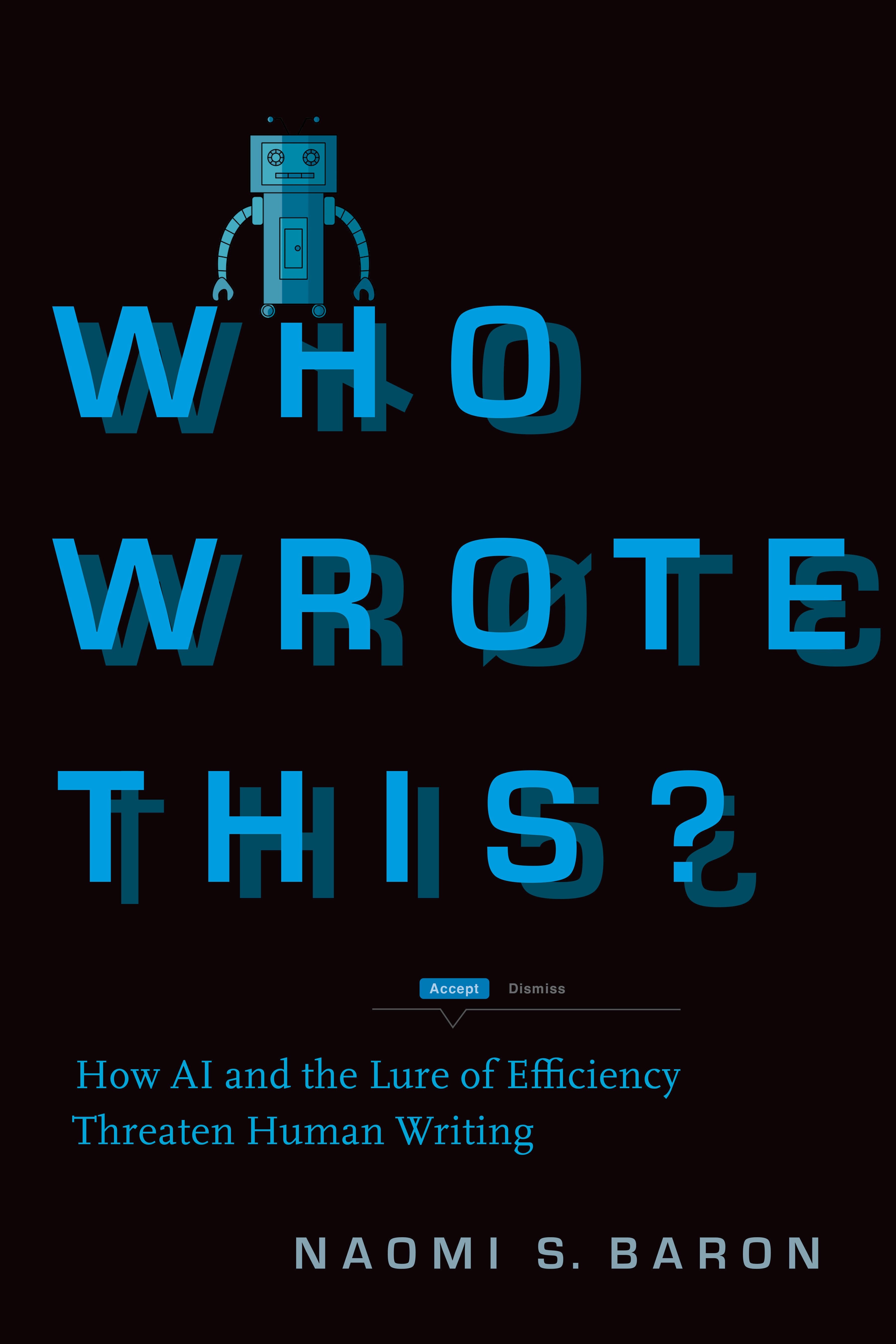
Who Wrote This?
Would you read this book if a computer wrote it? Would you even know? And why would it matter?
Today's eerily impressive artificial intelligence writing tools present us with a crucial challenge: As writers, do we unthinkingly adopt AI's time-saving advantages or do we stop to weigh what we gain and lose when heeding its siren call? To understand how AI is redefining what it means to write and think, linguist and educator Naomi S. Baron leads us on a journey connecting the dots between human literacy and today's technology. From nineteenth-century lessons in composition, to mathematician Alan Turing's work creating a machine for deciphering war-time messages, to contemporary engines like ChatGPT, Baron gives readers a spirited overview of the emergence of both literacy and AI, and a glimpse of their possible future. As the technology becomes increasingly sophisticated and fluent, it's tempting to take the easy way out and let AI do the work for us. Baron cautions that such efficiency isn't always in our interest. As AI plies us with suggestions or full-blown text, we risk losing not just our technical skills but the power of writing as a springboard for personal reflection and unique expression.
Funny, informed, and conversational, Who Wrote This? urges us as individuals and as communities to make conscious choices about the extent to which we collaborate with AI. The technology is here to stay. Baron shows us how to work with AI and how to spot where it risks diminishing the valuable cognitive and social benefits of being literate.
eBook

Making School a Game Worth Playing
Integrate game-based learning for 21st Century skills success!Kids today live in a digitally connected world. Prepare your students for the new global economy by leveraging the technology they love and understand best. This straightforward, easy-to-follow guide helps you build essential 21st Century skills using digital video games. Ryan Schaaf and Nicky Mohan provide a cutting-edge, research-based approach - built around time-honored instructional practices. Step-by-step strategies help you easily find, evaluate, and integrate digital games into your existing lesson plans or completely redesign your classroom.This practical guide helps teachers use well-designed game elements to: Promote meaningful student buy-in; Create student-centered, collaborative learning spaces; Teach and assess 21st Century Fluencies aligned to Common Core State Standards; Address multiple intelligences using research-based strategiesIncludes a detailed implementation outline, a revised Bloom's Digital Taxonomy oriented to game content, summarized notes, and a reading list for engaged, adventure-filled learning!“This book is easy to read, offers strategies that are easy to implement, and inspires a sense of urgency for educators to modify our teaching techniques to include more gaming in our classrooms. It is useful for teachers of all experience levels.”—Carrie Trudden, Educational Technology TeacherHoward County Public School System, Clarksville, MD“Schaaf and Mohan present gamification as a powerful tool for engaging learners and for the development of 21st-century fluencies, organized in levels as in the games it describes. This book is rich in resources for finding, evaluating, implementing, and designing classroom games.“—Danea A. Farley, Associate Professor and Coordinator of TechnologyNotre Dame of MD University
eBook

Social exclusion, power, and video game play
While many books and articles are emerging on the new area of game studies and the application of computer games to learning, therapeutic, military, and entertainment environments, few have attempted to contextualize the importance of virtual play within a broader social, cultural, and political environment that raises the question of the significance of work, play, power, and inequalities in the modern world. Studies tend to concentrate on the content of virtual games, but few have questioned how power is produced or reproduced by publishers, gamers, or even social media; how social exclusion (based on race, class, or gender) in the virtual environment is reproduced from the real world; and how actors are able to use new media to transcend their fears, anxieties, prejudices, and assumptions. The articles presented by the contributors in this volume represent cutting-edge research in the area of critical game play with the hope of drawing attention to the need for more studies that are both sociological and critical.
eBook

Learning by Playing
There is a growing recognition in the learning sciences that video games can no longer be seen as impediments to education, but rather, they can be developed to enhance learning. Educational and developmental psychologists, education researchers, media psychologists, and cognitive psychologists are now joining game designers and developers in seeking out new ways to use video game play in the classroom. This book provides perspectives on the most current thinking concerning the ramifications of leisure video game play for academic classroom learning. The first section of the text provides foundational understanding of the cognitive skills and content knowledge that children and adolescents acquire and refine during video game play. The second section explores game features that captivate and promote skills development among game players. The subsequent sections discuss children and adolescents' learning in the context of different types of games and the factors that contribute to transfer of learning from video game play to the classroom. These chapters then form the basis for the concluding section of the text: a specification of the most appropriate research agenda to investigate the academic potential of video game play, particularly using those games that child and adolescent players find most compelling.
eBook

Virtuous War
Virtuous War is the first book to map the emergence and judge the consequences of a new military-industrial-media-entertainment network. James Der Derian takes the reader from a family history of war and genocide to new virtual battlespaces in the Mojave Desert, Silicon Valley, Hollywood and American universities. He tracks the convergence of cyborg technologies, video games, media spectacles, war movies, and do-good ideologies that produced a chimera of high-tech, low-risk ‘virtuous wars’.
In this newly updated edition, he reveals how a misguided faith in virtuous war to right the wrongs of the world instead paved the way for a flawed response to 9/11 and a disastrous war in Iraq. Blinded by virtue, emboldened by technological superiority, seized by a mimetic terror, the US blundered from one foreign fiasco to the next.
Taking the long view as well as getting up close to the war machine, Virtuous War provides a compelling alternative to the partisan politics, instant analysis and technical fixes that currently bedevil US national security policy.
James Der Derian is Research Professor of International Studies at Brown University, where he directs the Innovating GlobalSecurity and Global Media Project at the Watson Institute for International Studies. He has produced numerous books, articles, and documentaries on diplomacy, war, media, and technology, including, most recently, Critical Practices in International Theory (Routledge, 2008)
Praise for 2nd Edition
'From Borges to Baudrillard and beyond, James Der Derian chronicles our ongoing obsession with war technology and our increasing disconnection with the reality of war. Eisenhower coined the phrase ‘the military-industrial complex.’ Der Derian has his own phrase, also powerful, thoughtful, and descriptive: ‘the military-industrial-media-entertainment network.’ A frightening thought, but also a central and illuminating thought for our times.' - Errol Morris, filmmaker
'There’s a marvellous unmasking here of the modern military-media-entertainment fantasy, a disease that pretends to be the cure… This is a book that brings theory and theorists to life, a book that horrifies and delights on virtually every page.' - Christopher Lydon, Open Source
'The expanded, brilliantly realized 2nd edition of Virtuous War makes indispensable reading. The world is catching up to Der Derian’s vision of where we are and what we must do about these lethal linkages of war, media, entertainment.' - Richard Falk, University of California, Santa Barbara, USA
Reviews of 1st edition:
'This eye-opening, entertaining and sobering study of the increasing 'virtualization' of American politics - and of war in particular - via media manipulation makes an important contribution to political, media and social studies...this fascinating and important material will make a splash in academic circles.' - Publishers Weekly
'The virtual wars that are being fought and planned are far from \"virtuous,\" and the author is to be congratulated for bringing this simple reality to our attention.' - Political Affairs
'Der Derian is successful is mapping out this newly digitized world.' - New Political Science
'The first book to offer a \"virtual theory\" for the military strategies, philosophical questions, ethical issues, and political controversies surrounding the future of war and peace.' - TechDirections
'[Virtuous War] is an important book, and a relevant one, especially given the current administration's struggle to transform and finance a military suited to the 21st century.' - Proceedings
List of Photographs Preface to the new edition Prologue 1. The Tank and the Tortoise 2. Between Wars 3. Global Swarming and the Bosnia Question 4. The Simulation Triangle 5. The Virtual Enemy 6. Virtuous War Comes Home 7. Virtuous War Goes to Hollywood 8. Kosovo and the Virtuous Thereafter 9. A Virtual Theory for the Global Accident 10. After 9/11 11. The Age of InfoTerror 12. Virtuous War and the Desert of the Real Acknowledgments List of Acronyms Notes Index
eBook

Teaching About Evolution and the Nature of Science
Today many school students are shielded from one of the most important concepts in modern science: evolution. In engaging and conversational style, Teaching About Evolution and the Nature of Science provides a well-structured framework for understanding and teaching evolution.
Written for teachers, parents, and community officials as well as scientists and educators, this book describes how evolution reveals both the great diversity and similarity among the Earth's organisms; it explores how scientists approach the question of evolution; and it illustrates the nature of science as a way of knowing about the natural world. In addition, the book provides answers to frequently asked questions to help readers understand many of the issues and misconceptions about evolution.
The book includes sample activities for teaching about evolution and the nature of science. For example, the book includes activities that investigate fossil footprints and population growth that teachers of science can use to introduce principles of evolution. Background information, materials, and step-by-step presentations are provided for each activity. In addition, this volume:
Presents the evidence for evolution, including how evolution can be observed today.
Explains the nature of science through a variety of examples.
Describes how science differs from other human endeavors and why evolution is one of the best avenues for helping students understand this distinction.
Answers frequently asked questions about evolution.
Teaching About Evolution and the Nature of Science builds on the 1996 National Science Education Standards released by the National Research Council-and offers detailed guidance on how to evaluate and choose instructional materials that support the standards.
Comprehensive and practical, this book brings one of today's educational challenges into focus in a balanced and reasoned discussion. It will be of special interest to teachers of science, school administrators, and interested members of the community.
eBook

Les Serious Games
Partant du postulat que le jeu est la meilleure pédagogie qui soit, et actualisant ce principe à l’ère du numérique, cet ouvrage propulse les jeux vidéo audevant de la scène scolaire : il introduit et soutient l’usage des serious games dans l’éducation !
Dès lors qu’ils équilibrent parfaitement les aspects ludique et éducatif, les jeux vidéo constituent un support d’apprentissage privilégié.
Or, s’ils sont omniprésents dans la société actuelle, leurs véritables enjeux et atouts restent largement méconnus, voire dissimulés derrière cette peur socialement partagée d’un univers prétendument violent.
L’auteure s’adresse donc aux enseignants, aux formateurs et à tous ceux qui sont impliqués dans l’éducation des jeunes (et des moins jeunes). Elle les convainc de l’intérêt qu’ils ont à considérer les serious games comme un outil pédagogique des plus pertinents et en parfaite cohérence avec les pédagogies actives prônées actuellement. Loin de l’auteure donc, l’idée de procéder à une complète gamification du système scolaire ou d’évincer les enseignants au profit du multimédia : l’enjeu est d’utiliser au mieux ces nouveaux outils afin de faciliter l’apprentissage chez une génération entièrement tournée vers les technologies nouvelles.
Tout en laissant transparaître sa passion pour les jeux vidéo, Yasmine Kasbi nous offre un ouvrage complet, fouillé et richement documenté sur l’univers des serious games.
eBook