
Catalogue Search | MBRL


Are you sure you want to remove the book from the shelf?

{{itemTitle}}
1,046
result(s) for
"Jewish aesthetics"
Sort by:
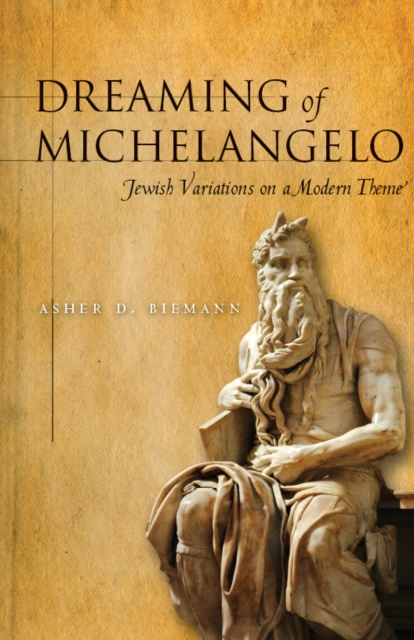
Dreaming of Michelangelo
Dreaming of Michelangelo is the first book-length study to explore the intellectual and cultural affinities between modern Judaism and the life and work of Michelangelo Buonarroti. It argues that Jewish intellectuals found themselves in the image of Michelangelo as an \"unrequited lover\" whose work expressed loneliness and a longing for humanity's response. The modern Jewish imagination thus became consciously idolatrous. Writers brought to life—literally—Michelangelo's sculptures, seeing in them their own worldly and emotional struggles. The Moses statue in particular became an archetype of Jewish liberation politics as well as a central focus of Jewish aesthetics. And such affinities extended beyond sculpture: Jewish visitors to the Sistine Chapel reinterpreted the ceiling as a manifesto of prophetic socialism, devoid of its Christian elements. According to Biemann, the phenomenon of Jewish self-recognition in Michelangelo's work offered an alternative to the failed promises of the German enlightenment. Through this unexpected discovery, he rethinks German Jewish history and its connections to Italy, the Mediterranean, and the art of the Renaissance.
eBook

Jewish Primitivism
Around the beginning of the twentieth century, Jewish writers
and artists across Europe began depicting fellow Jews as savages or
\"primitive\" tribesmen. Primitivism-the European appreciation of and
fascination with so-called \"primitive,\" non-Western peoples who
were also subjugated and denigrated-was a powerful artistic
critique of the modern world and was adopted by Jewish writers and
artists to explore the urgent questions surrounding their own
identity and status in Europe as insiders and outsiders. Jewish
primitivism found expression in a variety of forms in Yiddish,
Hebrew, and German literature, photography, and graphic art,
including in the work of figures such as Franz Kafka, Y.L. Peretz,
S. An-sky, Uri Zvi Greenberg, Else Lasker-Schüler, and Moï Ver.
In Jewish Primitivism , Samuel J. Spinner argues that
these and other Jewish modernists developed a distinct primitivist
aesthetic that, by locating the savage present within Europe,
challenged the idea of the threatening savage other from outside
Europe on which much primitivism relied: in Jewish primitivism, the
savage is already there. This book offers a new assessment of
modern Jewish art and literature and shows how Jewish primitivism
troubles the boundary between observer and observed, cultured and
\"primitive,\" colonizer and colonized.
eBook

On the Construction of National Symbol in S. Y. Abramovitsh's Susati
This paper focuses on the way national symbol is constructed in the Hebrew novel Susati , which was written as a national allegory at around the turn of the twentieth century. The paper sheds new light on the Jewishness of the chosen aesthetic representation. The paper argues that Abramovitsh's symbolic method accentuates a new understanding of Jewish national existence that is represented through the behavioral constructions that develop between the novel's human protagonist and the animal protagonist—the mare—as well as between these two and the devil. This elaborate and complicated literary representation mirrors the chaotic reality experienced by many Jews in early twentieth-century Eastern Europe.
Journal Article

The Artless Jew
Conventional wisdom holds that Judaism is indifferent or even suspiciously hostile to the visual arts due to the Second Commandment's prohibition on creating \"graven images,\" the dictates of monotheism, and historical happenstance. This intellectual history of medieval and modern Jewish attitudes toward art and representation overturns the modern assumption of Jewish iconophobia that denies to Jewish culture a visual dimension.
Kalman Bland synthesizes evidence from medieval Jewish philosophy, mysticism, poetry, biblical commentaries, travelogues, and law, concluding that premodern Jewish intellectuals held a positive, liberal understanding of the Second Commandment and did, in fact, articulate a certain Jewish aesthetic. He draws on this insight to consider modern ideas of Jewish art, revealing how they are inextricably linked to diverse notions about modern Jewish identity that are themselves entwined with arguments over Zionism, integration, and anti-Semitism.
Through its use of the past to illuminate the present and its analysis of how the present informs our readings of the past, this book establishes a new assessment of Jewish aesthetic theory rooted in historical analysis. Authoritative and original in its identification of authentic Jewish traditions of painting, sculpture, and architecture, this volume will ripple the waters of several disciplines, including Jewish studies, art history, medieval and modern history, and philosophy.
eBook


Music's Making
As a work of musical theory, or meta-theory, Music's
Making draws extensively on work done in philosophy and
literary criticism in addition to the scholarship of musicologists
and music theorists. Music's Making is divided into two
large parts. The first half develops global attitudes toward music:
emergence out of self and hearing through (drawing on Kabbalah and
other sources), middle-voice (as discussed in philosophical
phenomenology), liminal space (as discussed in literary theory), an
ethics of intersubjectivity (drawing on Levinas), and character,
canon, and metaleptic transformations (drawing chiefly on Harold
Bloom). The second half embodies a search for metaphors, figurative
language toward understanding music's endlessly variegated shaping
of time-space. The musicians and scholars who inform this part of
the book include Pierre Boulez, Gilles Deleuze, Anton Webern,
Morton Feldman, and James Dillon. The book closes with an extended
inquiry into the metaphors of horizontal and vertical experience
and the spiritual qualities of musical experience expressed through
those metaphors.
eBook

Locating Postcolonial Literary Aesthetic in Transcultural Contact Zone: A Politico-aesthetic Analysis of Hanif Kureishi’s Selected Short Stories
This research article addresses the concept of “postcolonial aesthetic” against the backdrop of theoretical assumptions presented by Bill Ashcroft in his article “Towards a Postcolonial Aesthetics.” He claims that postcolonial text in any form, whether written, visual, or auditory, gives birth to “aesthetic engagement” that causes a transformation in both “producer” and “consumer.” The aesthetic contact takes place in a contact zone of postcolonial text that Ashcroft calls “a space of negotiation,” where both writer and reader form a “constitutive collusion.” In this theoretical context, the article critically analyzes two short stories, My Son the Fanatic (1994) and We Are Not Jews (1995), written by a British–Pakistani writer, Hanif Kureishi. The selected short stories revolve around the theme of mixed identity, thus highlighting the significance of postcolonial fiction as a site to merge transcultural elements and trace aesthetic concerns in the transcultural contact zone of these literary texts, which, according to Ashcroft, is a transformational interaction of two cultures. The life events, situations, feelings, and the subsequent outcome of the inner and outer states of the protagonists are analyzed to figure out the aesthetic engagement of the texts. Following Ashcroft’s claim, the results show that the two selected short stories provide a constructive site for merging transcultural elements in the cultural contact zone, where both writer and reader contribute to postcolonial cultural production. Moreover, it argues that this transformative space allows the political and aesthetic qualities to develop side by side.
Journal Article

The ethnic avant-garde
During the 1920s and 1930s, American minority artists and writers collaborated extensively with the Soviet avant-garde, seeking to build a revolutionary society that would end racial discrimination and advance progressive art. Making what Claude McKay called \"the magic pilgrimage\" to the Soviet Union, these intellectuals placed themselves at the forefront of modernism, using radical cultural and political experiments to reimagine identity and decenter the West.
Shining rare light on these efforts, The Ethnic Avant-Garde makes a unique contribution to interwar literary, political, and art history, drawing extensively on Russian archives, travel narratives, and artistic exchanges to establish the parameters of an undervalued \"ethnic avant-garde.\" These writers and artists cohered around distinct forms that mirrored Soviet techniques of montage, fragment, and interruption. They orbited interwar Moscow, where the international avant-garde converged with the Communist International.
The book explores Vladimir Mayakovsky's 1925 visit to New York City via Cuba and Mexico, during which he wrote Russian-language poetry in an \"Afro-Cuban\" voice; Langston Hughes's translations of these poems while in Moscow, which he visited to assist on a Soviet film about African American life; a futurist play condemning Western imperialism in China, which became Broadway's first major production to feature a predominantly Asian American cast; and efforts to imagine the Bolshevik Revolution as Jewish messianic arrest, followed by the slow political disenchantment of the New York Intellectuals. Through an absorbing collage of cross-ethnic encounters that also include Herbert Biberman, Sergei Eisenstein, Paul Robeson, and Vladimir Tatlin, this work remaps global modernism along minority and Soviet-centered lines, further advancing the avant-garde project of seeing the world anew.
eBook

The Sense of Semblance
Holocaust artworks intuitively must fulfill at least two criteria: artistic (lest they be merely historical documents) and historical (lest they distort the Holocaust or become merely artworks). The Sense of Semblance locates this problematic within philosophical aesthetics, as a version of the conflict between aesthetic autonomy and heteronomy, and argues that Adorno's dialectic of aesthetic semblance describes the normative demand that artworks maintain a dynamic tension between the two. The Sense of Semblance aims to move beyond familiar debates surrounding postmodernism by demonstrating the usefulness of contemporary theories of meaning and understanding, including those from the analytic tradition. Pickford shows how the causal theory of names, the philosophy of tacit knowledge, the analytic philosophy of quotation, Sartre's theory of the imaginary, the epistemology of testimony, and Walter Benjamin's dialectical image can help explicate how individual artworks fulfill artistic and historical desiderata. In close readings of Celan's poetry, Holocaust memorials in Berlin, the quotational artist Heimrad Backer, Claude Lanzmann's film Shoah, and Art Spiegelman's graphic novel Maus, Pickford offers interpretations that, in their precision, specificity, and clarity, inaugurate a dialogue between contemporary analytic philosophy and contemporary art. The Sense of Semblance is the first book to incorporate contemporary analytic philosophy in interpretations of art and architecture, literature, and film about the Holocaust.
eBook

THE OCCUPATION OF THE SENSES
Colonial and settler colonial dispossession is performed through various forms of violence, justified by cultural, historical, religious and national imperatives. In this paper, I define one of these forms of violence as the occupation of the senses, referring to the sensory technologies that manage bodies, language, sight, time and space in the colony. This paper analyses the parades, marches and festivals performed in the Palestinian city space of occupied East Jerusalem; shares the slogans, chants and graffiti used by Israeli civil, religious and nationalist entities; and explores what is lived, seen, heard, felt and smelled by the colonized to uncover the political violence implicated in the occupation of the senses.
Journal Article