
Catalogue Search | MBRL


Are you sure you want to remove the book from the shelf?

{{itemTitle}}
19
result(s) for
"Jewish children in the Holocaust Juvenile literature."
Sort by:

Anne Frank
In 1942, a young Jewish girl named Anne Frank received a diary from her parents for her thirteenth birthday. Today, millions of people have read the compelling, heartfelt diary entries Frank recorded while living in hiding to escape Nazi persecution. Her work is an invaluable account of the Holocaust, an iconic classic of war literature, and a testament to her own hopeful and unbreakable spirit. This biography introduces readers to Frank's life and the legacy she left behind, complete with photographs and fact boxes. Readers will be inspired by Frank's incredible story and her essential contribution to recorded history.
BOOK

Representing the Holocaust in Children's Literature
First Published in 2003. Routledge is an imprint of Taylor & Francis, an informa company.
Lydia Kokkola is a Collegium Researcher at the Turku Institute for Advanced Studies(TIAS) University of Turku, Finland. She is also Adjunct Professor of Children's Literature in English at Åbo Akademi University, Finland.
\"Kokkola is committed to ethical criticism. She asks repeatedly how literature affects children’s thinking and beliefs about the Holocaust and fascism. This is a welcome approach, which is at its best, in my view...when it urges us to think seriously about the profound impact that literature can have on young readers...Kokkola combines theory and criticism of children’s literature with Holocaust studies in productive and knowledgeable ways.\" -- The Lion and the Unicorn
\" Lydia Kokkola's study...is keenly narratological, and she often draws on formalist and structuralist approaches as she explicates texts. Like many before her, she is concerned with narratives that simultaneously reveal and conceal as they deal with horrific events, but the kinds of questions she asks focus specifically on how information can be withheld of divulged...Kokkola's approach also brings new dimensions to previous discussions of children's literature and the Holocaust.\" -- Prooftexts: A Journal of Jewish Literary History
eBook


Second-Generation Memory and Contemporary Children's Literature
Winner of the Children's Literature Association Book Award
This book visits a range of textual forms including diary, novel, and picturebook to explore the relationship between second-generation memory and contemporary children's literature. Ulanowicz argues that second-generation memory - informed by intimate family relationships, textual mediation, and technology - is characterized by vicarious, rather than direct, experience of the past. As such, children's literature is particularly well-suited to the representation of second-generation memory, insofar as children's fiction is particularly invested in the transmission and reproduction of cultural memory, and its form promotes the formation of various complex intergenerational relationships. Further, children's books that depict second-generation memory have the potential to challenge conventional Western notions of selfhood and ethics. This study shows how novels such as Lois Lowry's The Giver (1993) and Judy Blume's Starring Sally J Freedman as Herself (1977) - both of which feature protagonists who adapt their elders' memories into their own mnemonic repertoires - implicitly reject Cartesian notions of the unified subject in favor of a view of identity as always-already social, relational, and dynamic in character. This book not only questions how and why second-generation memory is represented in books for young people, but whether such representations of memory might be considered 'radical' or 'conservative'. Together, these analyses address a topic that has not been explored fully within the fields of children's literature, trauma and memory studies, and Holocaust studies.
eBook

Anne Frank
Presents information about Anne Frank, including her childhood in Holland, her years in hiding, her death, and her legacy.
BOOK
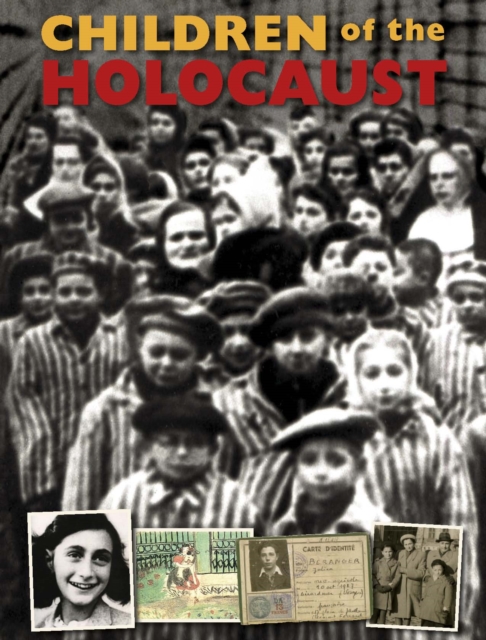
Children of the Holocaust
The Holocaust is one of the most shocking events of the 20th century and one that continues to resonate today. Its Nazi perpetrators showed no mercy, not even to children and perhaps, as a result, it is often the experiences of the children of this era that speak to us most strongly. This moving and important book explores what happened to children during the Holocaust, from the early persecution of the Jews to the 'final solution'. It also considers the experiences of those who escaped or hid, and those who survived. As the Holocaust moves further away from us in history, it is important to keep it in the consciousness of the next generation. By using the experiences of children, this book is a powerful way to engage the attention and sympathy of young people today.
eBook

The boy on the wooden box : how the impossible became possible...on Schindler's list
The biography of Leon Leyson, the only memoir published by a former Schindler's List child.
Book

The Child Victim as Witness to the Holocaust: An American Story?
This article points to the key role of the child victim in the representation of the Holocaust, especially in mainstream American life. Developing Peter Novicks claim that the Holocaust has been transformed into an \"American memory,\" the author notes that virtually all breakthrough moments in non-Jewish American awareness of the Holocaust (The Diary of Anne Frank, Wiesel's Night, the NBC television movie Holocaust, Spielbergs Schindler's List, the Holocaust Museum in Washington, D. C.) have highlighted the role of children, whose defenselessness serves as a metaphor for the general plight of Holocaust victims. While rhetorically effective, the figure child victim can also distort, personalize, and dehistoricize the Holocaust, providing a false sense of solidarity and understanding in mainstream American audiences.
Journal Article

Acting Out Justice in J. J. Steinfeld’s “Courtroom Dramas”
The article provides an interpretation of “Courtroom Dramas,” a short story from J. J. Steinfeld’s fiction collection Would You Hide Me? (Gaspereau, 2003). First, the paper examines Steinfeld’s articulation of traumatic loss, and interprets the trial in “Courtroom Dramas” as a means for a grandson to mourn his deceased grandmother and (through memory of her) others unknown to him in the Holocaust. Here the fictional account of loss interacts productively with various theoretical models prevalent in the field of trauma studies. Second, historical justice issues embedded in this Holocaust story are revealed. Steinfeld’s fiction is situated, finally, within a body of auto-ethnographic writing on the Nazi genocide, work foregrounding trans-generational memory. Cet article offre une interprétation de Courtroom Dramas, une nouvelle du recueil de J. J. Steinfield, Would You Hire Me? (Me cacheriez-vous ?) (Gaspereau, 2003). Il porte d’abord sur la manière dont Steinfeld exprime une perte dramatique et présente une interprétation du procès dans Courtroom Dramas comme un moyen pour le petit-fils de faire le deuil sa grand-mère décédée et (en se souvenant d’elle) de celui d’autres victimes de l’holocauste qu’il n’a pas connues. Une interaction productive se fait ici jour entre l’exposé de la perte dans une œuvre de fiction et divers modèles théoriques prévalant dans le domaine des études de traumatismes. En second lieu, l’article révèle des questions de justice historique enchâssées dans cette histoire de l’holo-causte. Enfin, il situe la nouvelle de Steinfeld dans l’ensemble des écrits auto-ethnographiques sur le génocide nazi, un travail qui met en avant la mémoire transgénérationnelle.
Journal Article
Thirteenth NewsWatch
(13) ---< (Morneau-Economists) Finance Minister Bill Morneau is giving assurances that his federal budget will take into account possible economic effects from the election of Donald Trump as U-S president.
Newsletter